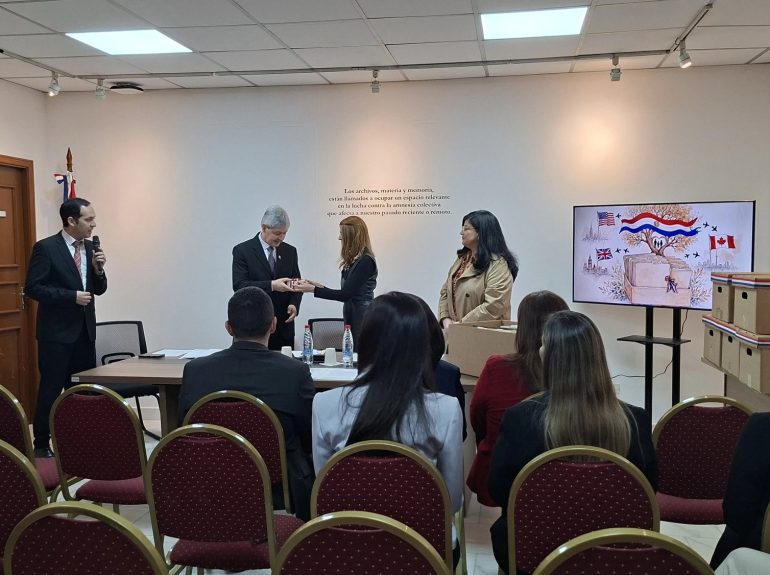

Paraguay’s judicial authorities have transferred decades-old international adoption records to the Museo de la Justicia (Museum of Justice) in Asunción. The documents could help adults adopted as children learn more about their biological origins and the circumstances surrounding their adoptions. The adoption records were processed mainly during the late 1980s and 1990s, including Paraguayan children adopted by families abroad. Follow-up reports came from the United States, Canada, the United Kingdom and Australia.
The handover included both original paper records and digital copies. The documents are now held by the Museo de la Justicia, formally known as the Centro de Documentación y Archivo para la Defensa de los Derechos Humanos. The institution is commonly associated with Paraguay’s Museo de la Memoria (Museum of Remembrance) and preserves important documentation relating to the country’s recent history.
Documents rediscovered and preserved
According to Trovato, who coordinates the Technical Support Office for Childhood and Adolescence, known as OTANA, the documents were discovered after the death of Judge Graciela Rolón. They had remained stored in her office and were reportedly found in good condition. Judicial authorities subsequently organised and digitised the material before transferring it for long-term preservation. The official Poder Judicial report states that this work had been underway since 2022.
Published accounts differ, however, over the exact number and period covered by the material. The Poder Judicial reported approximately 196 adoption files and 210 international follow-up reports, mainly relating to 1986 to 1992. Other reports described 281 original documents, comprising 139 national and international adoption files and 142 international follow-up reports. Those reports placed the records within the broader period from 1985 to 1997.
Why these records matter
The materials are part of the documentary heritage of people who once relied on Paraguay’s justice system for decisions with lifelong consequences. Supreme Court Justice Carolina Llanes says authorities should properly preserve the records. Therefore, people seeking information about their personal histories can access them, while authorities continue protecting confidential information.
The issue also has a wider historical context. International adoption became the subject of serious concern in Paraguay during the 1990s amid reports of irregular practices and child trafficking. In 1995, Paraguay passed Law 678, suspending the processing of new international adoptions for one year. The legislation did not affect cases already underway. Congress extended the suspension for another six months in 1996 and again in 1997 until new adoption legislation could enter into force.
Parliamentary discussions preceding the original suspension referred to allegations of irregularities involving international adoptions. Legislators raised concerns about falsified documents, intermediaries and possible networks involving different professionals and public officials. Contemporary international reporting also documented concerns about the trafficking of babies in Paraguay. A 1996 United States human rights report described baby trafficking as a serious problem and linked the adoption moratorium to efforts to develop stronger legislation.
Paraguay eventually enacted a new Adoption Law in 1997. Among other safeguards, Law 1,136 recognised an adopted person’s right to know their origins and established stricter procedures for international adoption. The law also required international adoptions to be monitored through authorities in receiving countries. This helps explain why the newly preserved collection contains follow-up reports sent to Paraguay from countries where adopted children were living.
How can adopted Paraguayans search for their records?
People who believe their adoption may be covered by the archive can contact OTANA. Trovato says people searching for their origins can approach them to determine whether their records are among the documents transferred. The email address currently published for these enquiries is oficinatecnicaninez@pj.gov.py. Reports indicate that eligible applicants may request information contained in the digitised records, subject to identity and confidentiality protections.