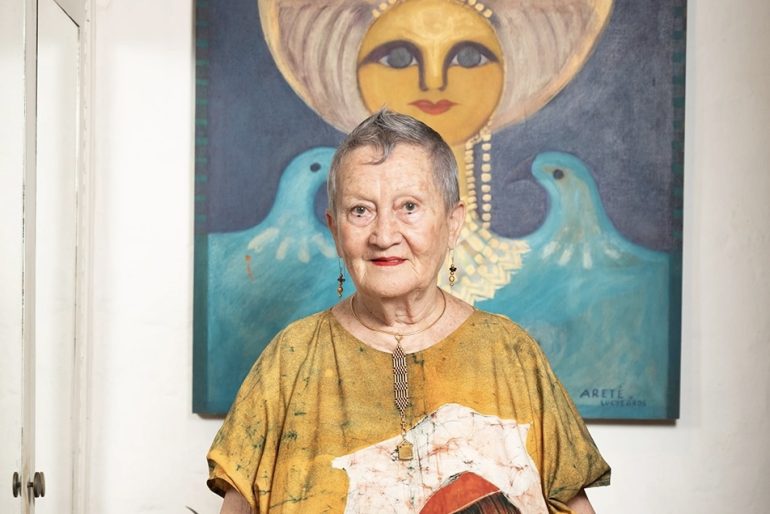

Lucy Yegros, born in Asunción on 26 October 1940, has spent decades exploring Paraguay’s culture through visual art. The Paraguayan artist works with painting, handmade paper, plant fibres and found objects. Since 1990, she has also signed her work as Areté, a name linked to ancestral reunion and sacred celebration. Through these different forms of art, Yegros explores the meaning of nature, memory and identity.
An artistic journey across borders
Yegros began exhibiting individually in 1982, presenting her work in Paraguay and abroad. Her artistic education included workshops across South America, Europe and the United States. She also learned from influential artists, including Livio Abramo, Olga Blinder and Susana Romero.
Throughout her career, Lucy Yegros has explored several artistic disciplines. Her work includes printmaking, sculpture, installations, performance and jewellery. She also experiments with recycled materials, redefining ordinary objects as artistic expressions. Rather than remaining within one medium, she continues to investigate new ways of communicating ideas.
The meaning behind Areté
The name Areté represents a central element of Yegros’s artistic identity. According to biographical material about the artist, the term refers to an ancestral reunion ritual within Chiriguano-Guaraní tradition. The concept symbolises a connection between the past and present. Through this identity, Lucy Yegros places ancestral memory at the centre of her artistic exploration.
Her work also showcases her relationship between culture and the natural world. By incorporating plant fibres and handmade paper, she explores materials that combine artistic creation with nature. Consequently, her practice invites audiences to consider how traditional knowledge can remain relevant today.
International recognition
Yegros has presented her work at several international exhibitions and cultural institutions. In 1990, she exhibited at the Museum of Art of São Paulo in Brazil. She later participated in the Mino Paper Art Museum’s artist residency programme in Japan in 1999. In 2001, she took part in the 49th Venice Biennale in Italy.
Her career also includes participation in the World Triennial of Small Prints in France in 1997, 2000 and 2003. Meanwhile, her work received recognition in Paraguay through several awards. In 1996, she won the gold medal for sculpture at the Paraguayan Christmas art competition. Two years later, she received the gold medal for installation at the Contemporary Religious Art competition.
Lucy Yegros: An evolving artistic legacy
Beyond exhibitions and awards, Lucy Yegros continues to explore different ways of expressing her ideas. Her interest in handmade paper and plant fibres demonstrates an ongoing commitment to material experimentation. Furthermore, her combination of visual art, literature and performance challenges conventional boundaries between artistic disciplines.
For Yegros, Areté provides a way to connect artistic creation with ancestral traditions. Her work encourages audiences to consider how cultural memory survives through materials, symbols and creative practices. Ultimately, her contribution to Paraguayan art lies in this continuing exchange between heritage and experimentation.
By bringing ancestral references into contemporary artistic expression, Lucy Yegros offers a distinctive perspective on Paraguay’s culture. Her career demonstrates how artists can preserve connections with the past while continuing to explore new creative possibilities.
For more information, find Lucy Yegros on Instagram, and also read: Augusto Roa Bastos Still Speaks: Why Paraguay’s Greatest Novelist Remains Essential.