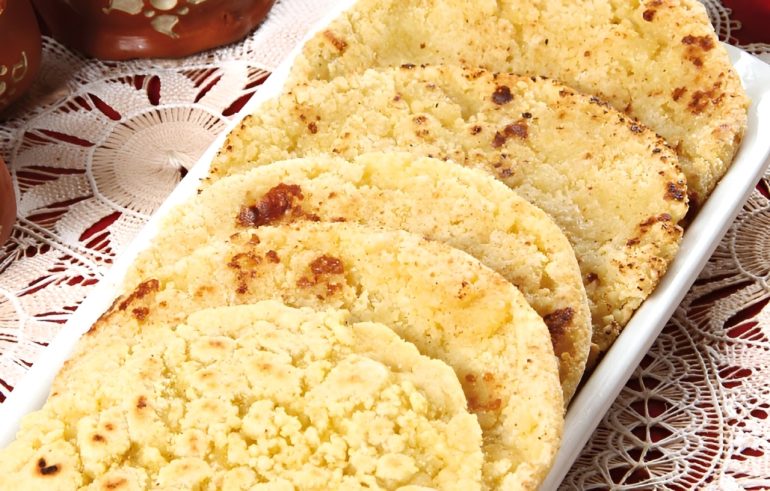

Few foods capture the essence of Paraguayan cuisine quite like mbejú. Whenever temperatures drop across the country, many people instinctively reach for this traditional cassava flatbread, pairing it with hot beverages such as mate, tea, coffee, or the beloved cocido. Crisp on the outside and soft, rich and cheesy on the inside, mbejú has long been one of Paraguay’s favourite comfort foods.
While the classic recipe remains the best known, modern variations have become increasingly popular. Today, it is common to find the traditional version alongside options filled with Caprese ingredients, or four cheeses. Whether prepared at home or served in cafés, restaurants, hotels, and other establishments specialising in Paraguayan cuisine, mbejú continues to bring people together around the table.
Yet its story extends far beyond the kitchen. Stretching back long before the founding of Paraguay, mbejú reflects centuries of Indigenous knowledge, cultural exchange, and culinary resilience. Its journey from the Guaraní people to modern Paraguayan households has made it one of the country’s most enduring culinary traditions.
Rooted in Guaraní tradition
The origins of mbejú can be traced to the Cario-Guaraní people. These people inhabited the region surrounding present-day Asunción long before the arrival of the Spanish in the sixteenth century. Cassava was one of the cornerstones of their diet because it thrived in the local climate, provided reliable harvests, and could be stored for extended periods.
Early colonial chroniclers described how Guaraní communities prepared breads and cakes using cassava, maize, and animal fat. These preparations were known as mbujapé, a Guaraní word meaning simply “bread”. Food historians generally consider mbujapé to be the predecessor of modern mbejú, although the recipe evolved considerably during the colonial period. This long culinary tradition makes mbejú one of Paraguay’s oldest continuously prepared foods.
Mbejú and cultural exchange
Although mbejú is deeply rooted in Indigenous food traditions, the version enjoyed today reflects the meeting of two culinary worlds. Following the establishment of Asunción and the introduction of cattle to the region during the mid-sixteenth century, European ingredients such as milk, butter, eggs, and cheese became increasingly available. Over time, local cooks combined these new products with cassava starch, gradually creating the version of mbejú recognised today. The resulting recipe became one of the defining examples of the blending of Guaraní and Spanish culinary traditions that shaped Paraguayan cuisine.
And what does “mbejú” mean? The name comes from the Guaraní language and is generally understood to mean a flattened cake. Different spellings, including mbejú, mbeyú, and mbeju, all refer to the same traditional flatbread that has remained an essential part of Paraguayan food culture for generations.
Essential part of the Paraguayan table
One of the reasons for mbejú’s remarkable longevity is its simplicity. Traditional recipes typically include cassava starch, Paraguay cheese, pork fat or butter, and salt. Unlike wheat bread, it does not require yeast or time to rise. Instead, the mixture is cooked directly on a hot pan, where the starch binds together as it heats, producing its characteristic golden crust and tender interior.
Every Paraguayan family has its own version, with slight differences in texture, cheese content, or cooking method. These variations have helped preserve the recipe while allowing it to evolve naturally across generations. Paraguayan gastronomic studies describe around sixteen traditional forms or named preparations of mbejú, although only about eleven remain commonly documented today. Each differs in the proportion of cheese, the type of fat used, or the inclusion of locally available ingredients. This diversity reflects the adaptability of the recipe while preserving its essential character.
A living piece of Paraguayan heritage
The enduring popularity of mbejú demonstrates how a recipe can survive centuries of political, social, and cultural change. Its story begins with the agricultural knowledge of the Guaraní people and evolved through the cultural exchange of the colonial era. Today, it continues to live on in kitchens across Paraguay, where each family adds its own touch while preserving the essence of the dish.
More than a simple cassava flatbread, mbejú is a symbol of continuity. In a world where many ancestral recipes have disappeared, mbejú remains an everyday reminder that food is one of the most enduring expressions of a nation’s history, identity and shared traditions.