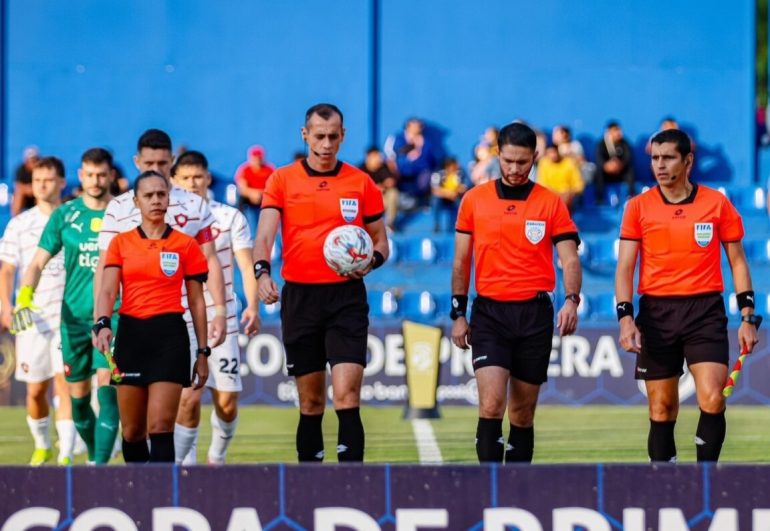

The Paraguayan Football Association (APF) has announced a series of significant modifications to the competition regulations for Paraguayan football. These strict new rules, designed to increase the speed of play and expand the scope of the Video Assistant Referee (VAR), will come into effect at the start of the Torneo Clausura 2026 on Friday 24 July. The changes are aligned with directives recently implemented by FIFA and were notably applied during the 2026 World Cup. The upcoming season will be the first domestic competition in Paraguay to adopt these modernised regulations.
The opening match of the season will see 2 de Mayo face Rubio Ñu, providing the first live demonstration of the updated rules. These adjustments follow a broader trend within the South American Football Confederation (CONMEBOL) and its member associations to standardise rules in line with global best practices set by the International Football Association Board (IFAB).
Strict new rules for substitutions and injuries
A key change aimed at reducing time-wasting involves the substitution process. From the moment the fourth official displays the substitution board, players leaving the field will have a strict ten-second limit to exit the pitch, timed by the on-field referee. Should a player fail to comply with this time limit, the player waiting to enter the match will be penalised. Specifically, the incoming substitute will be required to wait an additional 60 seconds before being permitted to join the game. This measure is intended to discourage players from deliberately slowing down the final moments of a match.
Similarly, a new protocol will apply to players who receive on-field medical attention. Following treatment, the player must leave the field of play and wait for the referee’s signal to re-enter. This rule aims to prevent teams from using minor injuries as a tactic to break the flow of the game. However, an important exception has been included; if the opponent who caused the injury is sanctioned with either a yellow or a red card, the injured player will not be required to leave the pitch, ensuring the team is not unfairly disadvantaged by an opponent’s foul play.
APF rejects ‘Vinícius Law’ on freedom of expression grounds
While adopting many international directives, the APF has confirmed that it will not implement the controversial rule colloquially known as the ‘Vinícius Law’. This proposed rule, which has been debated in other footballing bodies, would mandate the expulsion of a player for covering their mouth while speaking to an opponent or a match official. The association stated its decision was based on protecting the principle of “freedom of expression” for players. The APF is among several CONMEBOL organisations to take this stance, allowing players to continue communicating on the pitch without fear of such a sanction.
The potential impact of this rule was highlighted during the 2026 World Cup when Paraguay’s own Miguel Almirón was sent off against Türkiye under similar circumstances. The incident involving Almirón sparked considerable debate, and the APF’s decision reflects a desire to avoid such situations in its domestic competitions. By rejecting this specific rule, the association is making a clear statement about the type of on-field conduct it seeks to regulate, focusing on actions rather than strict new rules surrounding verbal exchanges that cannot be clearly deciphered.
Expanded authority for the Video Assistant Referee
The role of VAR will be significantly broadened under the new regulations. Officials will now be empowered to intervene in situations involving a second yellow card that has been incorrectly awarded, and which consequently leads to a red card. Furthermore, VAR can be used to correct a clear error of identification, where a yellow or red card has been shown to the wrong player. These changes are intended to prevent obvious injustices that can decisively alter the course of a match. However, the APF clarified that VAR will still not be used to review a first yellow card or a second yellow card that was missed by the on-field referee.
In a notable departure from previous protocols, the APF has stated that VAR reviews for mistaken identity or incorrect second yellow cards can now take place even if the game has already been restarted. This ensures that a serious error can be rectified regardless of the immediate passage of play. Additionally, VAR may now be used to review corner kicks that are presumed to have been awarded incorrectly. This check must be immediate and must not delay the game’s resumption. The opportunity for review will be voided if the attacking team takes the corner kick quickly.
Further measures to increase active playing time
To further accelerate the pace of play, strict new time limit rules will be enforced on set pieces. A five-second countdown will be applied to both throw-ins and goal kicks. If a player fails to take a throw-in within the allotted five seconds, possession will be awarded to the opposing team. In the case of a delayed goal kick, the consequence will be a corner kick awarded to the opposition.
Finally, the regulations address hydration breaks, stating they are not mandatory. The decision to implement a break will be at the referee’s discretion, based on “medical criteria and climatic conditions.” If a break is called, it must not exceed two minutes, and this time will be fully added to the regulatory time at the end of the half.
Clausura, Match day 1
Friday, 24 July
2 de Mayo – Rubio Ñu (16:00),
Cerro Porteño – Sportivo Trinidense (18:30).
Saturday, 25 July
Recoleta – San Lorenzo (16:00),
Ameliano – Nacional (18:30).
Sunday, 26 July
Olimpia – Libertad (16:00),
Guaraní – Sportivo Luqueño (18:30).