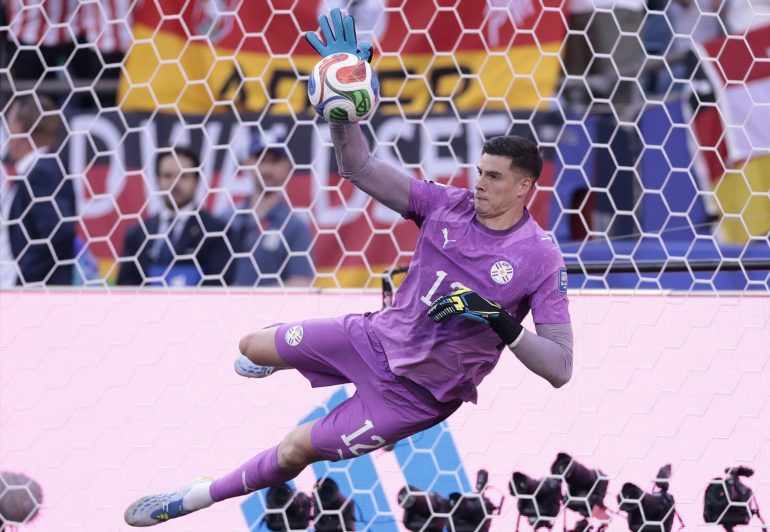

Paraguayan goalkeeper Orlando Gill has concluded the 2026 World Cup as the tournament’s leading goalkeeper in terms of saves, according to official statistics released by FIFA. The goalkeeper for the Paraguayan national team, known as the Albirroja (The White and Red), made a total of 28 saves across the five matches his country played during the global competition. This remarkable achievement has firmly established him as one of the standout figures for the squad, managed by Gustavo Alfaro.
The performance of Gill, who also became a World Cup hero as the goalkeeper who gave up everything for his family, was a consistent display of skill and resilience. His ability to command his penalty area and produce crucial saves was a significant factor in his team’s campaign. Consequently, his efforts have provided a considerable sense of reassurance to Paraguayan fans, who can be confident in the strength of their goalkeeping position for the foreseeable future.
A commanding lead in the rankings
The statistical data highlights the significant margin by which Orlando Gill led the goalkeeping charts. His total of 28 saves placed him well ahead of his nearest competitors. Following behind the Paraguayan was Eloy Room of Curaçao, who registered 21 saves. In third place were Gregor Kobel of Switzerland and Diogo Costa of Portugal, both of whom concluded their respective campaigns with 20 saves each.
Furthermore, Gill’s record remained unmatched even by the goalkeepers who participated in the tournament’s final stages. For instance, Emiliano Martínez of Argentina, despite his numerous interventions during the final match against Spain, did not manage to surpass the total set by the Paraguayan.
While Gill secured the title for the most saves, the prestigious “Golden Glove” award was presented to Unai Simón, the goalkeeper for the winning Spanish team. Simón’s award was based on different criteria, as he conceded only a single goal in eight matches throughout the entire World Cup.
A foundation for the future
The performance of goalkeeper Orlando Gill is more than just a statistical achievement; it represents a significant boost for the Paraguayan national team’s ambitions. For coach Gustavo Alfaro, having a reliable and world-class goalkeeper is a fundamental building block for constructing a competitive team capable of challenging at the highest level. This newfound security in a critical position will be invaluable as the Albirroja prepares for future international tournaments.
Ultimately, Gill’s accomplishment at the 2026 World Cup has not only brought him personal recognition but has also delivered a message of optimism and stability to the team and its dedicated supporters. His performance will be remembered as a major highlight of the tournament and a source of national pride.
Spain crowned champion
Spain became world champions for the second time after defeating Argentina 1-0 in the final played in New Jersey, with a goal from Ferran Torres in extra time. La Roja repeated the feat achieved in South Africa 2010 and once again lifted the most important trophy in football. Argentina finished as runner-up in their seventh World Cup final, while England took third place after defeating France 6-4 in a historic match, achieving their best performance since winning the title in 1966.
Paraguay reached the Round of 16 of the tournament after qualifying as one of the best third-placed teams, eliminating Germany in the round of 16, closing a campaign with 5 points, a goal difference of -3 and three goals scored (vs. United States, Turkey and Germany). With these stats, the Albirroja finished above teams with great world tradition such as the Netherlands, Germany, Ivory Coast, and Croatia, consolidating a performance that returned international prominence after 16 years of absence.