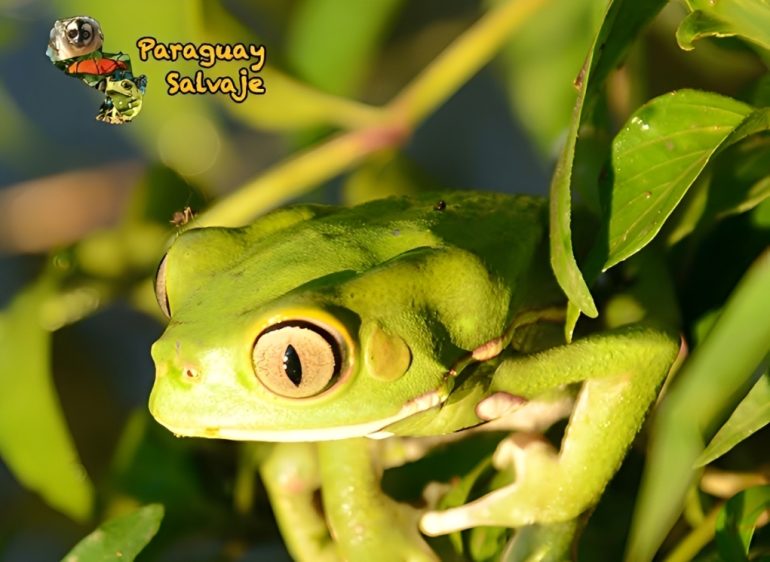

The ju’i pakova, scientifically known as Pithecopus azureus, is a small tree-dwelling frog found in Paraguay and neighbouring South American countries. Recognised by its bright green skin, orange markings and dark bands, this amphibian inhabits open landscapes, grasslands and savannahs. The frog moves slowly through vegetation, reproduces during the rainy season and builds distinctive leaf nests above temporary pools.
The species also occurs in Argentina, Bolivia and Brazil, according to regional amphibian references and Paraguayan biodiversity guides. During the rainy season, females lay eggs on leaves folded into protective nests above water, allowing tadpoles to reach the pools below. Although relatively small, measuring up to approximately 38 millimetres, the frog has specialised adaptations that help it climb vegetation and survive changing environmental conditions.
The meaning behind its name
The name ju’i pakova comes from the Guaraní language. In Guaraní, ju’i means frog, while pakova means banana, producing a name commonly interpreted as “banana frog”. The species receives this name because it is an arboreal amphibian frequently found resting on the trunks and leaves of banana plants. Across Paraguay, Indigenous terminology remains an important part of describing local species and communicating knowledge about the environment.
A frog that walks instead of jumping
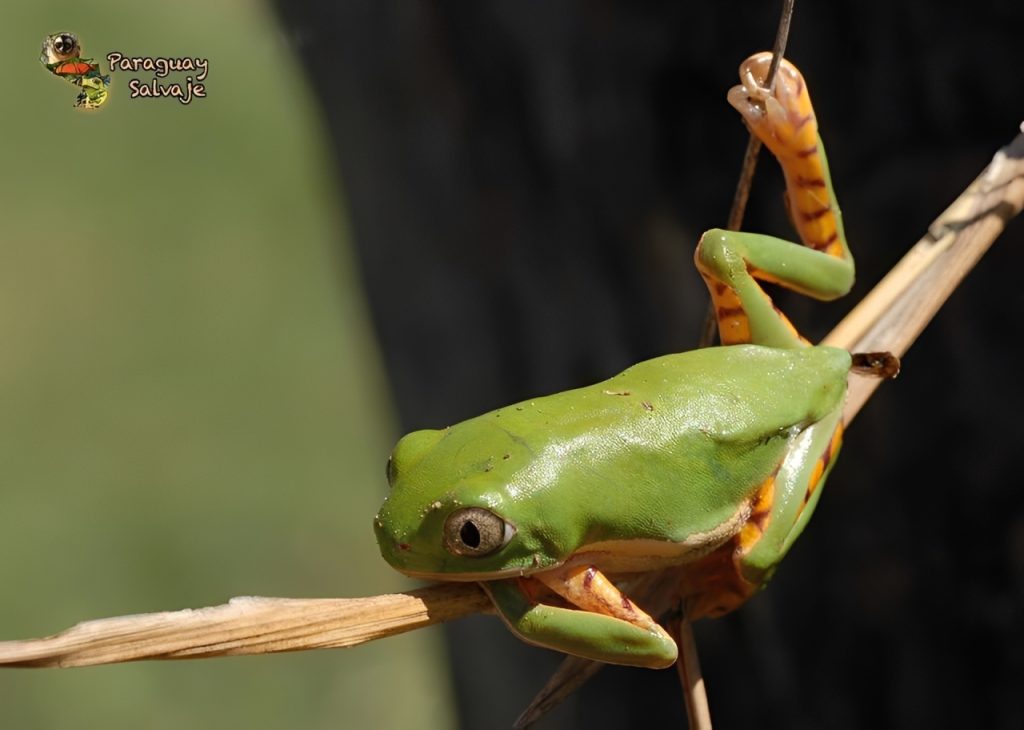
Unlike many frogs, the ju’i pakova typically walks slowly across vegetation rather than relying on powerful jumps to move between surfaces. Its robust body, short hind limbs and specialised toes support this movement, while its large eyes remain a noticeable feature. The dorsal surface is generally bright green, sometimes changing towards lighter brown, while orange and black markings appear along its legs.
These contrasting colours are not always visible when the animal rests, as its limbs can remain tucked close to its body. This positioning helps conceal the striking patterns, which become more apparent when the frog moves through leaves and branches. Its climbing adaptations allow it to navigate vegetation while remaining close to the sheltered environments where it feeds and reproduces.
How it reproduces
Reproduction depends on temporary pools that form during the rainy season, especially where suitable vegetation surrounds the water. Instead of depositing eggs directly into the pool, the female places them on leaves hanging above the water. Both adults fold and attach the leaf edges, creating a protective nest from which tadpoles eventually fall into the pool.
This unusual strategy connects the frog’s reproductive success to the availability of suitable plants and nearby water sources. Changes in vegetation or the disappearance of temporary pools could therefore affect breeding opportunities within its habitat.
From Paraguay’s wildlife to its new banknotes
The ju’i pakova has also gained recognition beyond its natural habitat through its appearance on Paraguay’s newly introduced banknotes. The inclusion of this native amphibian highlights the country’s biodiversity and brings attention to a species that many Paraguayans may not recognise.
Its appearance also offers an opportunity to learn more about Paraguay’s native wildlife and the importance of preserving its natural habitats.
Preserving Paraguay’s native amphibians
The ju’i pakova forms part of Paraguay’s wider amphibian diversity. Its conservation status requires careful interpretation, as the Tapytá reserve guide lists the species as having insufficient global data for assessment. This classification does not automatically indicate that the frog is threatened, but it highlights limitations in the available information. Continued research and habitat protection can help improve understanding of the species and support its long-term conservation.