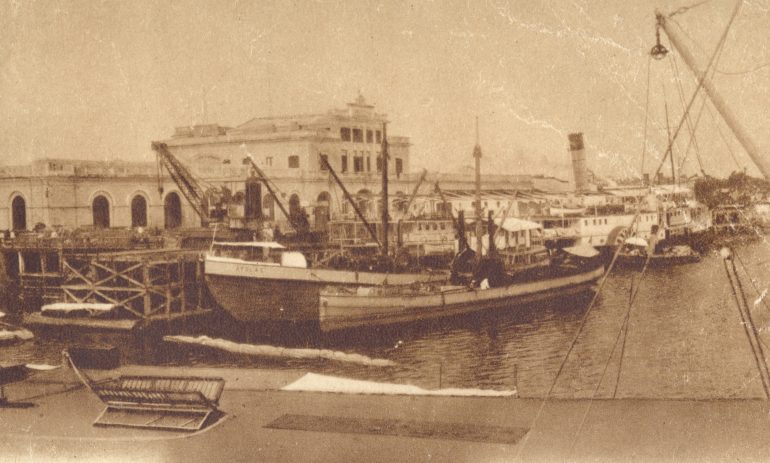

The Port of Asunción has played a central role in Paraguay’s history since the capital’s founding in 1537. Located on the Paraguay River, the port connected the country with regional trade routes, transported passengers and goods, and supported the capital’s economic growth. Over the centuries, the waterfront witnessed changes in transport, commerce and urban development that shaped the nation. In fact, Port of Asunción history is integral to understanding Paraguay’s economic and social development.
Today, the historic port building stands as a reminder of that legacy in central Asunción. Although commercial activities have shifted towards newer facilities, the site retains its historical and architectural significance. Its transformation into a cultural space reflects ongoing efforts to preserve the capital’s heritage and reconnect residents with the riverfront.
A port born with the capital
Spanish captain Juan de Salazar y Espinosa founded Asunción on 15 August 1537. The settlement grew beside the Paraguay River, which provided access to distant territories and supported communication between communities. According to the National Administration of Navigation and Ports, the first port occupied was the area now known as Playa Montevideo.
During the colonial period, river transport connected Asunción with settlements across the region. The port also supported expeditions that established other colonial cities, strengthening Asunción’s position within Spanish-controlled territories. Port of Asunción history is notable for its role in shaping colonial connections and regional expansion. Long before modern roads and railways, the river offered one of the principal routes for transporting people and supplies.
From riverbank to commercial infrastructure
For centuries, the port operated along the riverbank before developing more substantial infrastructure. During the 1890s, authorities built a retaining wall, wooden docks and warehouses to support growing commercial activity. These improvements helped organise cargo handling and prepared the waterfront for a more structured system of maritime and river transport.
The historic port building opened in 1907, marking an important stage in the development of the capital’s commercial facilities. From that point, the port handled imported goods, exported Paraguayan products and transported passengers to destinations along the river. Its location made the waterfront an essential connection between Paraguay’s domestic economy and regional trade networks.
A modern port takes shape
In 1927, the Paraguayan government contracted the American company Asunción Port Concession Corporation to construct and equip a modern port in the capital’s bay. The company received a concession to administer and operate the facilities until 1940. That year, the government assumed control of port administration, marking a new chapter in the management of this strategic infrastructure. Moreover, Port of Asunción history during this period reflects modernisation and governmental change.
The port continued to evolve as its buildings and facilities expanded. Construction work began on a major building extension in December 1957, and officials inaugurated the completed project on 15 August 1961. The expansion introduced an upper floor and a more modern architectural appearance, reflecting changing demands on the port’s administrative operations.
On 23 August 1965, Paraguay established the National Administration of Navigation and Ports through Law No. 1,066. The state institution assumed responsibility for managing and developing the country’s port infrastructure. Its creation formalised national administration of facilities that had supported river transport and commerce for generations.
The decline of cargo operations
As transport infrastructure and logistics changed, the historic port gradually lost its central role in commercial shipping. Cargo operations moved towards other locations, including Villeta, where facilities could better accommodate modern requirements. The change reduced activity around the old waterfront, leaving historic structures that recalled the port’s former importance to Paraguay’s economy.
However, the decline in cargo operations did not erase the site’s historical value. The port remained part of Asunción’s architectural heritage and the wider historic centre. Its buildings offered a physical record of the capital’s relationship with the river, from early colonial settlement to the growth of modern commerce.
Preserving the port for future generations
Restoration work on the historic port building began in 2019 under an urban redevelopment programme. Paraguay’s Ministry of Public Works and Communications worked alongside cultural authorities to preserve the building’s heritage while adapting the surrounding area. The project sought to reconnect the waterfront with the city and give the historic structures renewed public relevance.
On 15 December 2023, the National Secretariat of Culture announced the inauguration of the restored heritage building as a cultural space. The opening formed part of efforts to revitalise Asunción’s historic centre and preserve the city’s collective memory. Although the port’s original commercial role has changed, its history remains closely tied to the development of the Paraguayan capital.