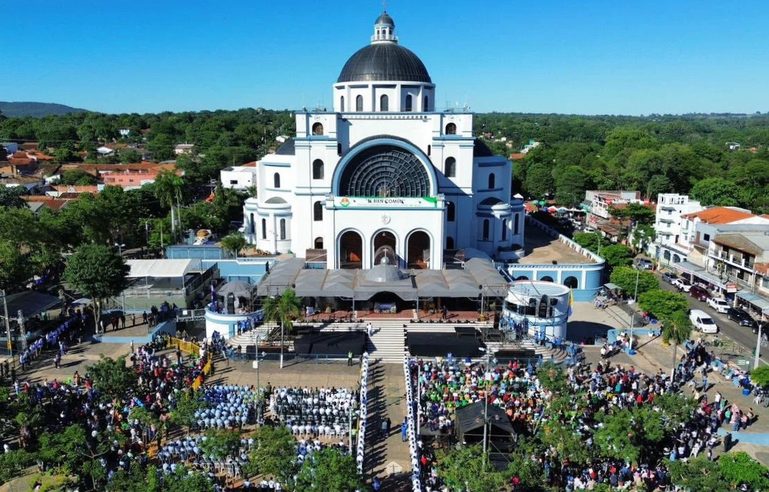

Paraguay’s Ministry of Public Works and Communications (MOPC) has commenced improvement works on routes and access roads to the city of Caacupé. These preparations are part of ‘Operativo Caacupé 2026’, an operation to manage the arrival of more than three million pilgrims to the city, also known as the Villa Serrana (Mountain Village). The works aim to improve and facilitate both pedestrian and vehicle traffic during one of Paraguay’s largest annual religious events.
The pilgrimage honours the Virgin of Caacupé, the patron saint of Paraguay, and culminates on 8 December, a national holiday. Faithful from across the country travel to the city to visit the Cathedral Basilica of Our Lady of Miracles, making it the nation’s most significant religious gathering.
Initial works underway
Initial interventions include pothole repairs along the old route of PY02, locally known as Tapé Tujá (Old Road), and its various offshoots. Additionally, crews are working on the asphalt in front of the Basilica, a site of major importance for the central mass held on 8 December.
The ministry also reported that teams will conduct work on the PY02 route variant and Departmental Route 009. Furthermore, improvements are planned for the section connecting the towns of Pirayú, Azcurra, and the Basilica, along with other paths frequently used by pilgrims.
Wider routes to Caacupé improvements
On another front, work has been undertaken on Departmental Route 027, specifically at kilometre 20 in the direction of Itá. Here, the asphalt layer was renewed to restore the road surface. This will provide better driving conditions for motorists arriving from the Central Department.
The overall goal of the infrastructure improvements is to enhance safety and ease of travel for the vast numbers of people who participate in the festivities. By addressing road conditions in advance, authorities hope to ensure a smoother and more secure experience for all attendees.
Traffic safety and organisation
The ‘Operativo Caacupé 2026’ also encompasses measures to organise the flow of vehicles and pedestrians during the mass arrival of pilgrims. To this end, various institutions are working in a coordinated manner to plan routes, diversions, and traffic controls.
These actions, combined with the enhancement of roads and access points, are intended to prevent accidents and facilitate the pilgrims’ journey to the Caacupé Basilica. Ultimately, the coordinated effort aims to protect the safety of those participating in the celebration as well as local residents.