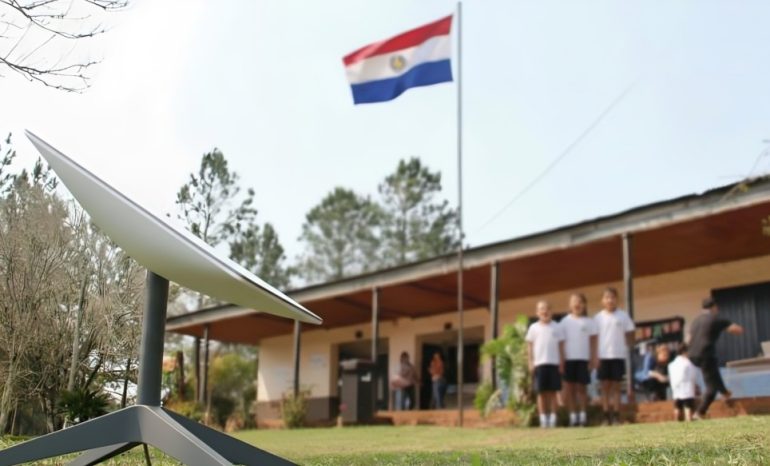

The Paraguayan government has announced a partnership with the satellite internet company Starlink to connect 1,600 schools across the nation. Paraguay partners with Starlink to provide high-speed internet access to more than 50,000 students and teachers, particularly those located in the most isolated regions of the country. The announcement was made by the president during a formal event at the Government Palace.
President Santiago emphasised that the project represents a fundamental step towards social equity and development. ,,Today we are taking another step in a transformation that goes far beyond technology. We are building a Paraguay where the place where one is born does not determine the opportunities one has to learn, to grow, and to be able to develop,” the president stated during the ceremony.
He highlighted that the integration of 1,600 connectivity kits will extend high-speed internet not only to schools, but also to health centres in remote communities throughout the national territory.
“Equal opportunities through technology”
The head of state stressed that the core objective of the alliance is to level the playing field for all citizens. “This is not just about antennas or technology. It is about a child from a remote community having the same learning possibilities as any child in the world,” the president affirmed.
Furthermore, he noted that “every Paraguayan who gains access to the digital world is a sign that we are moving in the right direction.”
This initiative is part of a broader strategy by the current administration to tackle the digital divide. Gustavo Villate, the Minister of Information and Communication Technologies, explained that the government is actively working to reduce digital inequality, protect the nation’s digital sovereignty, and position Paraguay as a provider of high-value digital services. In 2025, Starlink also connected 500 rural schools and hospitals in Paraguay.
A framework for digital expansion
Villate recalled that the administration had previously granted a license enabling Starlink to operate in Paraguay, which immediately broadened connectivity options in hard-to-reach areas. He also pointed to an earlier strategic alliance established at the beginning of this year between the Paraguayan Communications Company (Copaco) and Starlink. That initial partnership has already resulted in over 100 connections for isolated communities, facilitating access to education, health services, and electronic administration.
In a further development last week, the National Telecommunications Commission authorised the experimental use of W and A band frequencies for Starlink. According to Villate, this decision is expected to produce a substantial increase in internet speed for the thousands of users already connected in Paraguay. “It is a direct improvement on the quality of service that citizens receive,” he said.
Paraguay partners with Starlink
Representing Starlink, Juan David Vélez, the Government Sales Manager, expressed the company’s satisfaction with the new agreement. He stated that the enterprise, designed by SpaceX, is pleased to offer connectivity to over 1,600 schools in Paraguay. This will enable “online learning, real-time collaboration tools, global scholarships, professional resources, and much more,” Vélez explained.
He described Starlink as the world’s most advanced satellite constellation, which uses a low Earth orbit to deliver broadband internet capable of supporting streaming, online gaming, and video calls.
“Our mission is to reduce the digital divide, and after five years we are making enormous progress by rapidly expanding access to high-speed internet in places where it has historically been unreliable, unaffordable, or completely inaccessible,” Vélez stated. He added, “Today, Starlink connects more than 12 million customers in over 160 countries, markets, and territories.”
A unique social component
The project also includes a unique social component. During the event, the Minister of Justice, Rodrigo Nicora, announced a specific agreement with Copaco. Under this arrangement, the metal structures required for the satellite antennas will be manufactured by prison inmates. Nicora highlighted the rehabilitative aspect of this collaboration.
“Each manufactured support will be a concrete demonstration that persons deprived of their liberty can also contribute value to society when they are given the opportunity they need to do so,” the minister concluded.