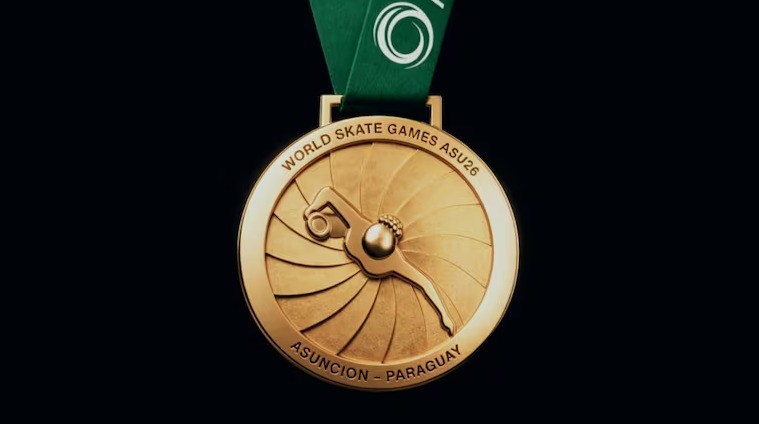

A medal can carry more than metal and ribbon. At the World Skate Games ASU26, to be held from 2 to 18 October in Asunción, the medals will also carry a piece of Paraguayan tradition. Organisers unveiled the design of the medal that will crown world champions at the Games, and its inspiration comes from the Galoperas, the traditional dancers of Asunción, whose swirling steps have survived for more than a century.
The design translates the spins and pathways of the dance, seen from above, into lines engraved on the metal. It links two forms of movement that rarely cross paths. One is a folk tradition rooted in Paraguayan identity; the other, an international sporting event bringing wheeled sports to Asunción. The medal will carry Paraguayan tradition around the world as athletes wear it, including many who may never have heard of Punta Karapã.
Who are the Galoperas?
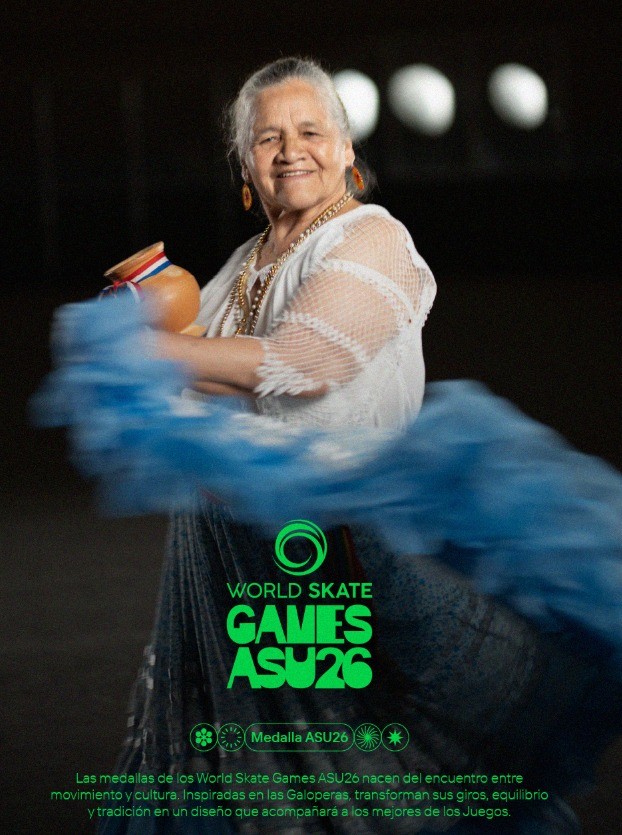
The Galoperas are traditional Paraguayan dancers who perform the galopa, a folk dance built on rhythm, spins and balance. Many dance with a clay jug, known as a cántaro, or a bottle balanced on their heads, a detail that has become their most recognisable trait. The dance historically accompanied patron saint festivals and community celebrations across the country. Today it is recognised as one of the clearest expressions of Paraguayan folklore.
Punta Karapã: where the tradition began
The dance was born in Punta Karapã, a small riverside neighbourhood in Asunción’s wider Chacarita area. The neighbourhood lies close to the city centre and the Paraguay River. The neighbourhood is also known as the birthplace of the guarania, the musical genre created by Paraguayan composer José Asunción Flores, who was born there. For more than 100 years, Punta Karapã has kept the Galoperas tradition alive, passing it from one generation to the next. The area remains a working-class riverside community, and its cultural weight has long outsized its modest size.
The women keeping the dance alive
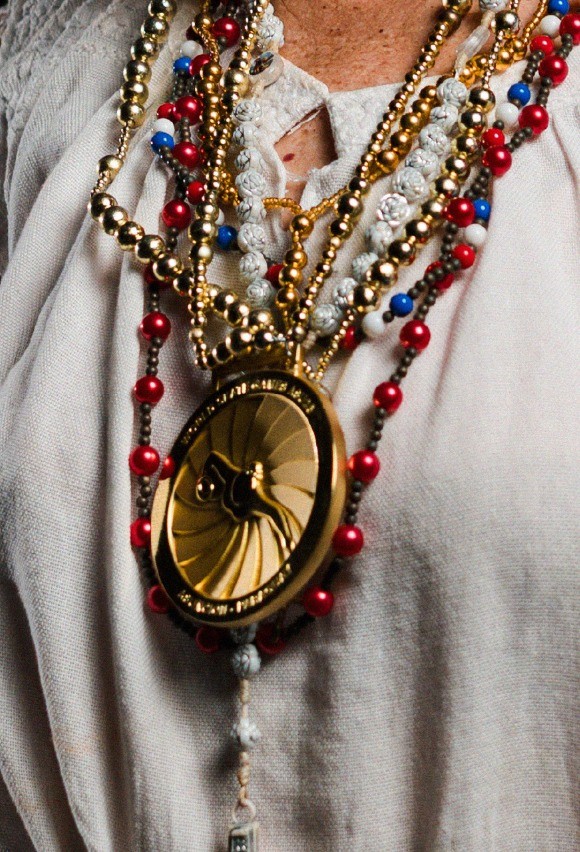
The National Secretariat of Culture named eleven Chacarita Galoperas Tesoro Vivo Nacional del Paraguay in 2023. The honour recognised their role in preserving a folk art passed down through generations. Among them was Josefina Bernal, who belongs to the fourth generation of Galoperas in her family. She described the recognition as a long-awaited source of pride for the group, she told local media.
Fellow dancer Julia Daniela Ávalos de Flores explained that many performers today descend directly from the tradition’s founders. Those founders began dancing in Punta Karapã before the practice took hold at nearby Club 3 de Febrero. The dancers say they hold no formal rehearsals, moving instead to whatever music and feeling the moment brings. Several of them are already grandmothers, and continue to dance both as cultural duty and as a form of gentle physical exercise.
What the dance actually means
The galopa is built on improvisation rather than choreography. Each dancer interprets the music in her own way, adjusting her steps, turns and balance to what she hears in the moment. As she turns, her pollera, the traditional wide skirt, spreads out and traces shapes in the air, adding a visual rhythm to the dance. The cántaro or bottle carried on the head is the dance’s most distinctive symbol, requiring poise and control rather than fixed routine, though not every dancer lifts it above the head; some rest it on the hip or shoulder instead.
What has kept the galopa alive is transmission within families and neighbourhoods, rather than formal instruction. Grandmothers have taught daughters, and daughters have taught granddaughters, for more than a century. That chain has allowed the dance to survive generational change while remaining recognisably the same practice performed decades ago. It is this continuity, as much as the dance itself, that Paraguayan cultural authorities have sought to protect.
Why the Galoperas’ turn became a World Skate medal
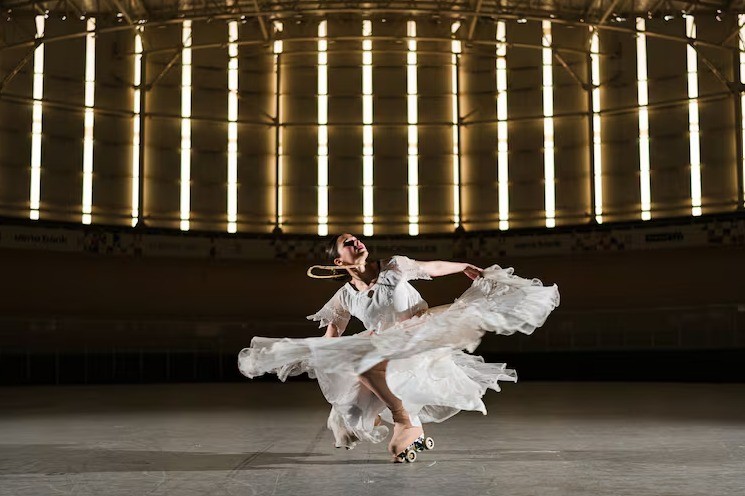
Organisers of the World Skate Games ASU26 found an unexpected parallel between the Galoperas and the athletes competing this October: balance, rhythm, precision and a fleeting instant when everything seems to flow. That shared language of motion became the concept behind the medal, uniting what organisers describe as tradition that turns with sport that rolls. Seen from above, a promotional World Skate Games ASU26 video for the medal explains, a galopera and a skater trace the same movement, and it is that aerial view of the dance’s spins and pathways that has been engraved as lines on the metal.
The World Skate Games ASU26 will run from 2 to 18 October 2026, bringing more than 8,000 athletes and officials from close to 100 countries to Asunción for 17 days of competition in wheeled sports. Tickets are already available through the event’s official sales platform. For the organisers, featuring the Galoperas in the medal design helps carry Paraguayan culture onto the world stage. Every athlete who steps onto the podium will take home a piece of Paraguay alongside their title.
A caption released alongside the presentation video summed up what the organisers were trying to capture: this is not simply a dance, but culture in motion, a rhythm passed from one generation to the next that retells, with every turn, who Paraguayans are.
A tradition that leaves Asunción
The Galoperas have spent a century dancing within the same few streets of Punta Karapã, largely unseen beyond Paraguay’s borders. The World Skate medal takes their dance far beyond Paraguay. It now travels on the shoulders of champions from around the world. It is, in its own way, a new chapter for a tradition that has always been about continuity: a Paraguayan neighbourhood dance turning, this time, on an international stage.