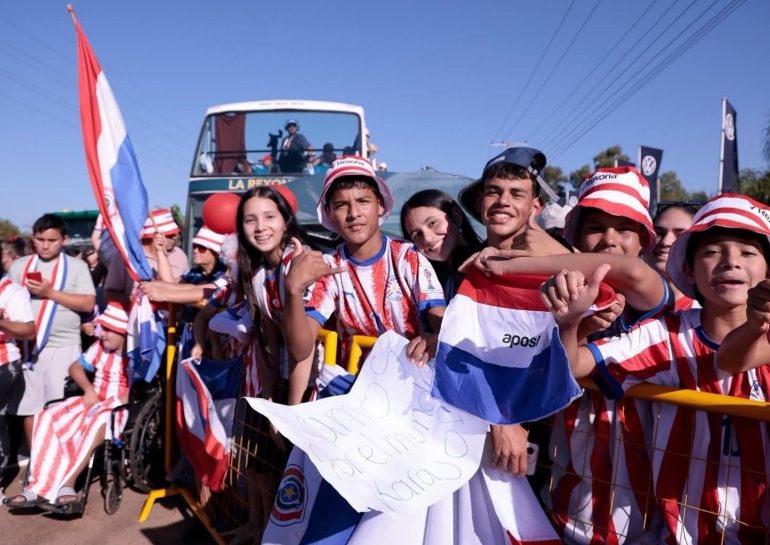

Football passion in Paraguay is reaching historic levels. After a painful absence of 16 years from football’s biggest stage, the Albirroja has secured qualification for the 2026 World Cup. This milestone is not only a sporting achievement; it represents the awakening of a profound emotional connection for an entire generation of young people who have never seen their country compete at a World Cup. For Paraguayan youth, the 2026 World Cup is not just another global sporting event.
It is the first time they will experience football’s biggest stage with their own national team on it, transforming something that once felt distant into a shared experience.
A generation making its debut as fans
For most Generation Z and Generation Alpha Paraguayans, World Cups were, until now, a distant spectacle. Their football memories do not include the 2010 campaign in South Africa. That achievement occurred before many were born or when they were too young to remember it.
Today, that reality has changed. Qualification has triggered collective euphoria. Young Paraguayans will finally experience the atmosphere of supporting their national team in the world’s biggest football tournament. Excitement and anticipation now shape daily conversations in schools, universities, and friendship groups.
“I spent my whole life watching World Cups supporting other teams,” says Héctor Moray (18), who is a student living in Lambaré, near Asunción. “This is the first time I am going to feel that I am really experiencing the World Cup with Paraguay.”
His experience reflects that of thousands of young Paraguayans who are preparing to create memories of their own rather than inheriting them through family stories.
Digital fever and a new “Guaraní spirit” (Garra Guaraní)
Young people are driving World Cup enthusiasm, and their main arena is social media. Platforms such as TikTok, Instagram, and X have been filled with content created by young users: viral clips of qualification highlights, memes, self-made tactical analysis, and spontaneous debates, alongside online communities discussing line-ups and team prospects, as well as a reinterpretation of the traditional Guaraní spirit (Garra Guaraní), adapted to contemporary music, aesthetics, and digital culture.
Miguel (17), also from Lambaré, says much of the excitement is unfolding online. “On TikTok, people are talking about nothing else. Every time I open the app, I see videos about the national team or people imagining how Paraguay will do at the World Cup.”
The World Cup is no longer experienced only as a sporting event, but as a cultural phenomenon unfolding in real time. For many young Paraguayans, social media has become a space where anticipation is shared collectively long before the first match is played.
The return of meaning to everyday rituals
One of the clearest signs of this shift appears in something simple: the Panini sticker album. For this generation, buying packets, swapping duplicates, and searching for missing stickers is no longer just nostalgia. It is anticipation made tangible. The Paraguay section is no longer symbolic. It is real. It belongs to them.
Antonio (18), also a student, recently started collecting stickers with friends after years of hearing stories from his parents about previous World Cups. “My parents always told me about how they experienced the 2010 World Cup. Now it is my turn to have that experience.”
He also says that he exchanges stickers at Super Seis supermarket, and sometimes at local fairs where people organise informal trading spaces to complete their albums.
The countdown: 12 June
The date is already fixed in everyone’s minds. The Albirroja will start on 12 June 2026 against the hosts, the United States, at 22:00 Paraguayan time.
This opening match is not only a major sporting challenge, but also the moment when millions of young Paraguayans will watch their national team play at a World Cup for the first time in their lives. Giant screens, public gatherings, and group meet-ups are already being planned to experience the night together.
Between expectation and belonging
Behind the excitement lies something deeper: a redefinition of belonging. Football has always been central to Paraguayan identity, but the World Cup had long remained outside that emotional centre. Now it returns.
After 16 years of waiting, support is unconditional, and Paraguayan youth are ready to make history from the stands and from their screens. They are not only about to watch a tournament. They are about to see themselves reflected in it.
“The day of the first match, I know I will be nervous from the moment I wake up,” Héctor says. “I have always heard people talk about where they were when Paraguay played at previous World Cups. Now we are finally going to have our own stories to tell.”
And in that moment, the World Cup becomes more than a sporting event. For Paraguayan youth, it becomes the starting point of a collective memory that did not exist before, but will remain.