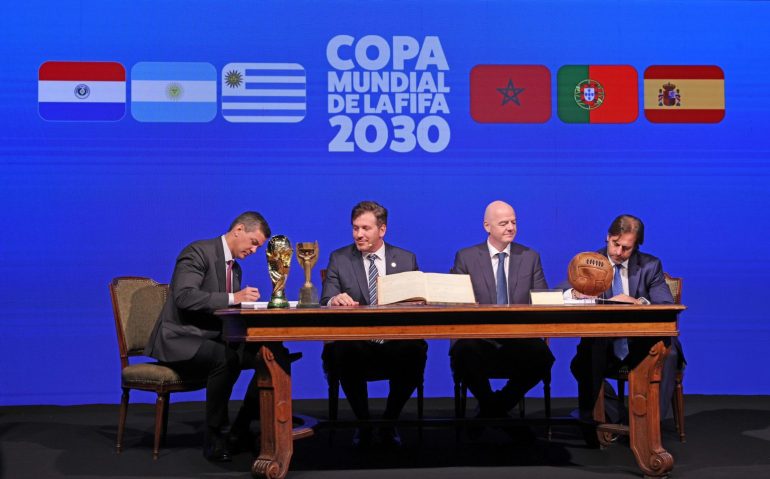

Paraguay has been officially confirmed as part of the historic organisation for the 2030 FIFA World Cup. This landmark tournament will commemorate the centenary of the world’s most prestigious football competition. The event will be held across six countries on three different continents: Spain, Portugal, Morocco, Argentina, Uruguay, and Paraguay, which will all play their part in the World Cup opening ceremony. FIFA’s recent discussions about expanding the number of participating countries could significantly elevate Paraguay’s role and transform it into a major 2030 World Cup venue.
The commemorative edition of the World Cup will blend the main hosting duties in Europe and Africa with historically significant venues in South America, where the competition first began in 1930. Consequently, Paraguay will join Argentina and Uruguay as one of the nations responsible for launching the tournament’s centennial celebrations. This unique structure creates a global event, honouring football’s rich history.
A unique centenary celebration format
The structure approved by FIFA makes a clear distinction between the primary host nations and the centenary host nations. Spain, Portugal, and Morocco are designated as the main hosts, where the majority of the tournament will unfold. These nations will stage most of the group stage matches, all knockout rounds, and the final match. This arrangement places the core of the competition in Europe and North Africa.
Meanwhile, Argentina, Uruguay, and Paraguay will play a special ceremonial role. These South American countries will stage the opening matches involving their respective national teams. They will also host a series of commemorative events to honour the centenary of the first FIFA World Cup, which was held in Montevideo, Uruguay, in 1930.
Potential expansion could increase South America’s role
The official format approved by FIFA currently outlines a tournament featuring 48 national teams. These teams would be divided into 12 groups of four, the model that was used in the current 2026 World Cups. However, FIFA is actively considering a proposal to expand the centenary tournament even further, to include 64 national teams. This would be a significant increase in the scale of the event.
If this expansion is approved, the competition would be reorganised into 16 groups of four teams, which would substantially increase the total number of matches played. A major change resulting from a 64-team format would be the enhanced role for Argentina, Uruguay, and Paraguay as host nations. While the official 48-team format limits these three countries to hosting only their opening matches and related ceremonies, the proposal from FIFA could allow each nation to host entire groups, including all matches corresponding to those groups during the tournament’s first stage.
Significant impact for Paraguay
Under the proposed expansion, Paraguay could host a substantially larger number of official matches. This would turn the country into a major 2030 World Cup venue and greatly amplify the sporting, tourism, and economic impact of the event on the country. Following the conclusion of the opening events and any potential group stage matches in South America, the competition will proceed to the main host nations of Spain, Portugal, and Morocco. The remainder of the tournament, including the final, will be played there.
FIFA has already provided its official confirmation that Paraguay will serve as one of the host nations for the 2030 World Cup. Its role, alongside Argentina and Uruguay, is to inaugurate the celebrations marking the tournament’s 100th anniversary. This involvement guarantees Paraguay a place in football history, irrespective of any potential changes to the tournament’s format.
A historic opportunity on the world stage
Hosting part of the 2030 FIFA World Cup represents a truly historic opportunity for Paraguay. The event is expected to strengthen the nation’s international visibility and provide a significant catalyst for enhancing its sports and tourism infrastructure. Upgrades to stadiums, transport links, and hospitality services will be required to meet the high standards of a global tournament.
Furthermore, this platform allows the country to position itself before millions of football fans worldwide during one of the most important sporting celebrations in the history of the game.
Also read: La Albirroja Returns To A Hero’s Welcome After 2026 World Cup Campaign.