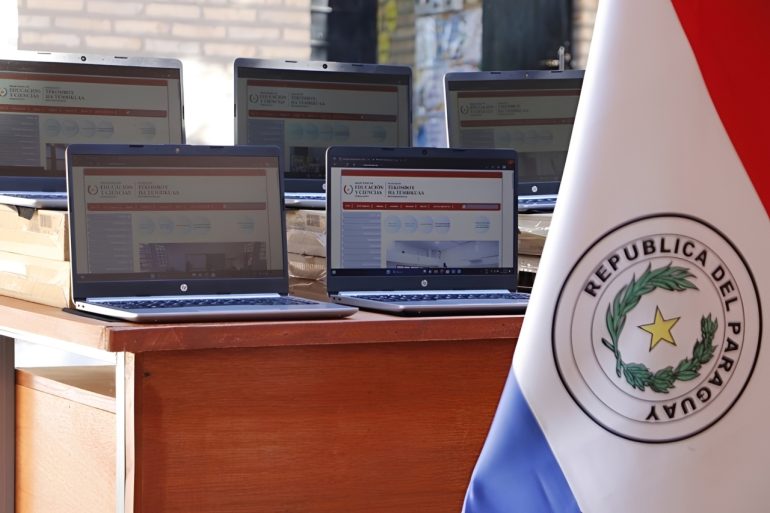

Paraguay has begun increasing its number of schools with Internet access through a new satellite connectivity programme involving the Paraguayan Communications Company (Copaco) and Starlink. The initiative started at a school in Ybycuí, department of Paraguarí. This marked the beginning of a rollout that aims to connect 1,600 educational institutions during the current Government term.
Copaco’s commercial manager, Gilles García, says the first installation represents an important step towards reducing the digital gap between urban and rural communities. “We started with the first of the 1,600 schools. It was an emotional day to see how children could access this technology.”
The partnership between Copaco and Starlink will provide satellite internet access to 2,100 schools across Paraguay. The project will complement the more than 2,000 schools already connected through Copaco’s fibre optic network, mainly in urban areas. Satellite technology will help extend connectivity to communities where traditional infrastructure remains limited. The Government’s objective is to connect more than 4,000 schools during the current administration, according to Copaco.
Expanding connectivity in rural communities
Paraguay currently has around 8,000 educational institutions nationwide. If the target is achieved, approximately half of the country’s schools would have access to high-speed internet. “Our mission is to connect 100% of schools,” García says. The initiative forms part of wider efforts to improve digital access in areas where connectivity remains a challenge.
The project is also expected to benefit other public institutions in rural communities. According to Copaco, health centres and police stations could receive connectivity after nearby schools are connected. “We are starting with schools, but we will eventually reach hospitals and police stations as well.” García explains that similar work has already been carried out in the Chaco region, where existing connections helped identify opportunities to expand access to nearby services.
Mapping institutions to reduce the digital divide
The initiative is being developed with support from other government institutions, including the Ministry of Information and Communication Technologies (MITIC), the Ministry of Health, and the Ministry of the Interior. According to Copaco, almost 1,100 police stations have already been identified for future connectivity plans. The company says trained installation teams will work simultaneously across ten departments to deploy the 1,600 Starlink devices planned for this year.
García says expanding access to public institutions will provide communities with more opportunities for education, services, and development. “The more institutions we connect, especially those in remote areas, the more development we can bring.”