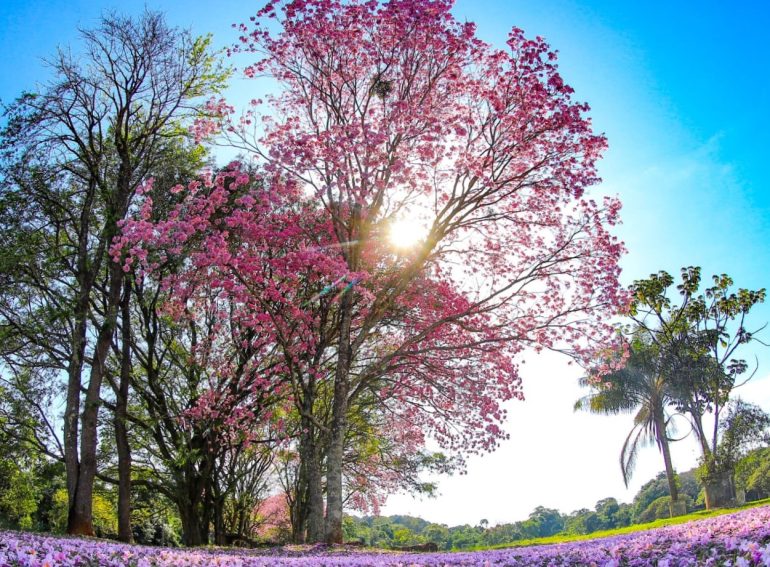

With the arrival of the flowering season for the tajy, or lapacho trees, Paraguayan landscapes are being painted in intense colours from their striking pink, yellow, and white blossoms. Reinilda Duré, a biologist and director of the Biological Research Directorate/National Museum of Natural History of Paraguay (DIB/MNHNP) at the Ministry of the Environment and Sustainable Development (MADES), explains the characteristics of this phenomenon in Paraguay’s lapacho trees, and why these species flower before their foliage returns.
The nature of deciduous trees
Duré noted that lapacho trees belong to the group of deciduous plants, which are those that lose their leaves at certain times of the year. “The lapachos or tajy are deciduous; this means that they lose their leaves in a specific period of the year,” she explained in conversation with state media.
The specialist indicated that not all tajy species lose their leaves completely. While some, such as certain pink lapachos, become totally bare before flowering, others display semi-deciduous behaviour. This occurs with some yellow specimens, which retain part of their foliage during the process.
Paraguay’s lapacho trees: An ‘explosion of flowering’
According to Duré, as the leaves begin to fall, the flower buds appear. Subsequently, once the tree is practically leafless, an “explosion of flowering” occurs, in which the flowers become the plant’s predominant feature.
The biologist also explained that lapacho flowers are grouped in structures called inflorescences. In the case of the tajy, these appear at the terminal part of the branches. Therefore, the flowers cover the tips of the bare trees and create the characteristic image of completely flowered branches.
Why flowering times differ
When asked about the difference in the duration of flowering among the different colours of lapachos, Duré explained that this is related to the behaviour of each species and the number of leaves it retains during the process.
“The yellow ones are quicker because they are not totally deciduous either; they are semi-deciduous. So they have some leaves,” she noted. According to Duré, by maintaining part of the foliage, the plant distributes its resources differently, which makes the flowering period shorter.
The reproductive advantage
In contrast, pink lapachos can keep their flowers for a longer time. The white specimens show intermediate behaviour, with their flowering lasting longer than the yellow ones but not as long as some of the pink varieties. Duré explained that the falling of the leaves also serves a function in the plant’s reproductive cycle, as it facilitates pollination by leaving the flowers more exposed to insects and the wind.
“It has always been said that the loss of the leaf also facilitates pollination by insects.” Later, when the leaves reappear, the dispersal of seeds occurs, a process that can also be aided by the wind.
A diversity of species
The specialist clarified that lapachos are not differentiated solely by the colour of their flowers, as there are different species with their own characteristics. “They are not all the same, they are not all of the same species,” she affirmed, explaining that the differences are determined by features such as leaf shape and through genetic studies.
Duré mentioned that different genera related to these trees are now recognised. In Paraguay, there are around nine species within the Handroanthus and Tabebuia genera. These include six species with one variety of Handroanthus and three of Tabebuia.
Not just the lapacho
Furthermore, she highlighted that this trait of flowering before the appearance of leaves is not exclusive to lapachos. Other trees, such as the jacaranda, timbó, and palo borracho, also exhibit this behaviour, losing their leaves during specific periods of their flowering cycle.
The tajy phenomenon is a showcase of Paraguay’s rich biodiversity, and it presents an opportunity to learn more about the natural cycles of the species that make up the country’s landscape.
Also read: Lapacho, Paraguay’s National Tree: The Winter Bloom That Colours A Nation.