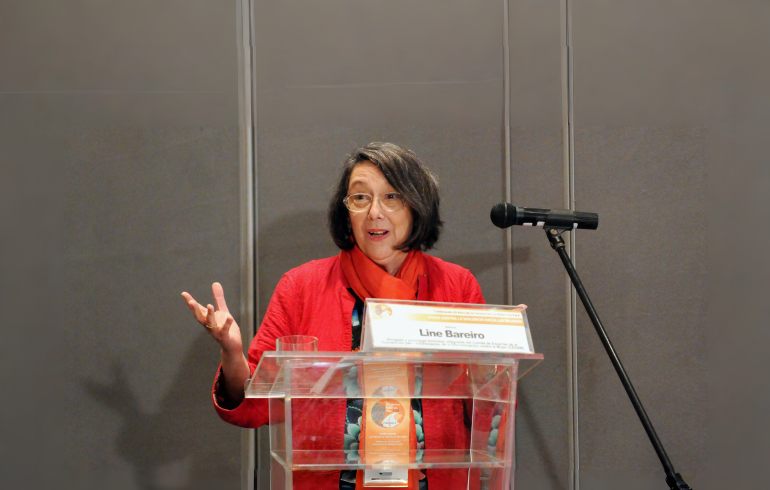

Paraguay mourns the death of Line Bareiro, one of the country’s most influential feminist leaders, political scientists and human rights advocates. Bareiro died on 1 August, 2026, in Asunción at the age of 75. Throughout her life, Bareiro shaped democratic debate, promoted gender equality and represented Paraguay in leading international institutions.
A lifetime dedicated to democracy and equality
Born in Asunción on 30 August 1950 as Olinda María Selva Bareiro Bobadilla, she became widely known as Line Bareiro. She studied law at the National University of Asunción before completing a master’s degree in political science at Heidelberg University in Germany. Her academic background later strengthened decades of public advocacy.
During the dictatorship of Alfredo Stroessner in Paraguay, Bareiro joined the student movement and defended human rights. She also participated in independent theatre and supported cultural initiatives that encouraged freedom of expression. Consequently, those experiences shaped her lifelong commitment to democracy and civic participation.
Building Paraguay’s feminist movement
After returning from Germany in 1982, Bareiro helped rebuild spaces for civil society despite political repression. She joined the Paraguayan Data Bank, an organisation that documented human rights abuses during the dictatorship. Later, she co-founded the Centre for Documentation and Studies, where she remained an active researcher until her final days.
Moreover, she helped establish several organisations that transformed women’s rights in Paraguay. These included Mujeres en Acción, the Coordinating Committee of Women of Paraguay, the Mercosur Feminist Articulation and Decidamos. She also supported the creation of Codehupy, the Network Against All Forms of Discrimination and the Network of Women Political Scientists.
International recognition for Line Bareiro
Bareiro’s influence extended far beyond Paraguay. Between 2011 and 2014, she became the first Paraguayan woman to serve on the United Nations Committee on the Elimination of Discrimination against Women, known as CEDAW. The appointment marked a milestone for Paraguay’s international representation on gender equality.
In addition, she advised UN Women in Latin America and the Caribbean. She also served on the General Assembly of the Inter-American Institute of Human Rights. Throughout her career, she contributed to equality policies in Paraguay, Costa Rica, Uruguay and other countries across the region.
Academic work and public service
Alongside her activism, Bareiro taught, researched and lectured in universities throughout Latin America and Europe. She published books, academic articles and research on democracy, citizenship, political participation and gender equality. Her work influenced public policy as well as future generations of researchers.
One of her best-known publications is Alquimistas: Documentos para otra historia de las mujeres, written with Mary Monte and Clyde Soto. Furthermore, she represented Paraguay at international conferences on women’s rights and democratic development. Her expertise earned respect across academic and political communities.
Line Bareiro’s Honours and lasting legacy
During her career, Bareiro received several national and international distinctions. These included Amnesty International Paraguay’s Peter Benenson Award, Uruguay’s Amanda Rorra Award and Asunción’s Serafina Dávalos Award. In 2018, a regional publication also recognised her among Latin America’s women political leaders making a difference.
Above all, Line Bareiro leaves a lasting legacy of democratic values, human rights and gender equality. Her research, activism and public service helped shape modern Paraguay and inspired countless women across Latin America. Her work continues to influence debates on democracy, participation and equal rights.
Also read: Meet Maggie Leri, The Paraguayan Who Learned To Defy Multiple Sclerosis.