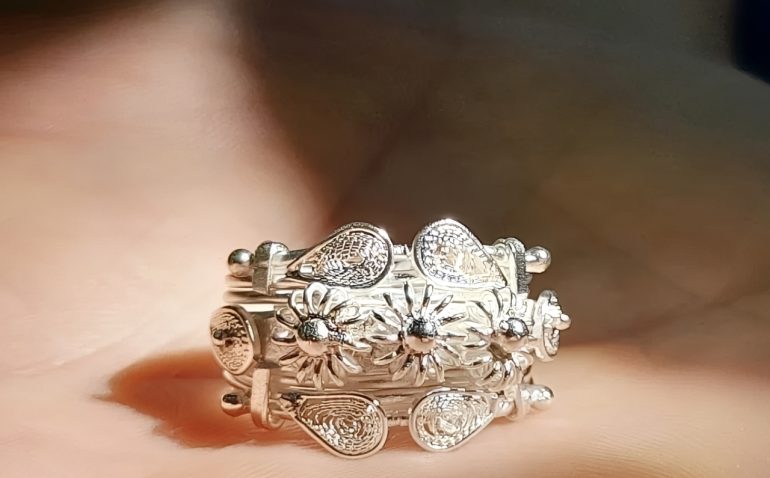

The anillo siete ramales (seven-branched ring) remains one of Paraguay’s most distinctive pieces of traditional jewellery. The legend surrounding its use during the War of the Triple Alliance has given the ring a profound cultural resonance that has been passed down through generations. Elegant in its design, the ring has endured for generations as a representation of fidelity and enduring hope.
The anillo siete ramales is formed from seven interlocking bands that fit together to create a single ring. According to Paraguayan tradition, each band represents a wish: love, health, peace, joy, prosperity, happiness, and long life.
Linked to the War of the Triple Alliance
The most widely repeated tradition traces the ring’s significance to the War of the Triple Alliance (1864-1870). This war was the devastating conflict in which Paraguay fought against Brazil, Argentina, and Uruguay. According to Paraguayan folklore, soldiers departing for the front would present an anillo siete ramales to their loved one before leaving for war. Women were expected to keep the ring on their finger as a sign of loyalty while awaiting their soldier’s return.
Popular accounts maintain that the ring was not to be removed. This was because its seven interconnected parts could easily come apart and prove difficult to reconstruct. Whether entirely historical or partly romanticised through oral tradition, the story transformed the jewel into a lasting emblem. Thus, the ring came to symbolise a love capable of surviving separation, uncertainty, and the passage of time.
A ring immortalised through music
By the twentieth century, the anillo siete ramales had become a recognised element of traditional Paraguayan dress and adornment. Its prominence is reflected in one of the country’s most celebrated songs, Galopera, composed by Mauricio Cardozo Ocampo in 1942.
The Galopera dance is thought to have inspired Botelleras. The choreography comprises women balancing water jars on their heads and distributing it to pilgrims and visitors attending religious celebrations. The lyrics to Ocampo’s song describe the dancers as adorned with traditional jewellery, including “anillos siete ramales y el rosario de coral” (seven-branched rings and the coral rosary).
Enduring craftsmanship
Today, the anillo siete ramales continues to be crafted by Paraguayan jewellers and filigree artisans, many of whom preserve techniques handed down through families. While modern versions are often purchased as souvenirs or cultural keepsakes, the ring retains the symbolism that has accompanied it for more than a century.
More than 150 years after the War of the Triple Alliance, the anillo siete ramales remains one of Paraguay’s most recognisable traditional jewels, linking contemporary craftsmanship with a story that continues to be passed from one generation to the next.