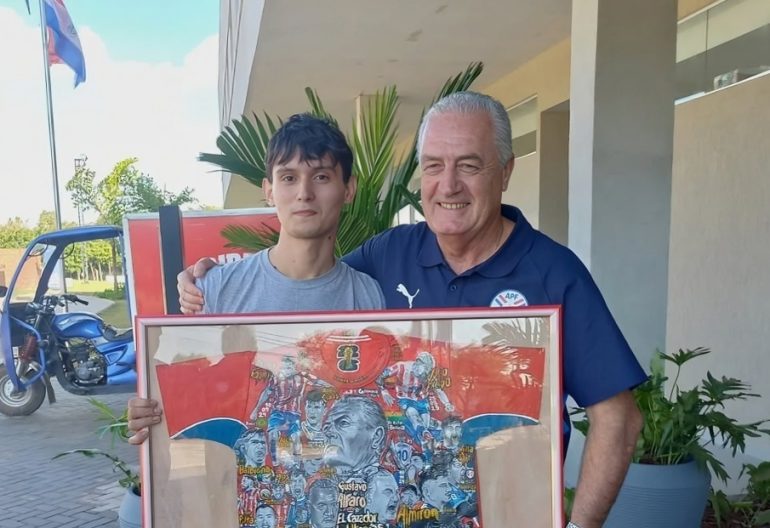

Paraguayan artist Ignacio Villalba creates hand-painted shirts for footballers and musicians, transforming personal histories into detailed wearable artworks. What began as childhood drawings of anime characters has evolved into a distinctive creative practice that now connects him with some of Paraguay’s most recognised public figures.
Based in Villarrica, Villalba produces one-of-a-kind designs that incorporate personal details, emotions, and defining moments from each client’s life. Villalba experienced an unforgettable moment, right before that start of the 2026 World Cup, after being received by Paraguay’s national team coach Gustavo Alfaro, to whom he gifted the shirt he had made himself. In this interview, Villalba also tells The Asunción Times about meeting player Diego Gómez.
The process
Every shirt takes between two and three months to complete, as each piece is carefully constructed as a visual narrative rather than a simple illustration. His approach goes beyond decoration. Before starting a design, he researches the person in depth, studying interviews, personal interests, musical preferences, family references, and career milestones. The aim is to translate a life story into a single composition.
“I try to capture their whole life in the shirt,” Villalba says. His designs often include references to music, football clubs, important achievements, and family memories. For him , these elements are essential because they give emotional depth to the final piece.
A turning point in his creative path
Villalba’s artistic journey began at the age of 10, when he first filled notebooks with drawings inspired by cartoons and anime. For years, paper remained his primary medium. Around a year ago, however, he shifted his focus and began painting directly onto shirts. That decision marked a turning point in his career.
“I have always really liked music and sport. They are things that perhaps did not work out for me in the way I wanted, but I found something that allowed me to feel close to them.”
This transition allowed him to combine personal interests with artistic expression, creating a style that is both intimate and recognisable. Today, his work includes not only shirts but also painted phone cases and other customised pieces.
“Many of my techniques were developed through self-teaching. In my early experiments, I worked with online tutorials and trial-and-error methods, often facing setbacks. Sometimes it was frustrating because I would make something nice and then it would break,” he recalls. “But I kept trying.”
Meeting Diego Gómez
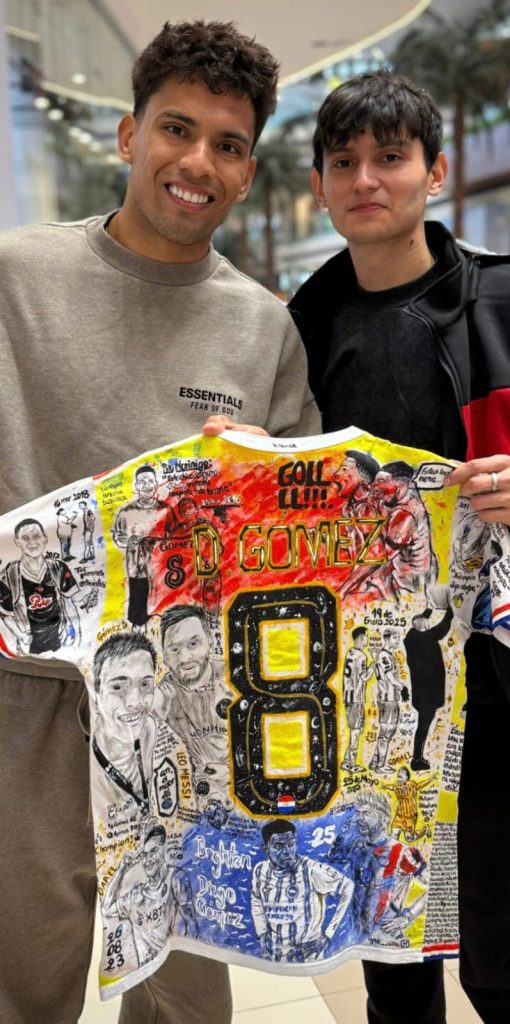
One of the most significant moments in Villalba’s career was meeting Paraguayan footballer Diego Gómez, a player he had admired for some time. The opportunity to present his work in person marked a shift in how he viewed his artistic path.
“When I realised the meeting was actually going to happen, I understood that this could become something very special.”
The experience was especially meaningful because he shared it with his mother, who has supported his work from the beginning. During the meeting, Gómez expressed admiration for the project and even attempted to give a shirt to her. She responded emotionally in Guaraní, saying: “Che ahechavo la che memby ovy’a, cheve guara ovalema,” meaning that seeing her son happy was enough for her.
For Villalba, that moment reinforced the importance of family in his work. “Family always has to be present in my shirts. Even when that person is no longer physically present.”
Feeling like a little kid
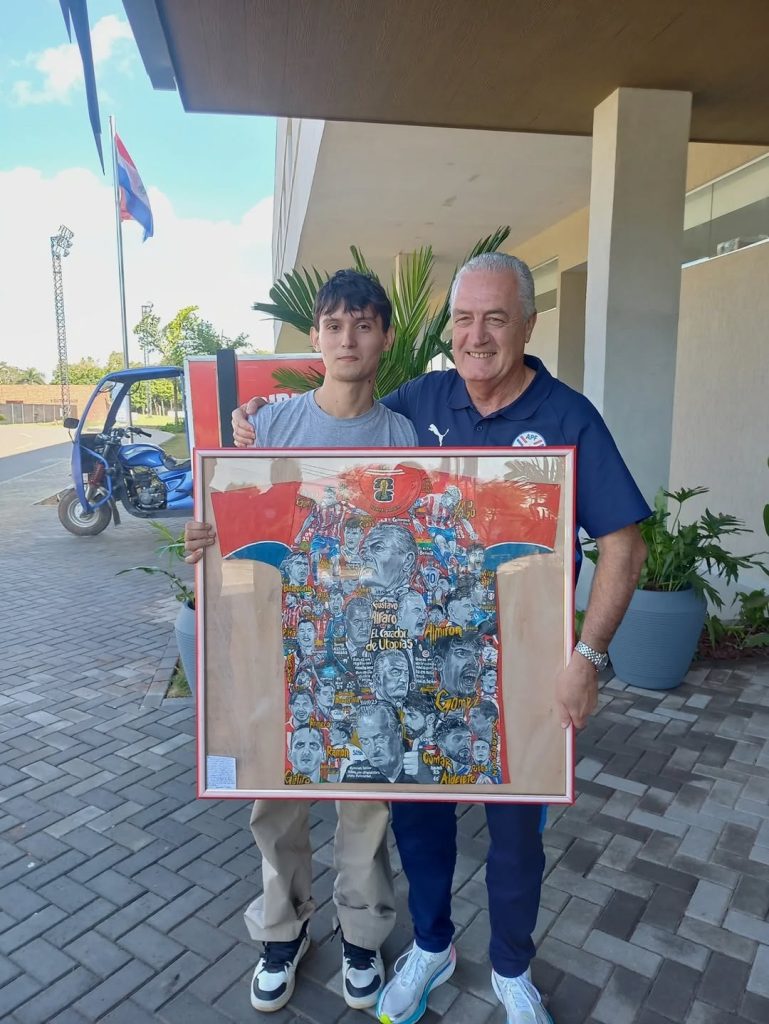
Villalba experienced another unforgettable moment, right before that start of the 2026 World Cup, after being received by Gustavo Alfaro, to whom he gifted the shirt he had made himself. “I felt like a little kid when he thanked me and gave me a hug,” said the artist after the unforgettable moment with Alfaro, nicknamed the “Hunter of Impossible Utopias” as he qualified with Paraguay for the World Cup
One of his most ambitious projects, a shirt dedicated to Enciso, has been in development for nearly a year.
He continues to dream of presenting his work to internationally recognised players such as Miguel Almirón, Antonio Sanabria, and even Lionel Messi, although he emphasises the importance of patience in his process.
“I want to do so many things,” he says. “But I try to go at a steady pace and enjoy each meeting.”
Football, music, and expanding recognition
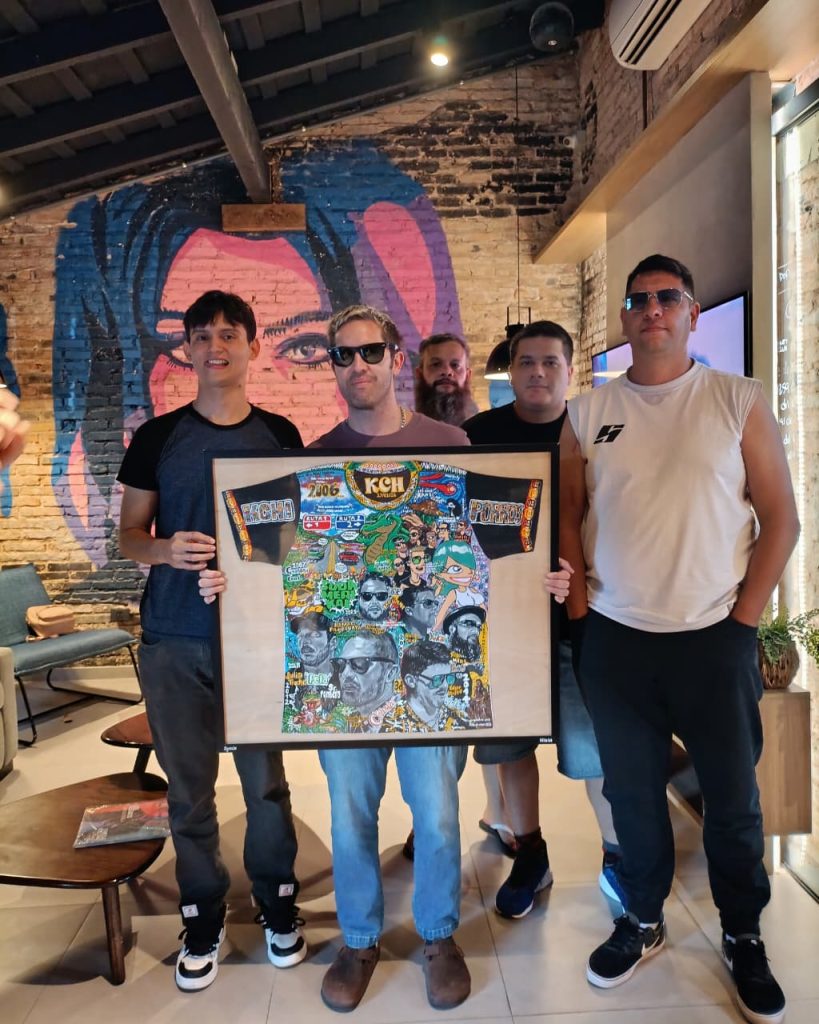
While Villalba’s early recognition came through football-related commissions, his work has also extended into music. One of the most meaningful collaborations for him was with the Paraguayan band Kchiporros, whose music he has listened to since childhood.
He was introduced to the group through bassist Edgar Aquino and eventually arranged a meeting to present a personalised shirt. However, when speaking in front of the band, he experienced an unexpected moment of nerves.
“All five of them were looking at me and I completely forgot everything,” he says with a laugh. “They took it with humour, but in that moment I realised how imposing people with such established careers can be.”
Despite the nerves, the experience strengthened his confidence and encouraged him to continue pursuing similar projects.
Growth, education, and future ambitions
Villalba is currently in his third year of studying Education Sciences, a path he hopes will complement his artistic practice. “Teaching is something I value deeply, as it may allow me to share his experiences with future students.”
As his work gains visibility, he has begun preparing pieces for other high-profile figures, including footballer Julio Enciso and national team coach Gustavo Alfaro.
A message behind the art
Beyond commissions and recognition, Villalba maintains a consistent message in his work: dedication and authenticity matter. Each piece reflects careful research, emotional detail, and a commitment to storytelling.
“When something is made with care, people can feel it. And sooner or later, opportunities arrive.”
For Villalba, the goal is not only to create visually striking shirts but to preserve personal stories in a form that can be worn, shared, and remembered.