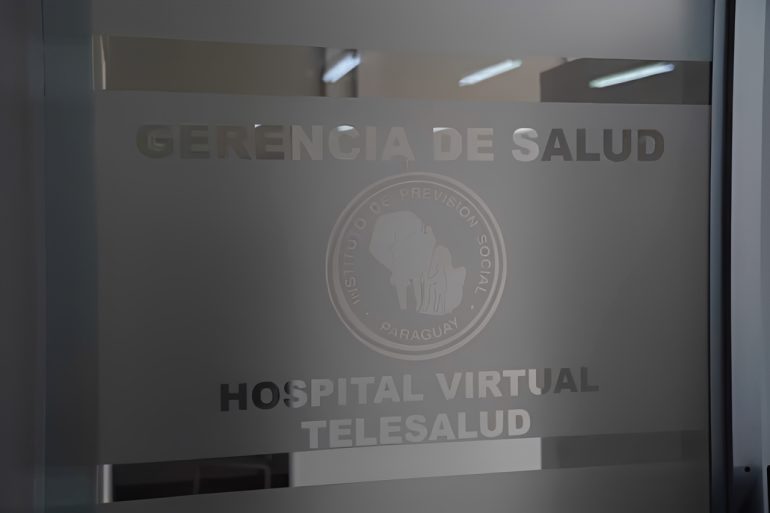

Thousands of insured patients could soon avoid long journeys and crowded waiting rooms as the Institute of Social Security (Instituto de Previsión Social, or IPS) prepares to launch its Virtual Hospital platform at the end of June 2026. IPS is Paraguay’s largest public social security and healthcare institution, providing medical services and social insurance coverage to workers and their families.
The initiative targets patients with chronic illnesses who require regular medical follow-ups and medication renewals. Health authorities expect the programme to reduce pressure on in-person services while making routine healthcare more accessible nationwide.
Complementing traditional healthcare services
“We identify the patients who need medication renewals and contact them directly,” says Derlis León, IPS Health Manager. “We do not wait for the patient to search for an appointment.”
He explains that the Virtual Hospital complements traditional healthcare services instead of replacing them, helping patients complete routine consultations without travelling unnecessarily to major IPS facilities.
A new model for routine care
The first phase focuses on insured patients over 55 who live with chronic conditions such as diabetes, rheumatoid arthritis, and other illnesses that require regular monitoring. IPS estimates that between 10,000 and 15,000 patients could benefit during the initial rollout. By moving those consultations online, IPS expects to free approximately 5,000 face-to-face appointments every month. Unlike the traditional system, patients do not need to compete for appointment slots. Additionally, health authorities believe the additional capacity could help first-time patients secure appointments more quickly.
IPS identifies eligible participants through its records and contacts them directly by text message to confirm a consultation. On the scheduled day and time, patients receive a call and connect with a healthcare professional through a video consultation. During the appointment, doctors review laboratory results, discuss symptoms, and evaluate ongoing treatments. If the patient’s condition remains stable, the physician authorises medication collection at the IPS clinic closest to the patient’s home or workplace. The process eliminates the need to travel to larger hospitals simply to renew prescriptions. If a doctor identifies symptoms that need in-person assessment or urgent treatment, the patient is referred immediately to a healthcare facility.
Three phases of expansion
Officials describe the Virtual Hospital as a long-term transformation. The first stage launches at the end of June 2026 and focuses exclusively on patients over 55 with chronic illnesses who require regular medication management. The second phase, expected roughly six months later, expands eligibility to insured patients aged 40 and above. IPS hopes the gradual approach will allow healthcare professionals and patients to become comfortable with the technology before the programme reaches a larger audience.
Within a year, authorities aim to open virtual consultations to any insured person of working age who wishes to access routine medical care remotely. León says the ultimate goal is to create a system where patients can communicate with doctors through digital platforms whenever their healthcare needs allow for virtual attention.
Taiwan partnership supports digital transformation
The project forms part of a goal to modernise IPS services through international cooperation. IPS President Jorge Brítez and members of the institution’s leadership recently met with Taiwan’s ambassador to Paraguay, Iván Yueh-Jung Lee, to discuss technological collaboration and digital solutions. According to IPS authorities, Taiwan will support the development of telemedicine services, staff training, and knowledge exchange in healthcare management.
Officials also discussed future technological innovations, including the possible incorporation of artificial intelligence tools into healthcare systems.
Bridging the technology gap
Many of the programme’s first users will be older adults, creating a challenge for a system that will rely on smartphones and video calls. IPS officials acknowledge that some patients may feel uncertain about using digital tools for healthcare consultations. To address those concerns, the institution plans a gradual introduction process. Patients first receive a message explaining the service and can decide whether they wish to participate. Family members may assist during consultations, while IPS staff guide patients through the process when necessary.
Healthcare professionals will also receive specialised training before the launch. IPS plans a two-week digital health programme for participating doctors, helping them adapt their consultation methods to the virtual environment. Officials hope the combination of staff preparation and patient support will encourage confidence in the new system and help establish virtual healthcare as a permanent part of medical services in Paraguay.
Also read: 1,400 New Cases Yearly, Paraguay Presents Angirũ Bot To Battle HIV.