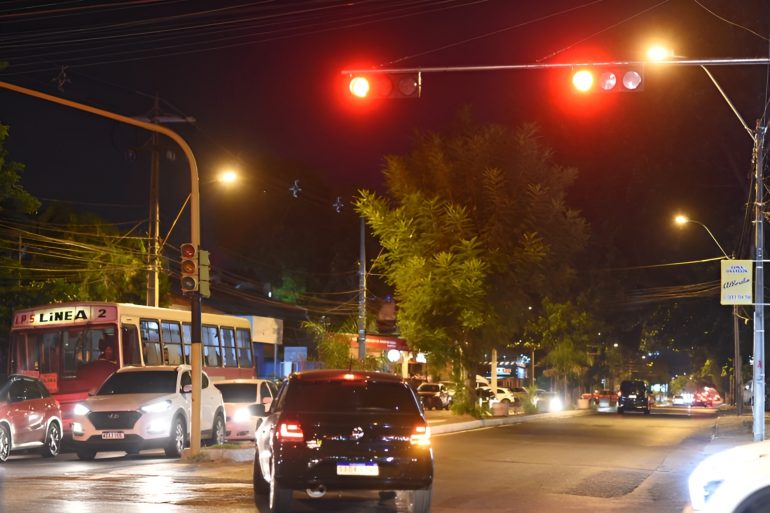

Between October and November 2026, the Municipality of Asunción is adjusting traffic lights along major avenues across Paraguay’s capital. The initiative aims to reduce traffic congestion and improve vehicle movement. According to initial measurements, the delays have fallen from six minutes to two on one of the main avenues.
Traffic light changes across the capital
Municipal technicians are carrying out the calibration of traffic lights. For this purpose, they analyse vehicle count and the traffic demand observed at different hours. As a result, time adjustments have reduced delays by four minutes during the morning rush hour on Avenida Molas López.
The work is also expanding to road corridors aiming to improve traffic flow across multiple intersections. This way, rather than treating each section separately, several traffic lights along the roads are being coordinated. The main avenues where this coordination is being implemented include Mariscal López, Eusebio Ayala and San Martín.
Avenida Eusebio Ayala’s corridor
A pilot project is underway on Avenida Eusebio Ayala. Specifically, between the Fortis supermarket area and Avenida de la Victoria, towards Shopping Multiplaza. This project is intended to respond to changing traffic conditions in these areas.
The initiative involves adjusting traffic signal cycles according to traffic volumes. A signal cycle is the time needed for a traffic light to complete its different phases. According to the municipality’s traffic specialist, signal cycles can last up to 140 seconds during peak periods. The traffic team now aims to reduce them to 120 seconds, considering road safety and pedestrian waiting time.
Creating a green wave
The municipality is also working to improve the green wave. This system coordinates traffic lights at successive intersections. It allows vehicles to travel more efficiently without stopping at every red light.
The green wave system uses a reference speed of 50 kilometres per hour, with a margin of around five kilometres per hour. Preliminary measurements on Avenida Eusebio Ayala show a travel-speed increase of approximately 2.3 kilometres per hour. Through further adjustments and evaluations, the technical team aims to achieve improvements of up to 10 kilometres per hour.
The system’s effectiveness depends on traffic conditions and drivers maintaining an appropriate speed. The volume of vehicles arriving at each intersection, unloading times and the distance between traffic lights also require technical analysis. Other external factors include bus stops, vehicles entering or leaving businesses and congestion on side streets.
Traffic improvements through technology
The municipality uses vehicle counts, cameras and other technological tools to analyse traffic. Of approximately 120 traffic lights connected to traffic-signal centres, between 50% and 60% have cameras. Their goal is to make better use of camera footage in real time, as current processes require downloading and analysing the images.
The initiative forms part of the municipality’s efforts to modernise traffic systems and improve urban mobility. The work is being carried out in coordination with its Advanced Traffic Management Centre.