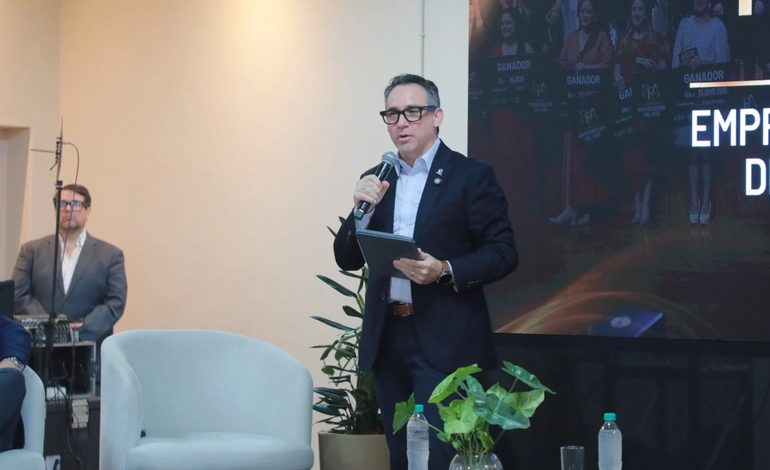

Paraguay Business Week 2026 is set to be the “largest international promotion event in the country,” according to Paraguay’s Vice Minister of MSMEs, Gustavo Giménez. The event aims to showcase the export potential of micro, small, and medium-sized enterprises, creating a connection to key markets in the region and across the globe. Paraguay Business Week 2026 will be held at the Itaipú Binacional headquarters in Hernandarias from 11 to 13 November.
The event is a joint effort by the Ministry of Industry and Commerce (MIC) and the Paraguay-Brazil Chamber of Commerce. The Chamber will also host its annual Expo concurrently, providing a significant platform for local businesses. “More than 300 national companies will have the opportunity to participate in a business ecosystem with more than 20 countries,” commented Giménez.
Anticipating record international participation
This year, the MIC anticipates the attendance of investors from over 20 nations, aiming to surpass the numbers achieved in 2025. “Last year, 17 countries participated and there were 9,000 people. We had attendees from the United States, Spain, and even Finland, and close to 40% were from Brazil. That is, some 4,000 Brazilians showed interest in doing business with Paraguayan companies,” Giménez said during an interview with state media.
The Itaipú Binacional facility, located on the border with Brazil, is one of the world’s largest hydroelectric dams and serves as a symbol of binational cooperation, making it a fitting venue for an event focused on strengthening international trade ties, organisers stated.
Plaza Mipymes: A gateway to global markets
“We are convinced that our MSMEs have the capacity to open new international markets, and for that, we have organised a space called Plaza Mipymes, where 24 companies from different parts of the country will be given an opportunity,” the Vice Minister explained.
Giménez clarified that the call is specifically for businesses that are already prepared for international expansion. “They must have products or services geared towards attracting international clients. In other words, export capacity.”
Other criteria include an interest in the Brazilian market, the ability to participate in business rounds, and a competitive product offering.
Showcasing diverse and competitive industries
Among the more than 60 companies that have applied for Plaza Mipymes are firms from various sectors. These include services for industries, food products with export registration, the garment industry, and digital services. “The MIC evaluates each company and provides support in the areas they need to improve so they can take advantage of commercial connection opportunities,” said Giménez.
The Vice Minister extended an invitation for all businesses to attend the event, even if they do not secure an exhibition space. To further encourage participation, the Paraguay Business Week 2026 will present an “Entrepreneur of the Year” award, which includes a prize of ₲25 million (approximately US$4,200). Additionally, prizes will be awarded in 10 other categories, featuring financial resources and other support, an initiative backed by private sector companies.
“We want all our MSMEs to have the experience of being able to go to a business matchmaking event and do networking.”
Zero Hunger programme boosts local enterprise
A significant number of the country’s MSMEs are currently experiencing growth linked to the Hambre Cero en las Escuelas (Zero Hunger in Schools) programme. This year, President Santiago Peña doubled the mandatory purchase percentage from this sector for the programme, raising it from 5% to 10%.
“This represents almost 40 million dollars for the various supplier companies, which strengthens the sector,” Giménez noted. The programme aims to provide school meals to students across the country, sourcing a portion of the food from local small and medium-sized producers.
Furthermore, to expedite payments to these suppliers, the government recently launched Adelanta. This payment management platform processes invoices in just 48 hours. Previously, this process could take between 30 and 60 days, creating a significant improvement in cash flow for small businesses supplying the state programme.