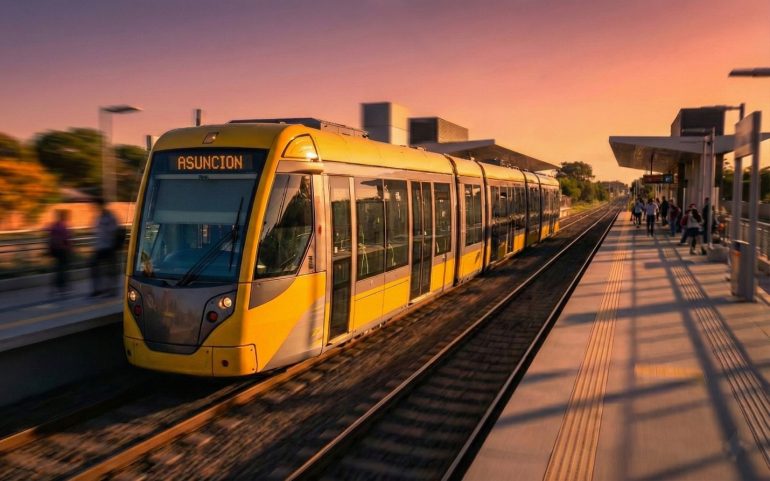

Paraguay’s acting Minister of Industry and Commerce, Rodrigo Maluff, has outlined the proposed route for the new Asunción Commuter Train project, which will feature nine stations within Paraguay’s capital city. In an interview with state media, Maluff provided the first detailed look at the planned network, which aims to enhance public transport and stimulate urban development. The project is advancing, with initial designs for the first phase expected to be presented to the public between late March and early April 2026.
This ambitious infrastructure project is designed to integrate key areas of the capital, from historic sites to modern development hubs. The full proposal for the Commuter Train has already been submitted to Paraguay’s National Congress for review. It anticipates transporting approximately 40,000 passengers daily using a 100% electric system. The total estimated investment for the entire project is projected to be between US$350 million and US$450 million.
Route begins in the historic centre
The journey is set to begin and conclude at Plaza Uruguaya, a significant landmark in the Historic Centre of Asunción. This initial station will establish a crucial link with the nearby Parque Caballero, which is currently undergoing a restoration process. This connection is part of a much broader investment plan, totalling nearly US$40 million, dedicated to the revitalisation of Asunción’s historic downtown area. The integration of the train station into this plan is expected to boost accessibility and encourage further regeneration efforts in the city’s core.
Following Plaza Uruguaya, the second stop will be located at Parque Caballero, reinforcing the connection between transport and public green spaces. From there, the line will proceed to its third station at the Distrito Perseverancia. This stop is particularly notable as it is linked to a private investment project valued at almost US$200 million. The station is envisioned as a multimodal hub, facilitating seamless transfers between various forms of transport, including buses, trains, and bicycles. Its strategic location near the Social Security Institute (IPS) on Sacramento Avenue is intended to serve a high volume of commuters.
Connecting key development zones
The fourth station along the route will be at the Botanical Garden, an area owned by the state railway company, Ferrocarriles del Paraguay S.A. (FEPASA). According to Maluff, there are plans to collaborate with real estate developers to promote growth and development in the vicinity of this station. The goal is to leverage the new transport link to create an attractive urban zone around the Botanical Garden, combining transport convenience with new residential and commercial opportunities.
The route continues towards the city’s athletic and educational centres. The fifth and sixth stations are planned for the Olympic Park, which belongs to the Paraguayan Olympic Committee (COP), and the adjacent Olympic Village. These stops will provide direct access to major sporting facilities, improving accessibility for athletes and spectators alike. Subsequently, the seventh station will be established at the Paraguay-Taiwan University, catering to students and academic staff and integrating the institution more closely with the city’s transport network.
Final stops and project timeline
The final leg of the Asunción route will connect to key technology and recreation areas. The eighth station is planned for the Digital District, which is under the purview of the Ministry of Information and Communication Technologies (MITIC). This will support the growing technology sector by providing efficient transport for its workforce.
The ninth and final station within the city will be at Parque Guasú, a major metropolitan park, offering improved public access to one of the capital’s most important recreational areas.
Asunción Commuter Train project: a detailed design
The minister emphasised that a detailed design of the route will be presented to the public in March or April 2026, contingent upon the formal ratification of the agreement between Etihad Rail and FEPASA. In parallel, significant preparatory work is already underway. Maluff detailed that his team is actively managing tasks such as securing the necessary land corridors for the railway tracks and conducting social impact assessments to ensure the project proceeds smoothly.