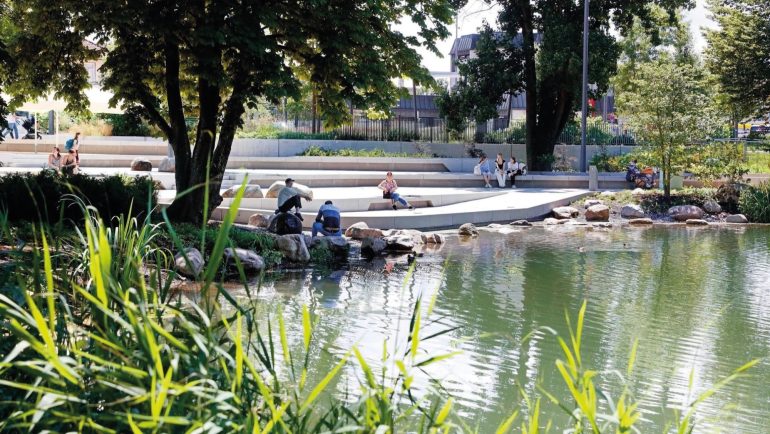

Asunción is working towards a more sustainable and resilient future through the Asunción Ciudad Verde de las Américas – Vías a la Sustentabilidad project. The Green Asunción project brings together urban planning, sustainable transport, waste management and green infrastructure. Its proposals include more trees, integrated cycle paths, improved public spaces and systems designed to manage rainwater.
Planning a green Asunción
Green Asunción focuses on strengthening institutional capacity for sustainable urban growth across Asunción and its metropolitan area. It also promotes coordination between key actors and supports stronger risk management. Additionally, a sustainable-city indicators platform could help monitor progress and guide future decisions.
Financial planning also forms part of the initiative, with the project seeking to improve municipal strategies for investing in sustainable infrastructure. These measures connect environmental planning with the development of the capital and its surrounding urban areas.
The Ministry of Environment and Sustainable Development (MADES) leads the project with the United Nations Development Programme (UNDP). The Ministry of Economy and Finance (MEF), Ministry of Public Works and Communications (MOPC), Ministry of Urbanism, Housing and Habitat (MUVH), National Emergency Secretariat (SEN) and Municipality of Asunción also participate.
Green Asunción project: Trees as part of urban infrastructure
The Urban Design Manual for Asunción’s Historic Centre places trees at the centre of its green and blue infrastructure strategy. The guidelines consider their role in managing rainwater and reducing the urban heat-island effect. The manual recommends local species suited to different spaces, including pavements, parks, squares and central promenades. Suggested species include lapacho amarillo, jacarandá, ceibo, inga, guabiyú and ñangapiry.
Other vegetation also has a practical role. Shrubs, herbaceous plants and ferns could help control erosion, reduce surface runoff and provide habitats for wildlife. Their proposed placement includes linear planting beds, corners and the edges of parks and squares.
Managing rainwater naturally
The manual of Green Asunción proposes sustainable urban drainage systems that allow rainfall to enter the ground instead of relying entirely on conventional drainage. Tree pits and linear planting beds can collect surface runoff and encourage infiltration.
Permeable pavement is another proposed solution for paths, areas within squares and uncovered parking spaces. The material allows rainwater to infiltrate the ground, helping reduce flooding and pressure on the drainage network.
Retention ponds could also appear in selected parks and squares. These artificial bodies of water would temporarily store rainwater, regulate peak flows and improve water quality before controlled discharge or infiltration. The manual notes that such installations would require regular maintenance and safety measures.
Connecting green spaces and mobility
Sustainable mobility represents another part of the project’s approach. Proposed measures include improved traffic management, new standards for public transport vehicles and multimodal transport solutions. Cycle paths integrated with green areas could also connect mobility with the city’s environmental infrastructure.
Meanwhile, waste management measures focus on improving national and municipal solid-waste plans. The project also proposes recovering informal disposal sites, encouraging waste separation and facilitating recycling.
Green Asunción further supports the management of important urban and protected areas. These include the Banco San Miguel and Bahía de Asunción ecological reserve, the Botanical Garden and Zoo, the Guasú Metropolitan Park and the green corridor across the Asunción Metropolitan Area.
Together, these measures present a vision of Green Asunción, where urban development and environmental planning work side by side. The project seeks to make the capital and its metropolitan area more sustainable, better prepared for environmental risks and more connected to its green spaces.