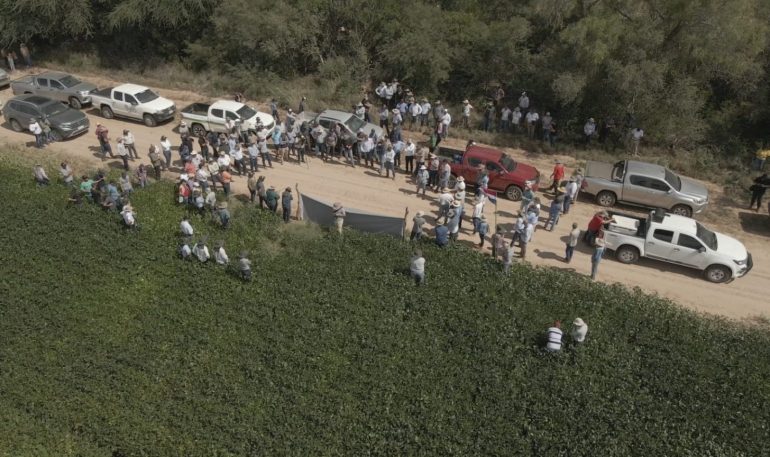

Despite its scarce water resources, the Paraguayan Chaco demonstrate that agricultural‑livestock integration can sustain soybean production. In this context, producers carried out the Soybean Rally 2026, an initiative designed to highlight the progress of the harvest and the resilience of farming practices in the region.
The event, organised by the Paraguayan Chamber of Exporters and Traders of Cereals and Oilseeds (Capeco), took place on 23 and 24 April in Picada Jordán, 4 Caminos, Zenteno and Alihuatá. Over two days, producers and specialists exchanged experiences, visited demonstration plots, and discussed strategies for expanding agriculture in the northern region, which in 2025 covered a cultivation area of 109,069 hectares in the Chaco.
Community participation and regional impact
The rally was conducted in caravan format, with each participant travelling in their own vehicle from designated starting points. The activity brought together producers, technicians and local communities, reinforcing the Chaco as a territory capable of combining innovation, adaptation and resilience in soybean production.
In the face of drought and the Chaco’s demanding environment, producers demonstrated remarkable resilience. Their efforts, together with the support of local communities, transformed the Soybean Rally 2026 into a meaningful and engaging event.
Soybean Rally 2026: Fostering dialogue
The rally also served as a platform for dialogue between technicians, local communities and institutions, reinforcing the importance of cooperation in facing climatic challenges.
Capeco indicated that the initiative began in 2022, although long before they had already been working on the proposal of how to showcase the Chaco’s productive system, a region mainly dedicated to livestock that increasingly incorporates agriculture.
A significant factor in the Paraguayan economy
Soybeans, which represented 33% of Paraguay’s exports in the first quarter of 2026, consolidate their presence in the Chaco thanks to innovative practices. Farmers improve soil fertility, anticipate rainfall cycles, and apply conservation techniques that allow crops to withstand the demanding conditions of the territory.
These efforts reflecte a broader commitment to sustainable agriculture and the diversification of production systems in areas traditionally considered less favourable for intensive farming.
Innovations in soil and crop management
Among the highlights of the Soybean Rally 2026 were projects focused on recovering degraded soils, integrating crops with livestock, direct seeding, water and soil management, and crop rotation with different grasses.
Agronomist Raúl Coronel spoke about the crops in his Plot 5, which was showcased at the event. He explained that these crops were planted using the Santa Fe system and, 70 days after planting, have shown significant recovery following the rains. He also emphasised the importance of adequate soil cover, achieved with corn and ruziziensis crop residues. He added that this practice has substantially improved soil conditions.
As a participant in the rally, producer Rony Doerksen, owner of Estancia Agro Monte Alto, explained that the current campaign began with favourable sowing conditions but was later affected by drought. Some rainfall allowed partial recovery, though yields did not reach their full potential. His testimony illustrated both the challenges and the resilience of Chaco agriculture.
Also read: First Starlink Internet Access Points Go Live In Paraguay’s Chaco Area.