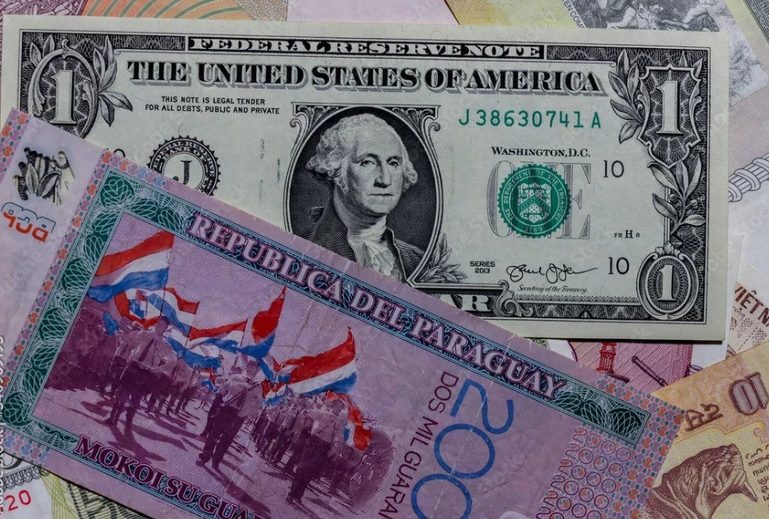

The Paraguay exchange rate is moving again, with the US dollar climbing against the guaraní, Paraguay’s national currency. On Friday 20 and Saturday 21 November 2026, it traded around ₲6,300, with some exchange houses quoting up to ₲6,400, a clear rebound from ₲6,150 a week earlier.
The volatility comes two weeks after the collapse of Ueno, the country’s sixth-largest bank. The question now is whether this exchange rate volatility is temporary or whether the pressure will persist.
Paraguay’s central bank placed Ueno, a digital-focused lender with nearly 3 million customers, into resolution on 2 November. Its solvency had fallen below half the legal minimum. Resolution is the legal procedure through which the state takes control of a failing bank to protect depositors.
The political fallout was swift. President Santiago Peña announced his resignation on 5 November, and the Paraguayan Senate removed him the following day. Vice President Pedro Alliana was sworn in as the new president on 6 November.
How the dollar moved since Ueno resolution
Before the crisis, the dollar traded around ₲5,950 at exchange houses. On 6 November, the day Peña was removed, it jumped to as much as ₲6,600. According to financial adviser Amílcar Ferreira, quoted in local media, some people were selling guaraníes for dollars as a safe haven. Others were even moving money out of Paraguay.
Calm returned the following week. The dollar fell to ₲6,300 on 9 November and closed that week at ₲6,150. It has since started to rise again. The guaraní is still stronger than a year ago, when the dollar traded close to ₲7,000.
Why the Paraguay exchange rate is moving
Ueno is not the only factor. Uncertainty after the bank’s collapse and safe-haven demand for dollars pushed the rate up in early November. A seasonal factor is also at work. Importers are stocking up for year-end sales, which raises demand for dollars, according to local media reports.
Confidence has been returning gradually. Foreign-exchange agents attribute the easing of distrust to the swift handling of the political crisis, court action and payments to depositors. The rebound this week shows that confidence remains fragile.
Exchange rate outlook: Calm or more pressure?
It is too early to call the market stable, says Emil Mendoza, president of the Paraguayan association of exchange houses. The Paraguay exchange rate outlook depends largely on how Ueno’s resolution unfolds. The central bank is working with other banks on a sale of Ueno’s assets and liabilities.
If the process continues without wider banking problems, confidence could improve and the dollar could settle. If fiscal costs rise or confidence weakens, pressure on the guaraní could continue. Investors are already cautious. Paraguay’s dollar bond maturing in 2050 lost about 3% between 2 and 13 November, according to Finance Ministry records.
The data platform Trading Economics projects the dollar at around ₲6,176 by the end of the quarter. That is a model forecast, not an expectation from Paraguay’s authorities.
Fitch: The strongest warning so far
Paraguay’s credit rating reflects how likely the country is to repay its debt, and three agencies assess it. Fitch rates Paraguay BB+, one step below investment grade, the category that marks a country as a relatively safe borrower. Until the Ueno resolution, that rating carried a positive outlook, meaning an upgrade was possible.
On 11 November, Fitch placed the rating on Rating Watch Negative, a formal signal that a downgrade is possible. It cited possible spillovers to the banking system, public finances, economic growth and policy continuity. Ueno held roughly US$850 million in public funds in June, including state pension money.
Fitch added an important nuance. The agency does not currently expect broader financial-stability problems, because other major banks have sound solvency and liquidity. Economy and Finance Minister Óscar Lovera says the decision reacts to a one-off event. In his view, the outcome depends on Ueno being resolved without affecting the rest of the financial system. He also notes that Fitch continues to recognise Paraguay’s growth, reserves and stable inflation.
Moody’s: Investment grade remains
Moody’s rates Paraguay Baa3, the lowest step of investment grade, with a stable outlook. It reaffirmed that rating in July, and it first granted investment grade in 2024. It has not changed the rating since Ueno failed.
After the collapse, Moody’s said it expects no immediate impact on Paraguay’s sovereign credit profile. The agency said the fallout can stay contained if the resolution is fast and orderly. Moody’s also stated Peña’s resignation highlights persistent institutional and governance weaknesses.
S&P: Sovereign rating unchanged
S&P Global Ratings rates Paraguay BBB-, also investment grade, with a stable outlook since its upgrade in December 2025. It has not changed the sovereign rating since the crisis began. It did cut Ueno itself from BB to D, its default grade, on 4 November.
What happens next for Paraguay’s credit rating
Investors and rating agencies will now watch several things. These include the dollar’s path, progress on Ueno’s resolution and the final cost to the state. They will also look at depositor confidence and liquidity in the banking system.
The next big decision is Fitch’s final ruling on its negative watch. Any later move by Moody’s or S&P would also matter. Paraguay’s credit rating is still investment grade at both agencies. Even so, Fitch’s watch makes the handling of Ueno an important test. It will show whether the crisis stays contained or begins to affect Paraguay’s broader sovereign risk.