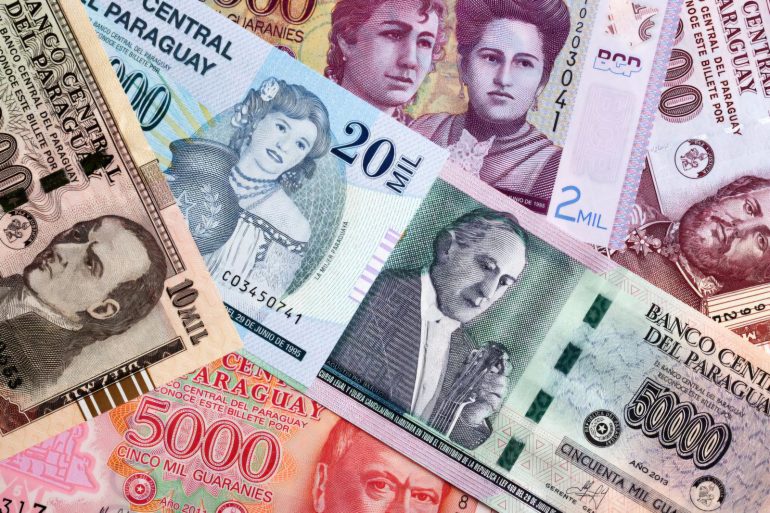

Paraguay enters Monday, 9 November 2026, following a week in which its national currency, the guaraní, depreciated by over 8% against the US dollar in just five days. According to Bloomberg, the guaraní became the world’s worst-performing currency on Thursday, 5 November. For a country accustomed to relative monetary stability, the speed of the depreciation has raised concerns among local businesses, investors and financial observers.
The sudden decline coincided with two major developments: the abrupt closure of Ueno Bank and a political crisis that resulted in the impeachment of President Santiago Peña. Although the guaraní showed signs of stabilisation on Friday, 6 November, the dollar remained considerably higher than before the crisis.
As Paraguay begins a new working week under President Pedro Alliana, attention turns to whether the currency can recover, how quickly depositors will regain access to their savings and what the recent developments could mean for the economy.
Downfall and politcal crisis
One of the main developments preceding the currency’s sharp depreciation was the resolving of Ueno Bank. The institution, which launched as a digital-first challenger bank in 2021 after acquiring Financiera El Comercio, expanded rapidly. By late 2025, it held approximately 9% of banking deposits in Paraguay and served around 2.9 million customers, representing a substantial proportion of the nation’s adult population. However, that expansion ended abruptly when the Central Bank of Paraguay (BCP) initiated the bank’s resolution process on 2 November 2026.
The banking failure quickly developed into a political crisis. Former President Santiago Peña had held financial stakes in Ueno Bank’s parent holding company until March 2025, while former Central Bank president Carlos Carvallo had previously served as Ueno’s president. Amid allegations of conflicts of interest and concerns about the management of public funds, Peña’s political movement withdrew its support.
Why did the currency fall so sharply?
The collapse of the guaraní against the US dollar is not merely a reaction to bad headlines; it is driven by three specific structural mechanisms in Paraguay’s economy:
An exceptionally shallow FX market
Paraguay’s foreign exchange market is relatively small. Financial analysts note that single transactions ranging between US$1 million and US$3 million are large enough to alter the exchange rate noticeably. Consequently, it did not take a massive, institutional capital flight to crash the currency, just a handful of large corporate actors shifting their positions at once.
Panicked flight to safety
With Ueno’s mobile app locked, credit cards suspended, and the presidency in flux, citizens and business owners scrambled to protect their liquidity. Classic bank run mechanics took hold in the currency market: individuals rapidly sold off guaraníes to buy US dollars or move capital abroad.
Seasonal commercial demand
The panic hit during an already vulnerable time of year. Local importers routinely buy large sums of US dollars in November to pay for year-end holiday inventory. The sudden spike in panic-driven dollar buying combined with routine seasonal demand created a severe supply shortage of foreign currency.
Stabilisation and the road ahead
While the short-term outlook remains volatile, several structural buffers are expected to mitigate a total economic collapse:
Deposit guarantee coverage: Newly fast-tracked legislation aims to accelerate payouts through Paraguay’s Deposit Guarantee Fund. With coverage limits protecting up to 40 to 75 minimum monthly wages, experts estimate that roughly 97% of affected Ueno Bank depositors will eventually recover their savings in full.
Export sector cushion: While the depreciation severely hurts local purchasing power and importers, a weaker guaraní provides an immediate competitive boost to Paraguay’s agricultural and industrial exporters, who had previously struggled under a stronger local currency.
What happens next?
The coming weeks will help determine whether the guaraní’s recent depreciation represents a temporary market adjustment or a more prolonged period of financial uncertainty. Ultimately, the currency’s stabilisation will depend partly on how quickly regulators restore access to deposits, how the new administration manages the transition, and whether confidence in Paraguay’s financial institutions improves.