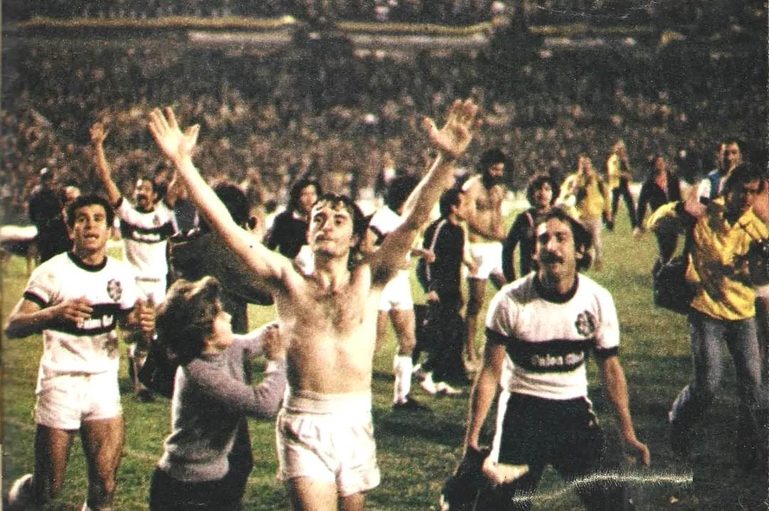

In an era when football stadiums are renamed after corporate sponsors and player loyalty is often measured in wages, one phrase has endured in Paraguayan football. As Club Olimpia closes in on a record 49th title in the late stages of the 2026 Clausura season, the record champion of Paraguayan football remembers the sentence “La gloria no tiene precio”: Glory has no price.
The words are credited to the club’s late president, Osvaldo Domínguez Dibb. They originated from one of the most significant victories in Paraguayan football, and for Olimpia supporters, the phrase is synonymous with the club’s identity.
The briefcase at La Bombonera
The story dates back to 1979. On 22 July, the first leg of the Copa Libertadores final took place at Estadio Defensores del Chaco in Paraguay’s capital. On that day in Asunción, Olimpia beat Argentine giants Boca Juniors 2-0. The return match was set to occur five days later in Buenos Aires at stadium La Bombanera. Before it could take place, Boca’s management allegedly made an attempt to sway the result.
According to Domínguez Dibb’s autobiography, Memorias de la Gloria: Mi Vida (Memories of the Glory: My Life), Boca president Alberto J. Armando visited the Paraguayan delegation carrying a briefcase containing US$40,000. The proposal was straightforward. The money in exchange for Olimpia allowing Boca to win the second leg, forcing a third match in Uruguay to generate further revenue.
The first Copa Libertadores for Paraguay
Domínguez Dibb refused. “Mi país no necesita dinero, necesita gloria deportiva”: My country does not need money, it needs sporting glory. The following night, Olimpia held Boca to a 0-0 draw, securing the club’s first Copa Libertadores title. It was the first time a Paraguayan club had won South America’s biggest club tournament. There is no independent public corroboration from the Boca side.
Former Paraguayan President General Alfredo Stroessner reportedly asked Domínguez Dibb how much money the club had made from its historic victory. Stroessner was surprised to learn that Olimpia had actually lost money on travel expenses and player bonuses. When he questioned the financial outcome, Domínguez Dibb replied: “No, mi General. La gloria no tiene precio”: No, my general. Glory has no price.
From waterboy to President
Domínguez Dibb’s refusal makes more sense when viewed against his early life, contextualized with his longstanding connection to Olimpia. According to his autobiography, the former Olimpia President was born to a Syrian immigrant businessman, and developed an early passion for football. His father disapproved, dismissing it as a pérdida de tiempo (a waste of time). So, he found his own way into the stadium after his father refused to buy match tickets for him.
At just 11 years old, he became the team’s aguatero (waterboy), carrying buckets of water onto the pitch for the players in exchange for free entry. He saved the bus fare his father gave him and spent it on oranges to eat while watching the matches.
Nearly three decades later, the offer from Boca presented a choice that went beyond money. The boy who had once found a way into the stadium because he loved the game was now in a position to decide what that club stood for. Accepting the offer would have meant putting a price on the very thing that had drawn him to Olimpia in the first place.
A legacy beyond the stadium
Osvaldo Domínguez Dibb died in February 2024 at age 83. During his time at Olimpia, the club won three Copa Libertadores titles and the Intercontinental Cup, establishing him as one of the most successful club presidents in South American football.
The famous phrase was memorialized, originally painted onto the wall of Olimpia’s Manuel Ferreira stadium. While it has since been demolished, its replacement, the Estadio Osvaldo Domínguez Dibb, is under construction and is planned to accommodate 46,000 spectators. The new venue is intended to host a 2030 FIFA World Cup match.
Club Olimpia’s new stadium plans contain an on-site museum dedicated to the club’s history, alongside facilities for supporters and other visitors. The phrase Glory has no price, closely associated with Domínguez Dibb and the club’s 1979 Libertadores triumph, remains part of Olimpia’s identity.