

From local dance studios in Paraguay to workshops and competitions across Europe, Paraguayan Titi Báez has built a place for himself in the global hip-hop scene. The 28-year-old dancer, choreographer and teacher has spent five years pursuing opportunities abroad. Also a photographer and filmmaker, Báez has found a way to support his career in dance through complementary creative outlets.
Talking to The Asunción Times, Báez explores his beginnings, the challenges along the way, and his views on Paraguay’s dance scene.
Finding his place in hip-hop
Tit Báez, who’s real name is Carlos Báez, began dancing at the age of seven. He first discovered his passion for dance while watching his two older brothers rehearse for school competitions at home in the city of San Lorenzo. “I would watch them and repeat their steps until I had learnt the choreography by heart,” he recalls.
Eventually, Báez also began performing and competing at school events while training at dance academies. At the time, the routines were labelled as modern dance. “What we danced to was not yet hip-hop as such. It was mainly choreography set to electronic or hip-hop music.”
At age 16, an experience abroad marked his relationship with hip-hop culture. As part of a 40-member Paraguayan team, the dancer travelled to the US to compete at the 2025 World Hip Hop Championship. “In the United States was where I truly experienced hip-hop firsthand, right from the cradle. From then on, I began to go deeper into the culture.”
Childhood passion turns into a professional career
What began as a hobby gradually became a profession. By the time he finished secondary school, Báez was already teaching hip-hop at dance academies. When asked how he would describe his work, he answers: “What I do, dance, teach and live is hip-hop culture itself.”
After finishing school, he also began pursuing a second artistic career. “With what I earned through dance shows and teaching, I bought a camera and started photography.” His work behind the camera supported his main passion. “One paid for the other, and the other paid for the one. But dance was always at the centre of it all, because I reinvested everything I earned into it.”
Building a career beyond Paraguay
In 2021, Báez took his career abroad in search of professional opportunities. “For two and a half years, I travelled between the US, Europe and Paraguay, looking for opportunities to work and take classes,” he recounts.
In New York, he attended an intensive training programme led by influential hip-hop figures from 2021 to 2023. “For two months each year, I trained daily from 7 in the morening to 8 in the evening. I dedicated myself entirely to dance and worked as a photographer at night. I did not have time for anything else,” he recalls.
New opportunities on the global stage
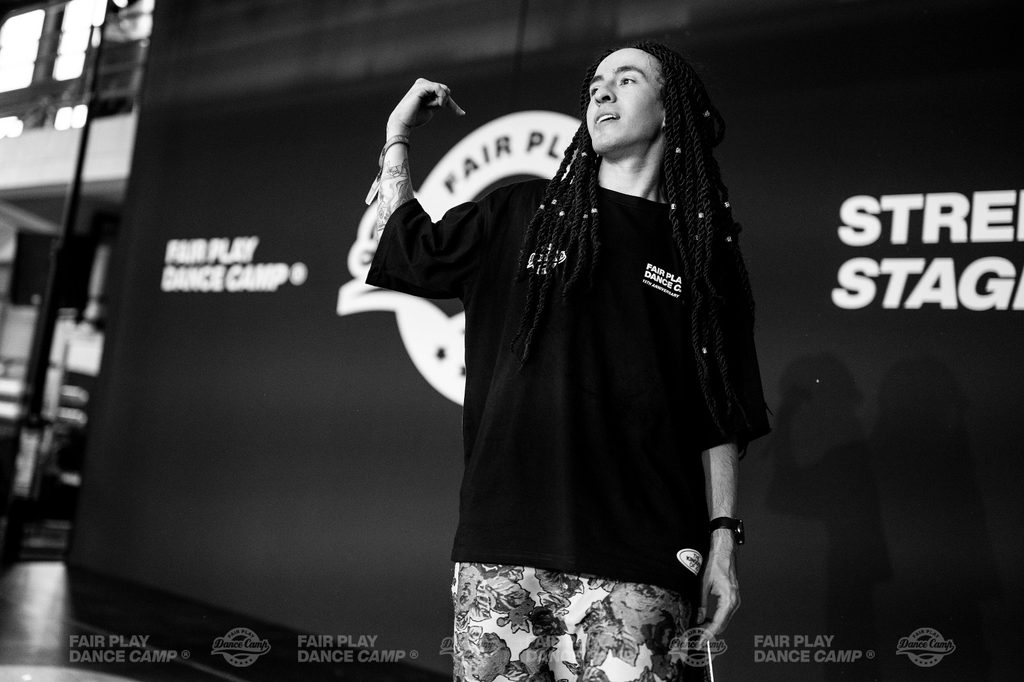
After years of training, Báez began achieving important milestones. He was selected as an instructor for the 2025 Fair Play Dance Camp in Poland. After submitting a choreography video just before the application deadline, he received around 12,000 votes online and secured his place at the event.
The opportunity required him to teach nearly 200 people in English for the first time. An experience he describes as both exciting and high-pressure.
“I memorised my choreography so I could explain how I moved even my little finger. But under such pressure, I would still forget basic words such as ‘hand’, ‘right’ and ‘left’, he explains. Eventually, “after a couple of classes, I felt more at ease with expressing myself.”
After the event in Poland, he went on a teaching tour through London, Madrid, Barcelona and Málaga. Other career milestones include participating in Summer Dance Forever in Amsterdam and performing alongside music artists such as A$AP Rocky, Nicky Jam and Tini Stoessel.



Titi Báez about Paraguay’s urban dance scene
Báez has covered the costs of his training, equipment, clothing and travel through his own earnings. “I did everything through my own means from the beginning,” he says. Even after adding prestigious events to his résumé, the dancer did not receive any institutional support in Paraguay.
Although he faces the same financial challenges as other artists, Báez remains positive about Paraguay’s urban dance scene: “Nowadays, there are many more opportunities.” Beyond working with music artists and at dance studios, he mentions that large-scale events have brought greater visibility and work opportunities for local urban dancers.
However, he adds, “I still find it quite a difficult path because people cannot always afford to receive training or go abroad. Making a living solely from dance is quite challenging, mainly because of the lack of support and recognition.” Although the country’s artistic scene “is on the right track, there is still a lot of room for growth.”
Inspiring other dancers and artists
Titi Báez acknowledges that building a career abroad involves sacrifices, loneliness and leaving the comfort of home behind. However, he believes that “to evolve, we must put ourselves in uncomfortable situations to eventually feel comfortable in them.”
He encourages aspiring dancers to pursue their ambitions without letting fear or financial limitations hold them back. “Go for it 100% and do not be afraid. We can all achieve our goals with little or a lot of money. It depends on what we are willing to do to make them happen.” His final advice is simple: “Work for it, take action and do whatever it takes. It is not impossible.”
Titi Báez’s next dance moves Alongside planning a second tour through Europe, Titi also runs a programme bringing international choreographers to teach in Paraguay. Now, he aims to work with more international artists and establish himself among the world’s top dancers.
To follow his next steps, find Titi Baéz the dancer on Instagram and Titi Baéz the photographer on Instagram.