
It is seven in the morning and the phone will not load. WhatsApp sits frozen on a single grey tick. The banking app refuses to open, the delivery driver cannot confirm the order, and the supermarket till rejects a QR code that normally takes two seconds to scan. Nothing has broken in the usual sense. The internet has simply gone, and with it, a piece of daily life that most people in Paraguay never think about until it disappears.
This is not a real event. It is a thought experiment: what would happen if Paraguay lost internet for twenty-four hours, and how deeply does daily life depend on it? The answer says less about technology than about how ordinary life has moved online unnoticed.
A country that is now mostly online
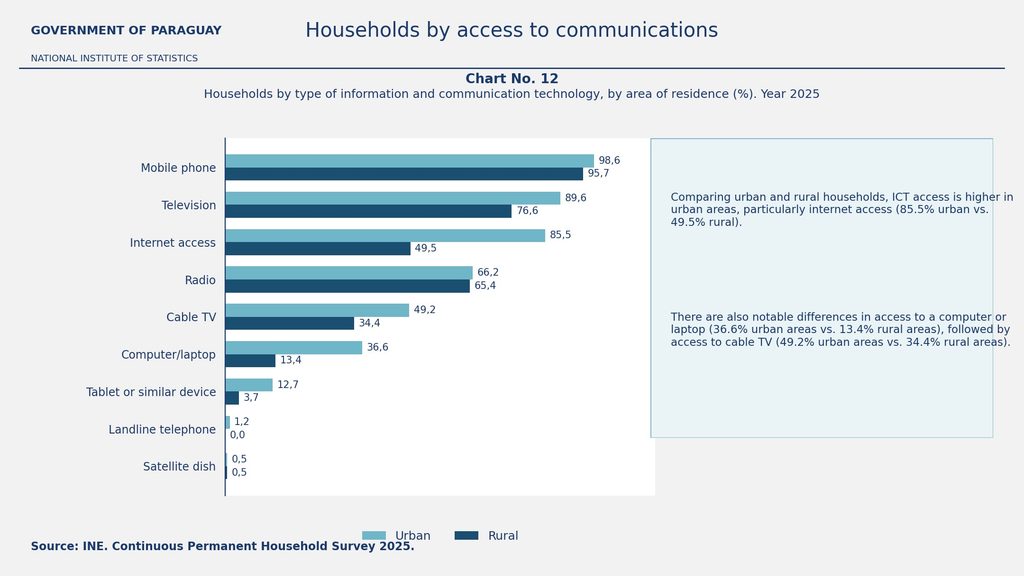
Internet in Paraguay is no longer a niche presence; it is close to universal. According to the national statistics institute, INE, 85.4% of Paraguayans aged ten and over went online in 2025, amounting to roughly 4.43 million people. That figure covers people in cities and in the countryside, young students and older professionals. If Paraguay lost internet for even a day, the disruption would reach into homes across the country almost simultaneously.
This level of connection did not arrive overnight. It reflects years of expanding mobile coverage and falling data costs, turning internet into a utility, not a luxury. A blackout, then, would not just silence entertainment or social media, it would interrupt the invisible infrastructure behind daily transactions.
The first hour: messaging goes quiet
In the imagined scenario, the earliest and most obvious casualty is messaging. WhatsApp, the platform most Paraguayans use to arrange their day, coordinate with colleagues, and stay in touch with family, would simply stop working. Group chats used by schools, workplaces, and even neighbourhood security networks would fall silent at once.
For many households, this alone would feel disorientating. Plans made the night before would need confirming the old-fashioned way, in person or by phone, if calls still worked. It seems a small disruption on paper, yet it exposes how far coordination has shifted from speech to text.
Midday: the money problem begins
By midday in this scenario, the more serious consequences would surface, and they would centre on money. Paraguay’s payment system has moved decisively away from cash in recent years, and the Central Bank of Paraguay, known as the BCP, has the figures to prove it. In 2025, transfers accounted for 42% of operations within the national payment system, while QR code payments made up a further 21%.
Much of this activity runs through the SPI, or Sistema de Pagos Instantáneos, (Instant Payment System) a BCP-operated system that moves money between accounts at different banks within seconds, at any hour of the day. Before it existed, a transfer between two different banks could take hours, or until the next working day, to arrive. Since March 2026, the SPI has permitted transfers of up to ₲10 million in a single operation, a limit that underscores how much everyday commerce now relies on instant digital transfers instead of a queue at the bank counter. Take the internet away, and both the SPI and QR payments would stop functioning immediately.
Small businesses that stopped holding much cash, since QR payments made it unnecessary, would feel the strain first. A market stallholder used to scanning codes all morning would suddenly need customers to produce cash they may not carry. Multiply that scene across thousands of shops, taxis, and food stalls, and the scale of the disruption becomes clearer.
Afternoon: cash makes a comeback, unevenly
As the hours pass in this imagined day, cash would likely re-emerge as the fallback currency, though not evenly across the country. Urban residents, more reliant on digital payments, might scramble harder than rural areas, where cash has stayed common despite growing internet use.
Age would matter too. Older residents who never fully adopted mobile banking might notice little change beyond a lack of messages from younger relatives, while younger, urban professionals whose entire financial life sits inside a smartphone could find themselves genuinely stuck. The blackout, in other words, would not affect everyone equally, and that unevenness is itself revealing. It shows which parts of Paraguayan society have gone fully digital, and which still keep one foot in older habits.

Evening: work grinds to a halt
By late afternoon in the scenario, the disruption would likely spread into workplaces themselves. Cloud-based tools, shared documents, and remote logins, all now standard in many Paraguayan offices, would become unreachable. Employees relying on such platforms, from client communication to invoicing, would find their working day paused, regardless of the hour.
For businesses that depend on delivery apps or online booking, the effect would be immediate and visible. Restaurants that fill orders through delivery platforms would lose that channel outright, while customers accustomed to summoning a ride or a meal with a few taps would be left improvising, much as earlier generations did without a second thought.
A day without internet in Paraguay
Pieced together, the imagined day would unfold less as a single dramatic event and more as a slow accumulation of small failures, each one exposing a habit nobody realised had become so fragile. None of it would be catastrophic in the way a natural disaster might be. It would be something subtler, a long, frustrating reminder of how many conveniences depend on a signal nobody sees.
If Paraguay lost internet for twenty-four hours, the country would not collapse. It would simply slow down, sentence by sentence, transaction by transaction, until cash returned to pockets and voices returned to phones. The real lesson is not that Paraguay could survive such a day, because it plainly could. It is how many small habits, from paying for bread to confirming a shift at work, have moved online so gradually that almost no one marked the turning point.