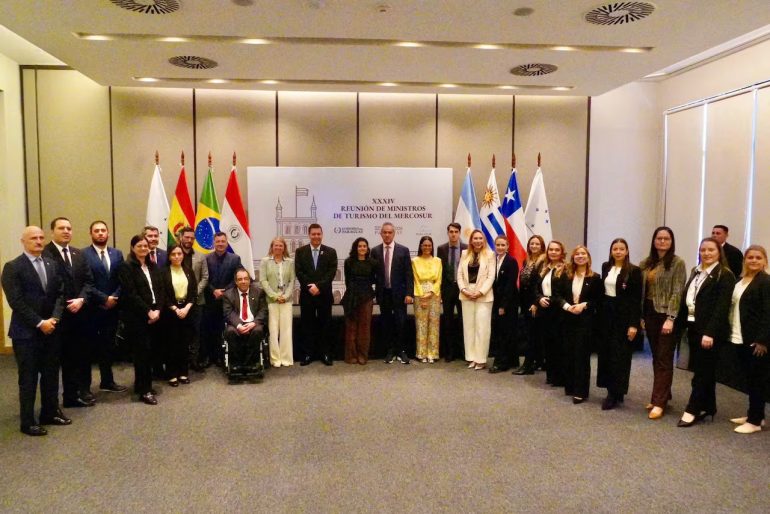

The 34th meeting of Mercosur Tourism Ministers was held in Asunción under Paraguay’s pro tempore presidency. Mercosur is the South American regional bloc that promotes economic and political cooperation among its member countries. At the meeting, delegates approved a coordinated regional agenda aimed at positioning South America as a competitive, integrated and globally recognised tourism destination.
Authorities from Paraguay, Argentina, Brazil, Uruguay, Chile and Bolivia agreed that joint action strengthens the region’s tourism potential and enhances its international visibility, particularly through integrated travel circuits and the region’s cultural diversity, stability and security.
Stronger regional cooperation in tourism
At the opening of the meeting, Paraguay’s Minister of Tourism, Jacinto Santa María, stressed the need for a shared regional agenda that strengthens tourism as a driver of development. He reaffirmed Paraguay’s commitment to regional cooperation and integration as tools to improve the bloc’s global position. Delegations prioritised the promotion of South America through the “Visit South America” brand. They agreed to expand their presence at international tourism fairs and digital platforms, alongside stronger global campaigns targeting strategic markets. They also supported a shift towards an experience-based tourism model, encouraging multi-country travel rather than isolated national offers.
Member countries have advanced joint initiatives that present South America as a unified tourism space. These include routes linking cultural, natural and gastronomic attractions across borders. The aim is to encourage visitors to experience the region as a single destination. Among these initiatives are the “Jesuit Route in South America”, the “Southern Natural Route”, and a forthcoming Regional Gastronomic Tourism Guide led by Argentina. These projects seek to strengthen regional cooperation while highlighting shared heritage as a central element of tourism strategy.
Countries present national priorities
Argentina called for deeper cooperation based on complementarity rather than competition. It stressed connectivity, infrastructure, and tourism facilitation, alongside student, religious, and sports tourism, and the growing role of artificial intelligence and digital innovation.
Uruguay presented progress in regenerative tourism and public–private coordination. Brazil reaffirmed its proposal to develop a Mercosur Football Tourism Route linked to the 2027 FIFA Women’s World Cup. Bolivia emphasised the integration of nature, culture, gastronomy, and music in regional promotion, while Chile called for common indicators and shared tourism intelligence.
The meeting was also attended by the Secretary-General of UN Tourism, Shaikha Al Nowais, and Executive Director Natalia Bayona. They supported the regional initiatives and highlighted the importance of advancing towards a more innovative, sustainable, and inclusive tourism model across South America.
Also read: EU-Mercosur Agreement: How Paraguay Will Benefit From The US$61 Billion Trade Deal