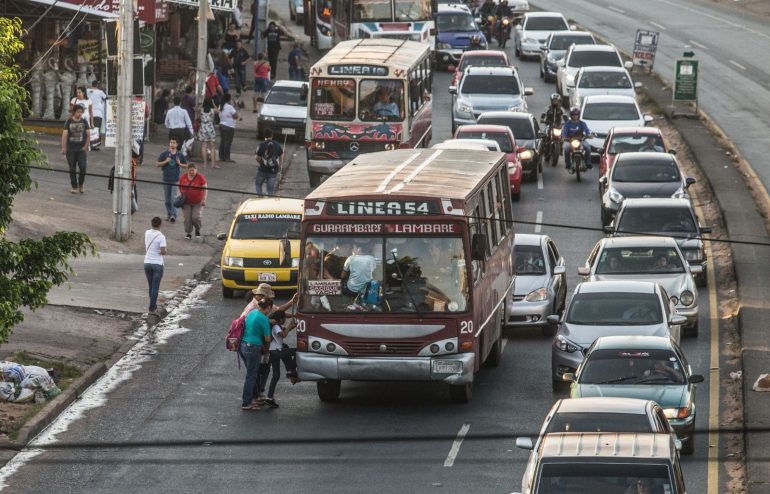

Asunción, the capital of Paraguay, is facing an increasingly complex urban mobility crisis as the number of people entering the city each day continues to far exceed its resident population. Although approximately 462,000 people officially live in Asunción, the city receives more than 1.5 million workers, students, traders and visitors every day from different districts across the metropolitan area, resulting in the Asunción traffic challenge.
The situation has raised growing concerns regarding the sustainability of the transport system, road infrastructure, public services and municipal finances. Authorities and specialists warn that the pressure created by this constant influx of people has become one of the country’s most significant urban challenges.
Every morning, an endless stream of vehicles enters the capital from neighbouring cities such as San Lorenzo, Luque, Lambaré, Fernando de la Mora, Mariano Roque Alonso and Villa Elisa. The result is a city that, during much of the day, must sustain a population that nearly triples its official size.
Asunción traffic: A capital under constant pressure
For decades, Asunción has concentrated a substantial share of Paraguay’s commercial, financial, educational and governmental activity. Ministries, universities, hospitals, banks and major companies continue to maintain most of their operations within the capital, making it the country’s principal destination for employment and public administration.
However, urban and metropolitan growth has advanced more rapidly than the city’s infrastructure has been able to adapt.
The main access routes into the city – including Acceso Sur, Avenida Eusebio Ayala, Avenida Mariscal López and the Costanera corridors – experience severe congestion on a daily basis, particularly during morning and evening peak hours. Endless queues of cars, buses, motorcycles and lorries have become part of everyday life for many thousands of commuters.
Public works and investments to respond to urban demand
In response to this scenario, the Municipality of Asunción maintains that recent improvements in tax collection have enabled the acceleration of projects considered essential for the city’s infrastructure.
According to figures released by the municipal administration, the city achieved record levels of revenue collection, allowing authorities to advance projects primarily related to storm drainage systems, road rehabilitation and urban modernisation. Officials argue that these investments are crucial in responding to the enormous number of people who use the capital’s infrastructure every day.
Among the most significant interventions are projects in neighbourhoods historically affected by flooding, such as San Pablo and Santo Domingo, in addition to works along strategic corridors including Santa Teresa, Aviadores del Chaco and Molas López.
The municipality also states that the expansion of the property market and the growth of private developments are creating opportunities to modernise key sectors of the city.
The challenge of public transport
One of the most heavily criticised aspects by both citizens and specialists is the limited efficiency of the metropolitan public transport system. Despite transporting hundreds of thousands of passengers each day, the system continues to rely mainly on conventional buses operating along saturated road networks. Delays, overcrowding, irregular schedules and insufficient integration between municipalities remain recurring problems for public transport users.
Urban planning experts argue that Asunción requires a modern and integrated mobility strategy capable of reducing dependence on private vehicles. Among the proposals most frequently discussed are the modernisation of bus corridors, the development of rapid transit systems, greater investment in sustainable mobility and stronger coordination between municipalities.
There is also increasing emphasis on creating safer infrastructure for pedestrians and cyclists, as well as incorporating intelligent technology for traffic management. Many experts agree that the problem cannot be resolved solely by the Municipality of Asunción. Since mobility flows extend throughout the metropolitan area, any effective solution requires coordination between local governments and the national administration.
The financial impact on the city
The Asunción traffic challenge also represents a substantial financial burden for the municipality. Although hundreds of thousands of non-residents use Asunción’s streets, services and infrastructure every day, the municipality primarily collects taxes from residents and registered businesses located within the capital. This creates a structural imbalance between the demand for services and the city’s financial capacity to maintain them.
Road maintenance, traffic management, waste collection, public security and the upkeep of public spaces all involve increasingly high costs for a city whose effective daily population far exceeds its officially registered population. Municipal authorities have repeatedly highlighted the need for stronger cooperation between national institutions and metropolitan municipalities in order to confront these financial pressures.
Urban growth and long-term planning
The situation in Asunción reflects a broader trend observed across numerous Latin American capitals, where metropolitan expansion has exceeded the original capacity of urban infrastructure. Over recent decades, surrounding cities have experienced rapid population growth and urbanisation, while much of the country’s economic activity has remained concentrated in the capital. As residential expansion spread into suburban districts, commuting distances increased and dependence on daily travel into Asunción intensified.
Urban planners argue that future solutions must include long-term regional strategies designed to decentralise economic opportunities and strengthen infrastructure outside the capital. The expansion of business districts, universities, hospitals and public offices in surrounding municipalities could help reduce the concentration of daily movement into Asunción.
Specialists also emphasise the importance of promoting sustainable urban policies that prioritise efficient public transport, integrated urban development and environmental resilience.
Looking towards the future
As Paraguay continues to urbanise, the city’s ability to respond to the Asunción traffic challenge may become one of the defining factors shaping the country’s economic and social development in the decades ahead.