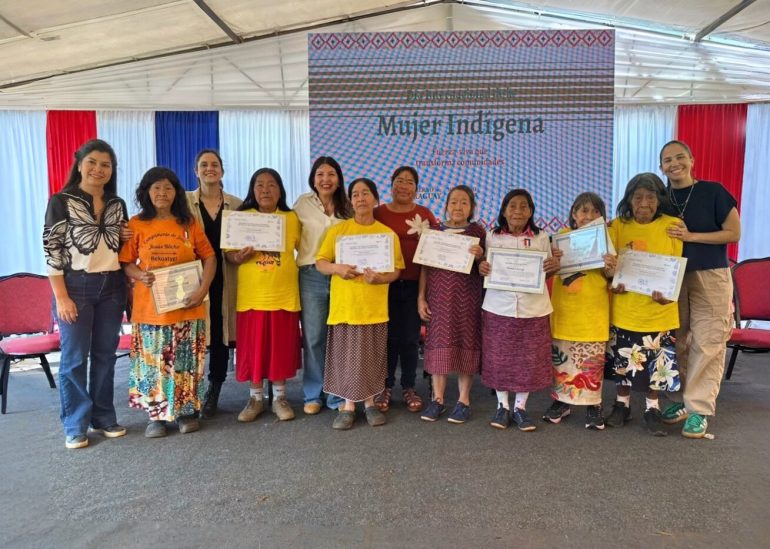

Three Aché women from eastern Paraguay are safeguarding traditional knowledge passed down through generations within their community. Paraguay’s National Secretariat of Culture (SNC) named María Tatúgi, Anselma Mbyvangi and Teresa Karengi, from Puerto Barra in Naranjal, Alto Paraná, Living National Treasures. This is an official honour conferred on master bearers of traditional knowledge and skills who safeguard Paraguay’s intangible cultural heritage.
The recognition was presented on International Indigenous Women’s Day. For the three women, their work represents much more than producing handmade objects. Their knowledge connects craftsmanship with the surrounding environment, family life and the transmission of Aché culture.
The women keeping aché basketry alive
María Tatúgi, Anselma Mbyvangi and Teresa Karengi preserve knowledge concerning natural resources, plant fibres, basketry, weaving and the creation of practical everyday objects. These skills require knowledge of both the materials available in the forest and the techniques needed to transform them. Tatúgi was additionally recognised by the Paraguayan Institute of Handicrafts (IPA) as one of the Women Custodians of the Aché People’s Craft Heritage. Alicia Tokangi de Ryta, Gloria Wachupira de Kracho, Carmen Mbywangui, Ramona Kuachingi, Linda Krurugi de Mirogi and Dolores Kandegi received the same distinction.
The IPA also formally recognised three Aché craft traditions as emblematic techniques of Paraguayan craftsmanship: basketry, woodcarving and pyrography. The institution says documenting and protecting such practices helps ensure that the knowledge survives for future generations.
Basketry occupies a particularly important place in Aché culture. In fact, traditional Aché basketry became part of Paraguay’s National Intangible Cultural Heritage in 2022. The recognition also included hunting calls, ceremonial bathing, traditional bow-and-arrow making, and oral narratives.
From forest fibres to everyday objects
The craft reveals the close relationship between Aché communities and their natural environment. Rather than beginning with manufactured material, basket-making traditionally starts with identifying, gathering and preparing suitable plant fibres. According to the Paraguayan Institute of Handicrafts, Aché artisans use natural materials such as pindó palm, samu’u and wild nettle. Aché craftswomen weave the fibres by hand to create mats, fans, and different types of baskets and bags.
One of the most distinctive pieces is the nakó, a large U-shaped carrying basket. It incorporates a broad woven band known as the nakochá, which an Aché woman places over her forehead so the basket rests against her back. Other pieces demonstrate how craftsmanship historically responded directly to everyday needs. The kromipia, for example, is a strong woven band traditionally used for carrying children. It can be produced through double-thread braiding using samu’u fibres to create a dense, resistant material.
Research on Aché fibre traditions also documents the rawe, a mat made from pindó; the ewichã, a small cylindrical basket; and other containers made from different fibres. Historically, baskets helped women gather and transport fruits, tubers and other forest resources, as well as carry children.
Knowledge passed from one generation to another
The significance of the three women therefore extends beyond the objects they produce. Their recognition also concerns the knowledge necessary to find natural materials, understand their properties and transform them through techniques learned over many years. According to the SNC, this knowledge is transmitted through observation, family learning, direct participation and everyday practice. These skills survive because experienced community members continue practising and sharing them.
This method of transmission helps explain why recognising individual knowledge holders is important for intangible cultural heritage. A basket can survive in a collection, but the ability to identify its fibres, prepare them correctly and reproduce the weaving technique depends on people continuing to possess that knowledge.
The recognition ceremony in Puerto Barra formed part of a broader inter-institutional event involving several Paraguayan state bodies. Culture Minister Adriana Ortiz Semidei presented the Living National Treasure declarations, while community representatives and members of the Aché community also participated.
Also read: Pilcomayo Vicariate Complex Awarded Paraguay’s Cultural Heritage Status.