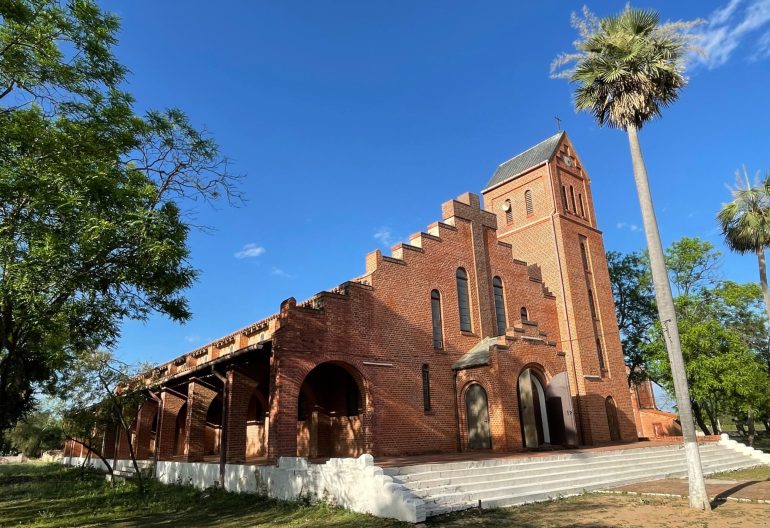

Paraguay’s National Secretariat of Culture (SNC) has officially declared the historic complex of the Apostolic Vicariate of Pilcomayo as a National Cultural Heritage Asset. Located in Mariscal José Félix Estigarribia in the department of Boquerón, 520 kilometres North-West of Asunción, this declaration aims to preserve one of the most significant sites in the religious and architectural history of the Paraguayan Chaco.
This important decision formalises the protection of a space that embodies decades of regional history. Consequently, the site now falls under a strict national preservation mandate, ensuring its conservation for years to come.
A protected historical ensemble
The official designation was established through SNC Resolution No. 394/2026. This measure formally incorporates a three-block area into the national heritage protection framework. Specifically, the protected ensemble includes the St. Michael the Archangel Church along with its associated annex buildings. Furthermore, it encompasses the San Miguel Róga Episcopal House and the workshops once used by the original Mennonite settlers in the region.
The declaration acknowledges the profound architectural, historical, and symbolic value of the vicariate complex. Constructed in 1956, the buildings are a remarkable example of mid-20th-century architecture in the Chaco. They retain many characteristic elements of the era, such as exposed brickwork, wide lateral galleries designed for ventilation, traditional gabled roofs, and distinctive semi-circular arches.
Centre of evangelisation and community life
Beyond its architectural merits, the site holds deep historical importance. It was a central hub for the evangelisation efforts led by the Missionary Oblates of Mary Immaculate (OMI) throughout the Central Chaco. These missionaries played a crucial role in establishing communities and providing social and spiritual support in a vast and often isolated territory. The vicariate therefore stands as a physical testament to this significant chapter of religious history in Paraguay.
The complex is also intrinsically linked to the legacy of Monsignor Pedro Shaw OMI. Known affectionately as Pa’i Puku (a Guarani term meaning ‘Tall Priest’), he dedicated his life to his mission in the region, beginning in 1952. Shaw later served as the apostolic vicar of Pilcomayo from 1981 until his death in 1984. His profound impact on the local community is honoured within the complex, as his remains are interred in the St. Michael the Archangel Church.
In addition, a Land Rover that Shaw used for his pastoral journeys across the rugged Chaco terrain is carefully preserved on the premises, serving as a connection to his extensive work and dedication.
Formalising protection for the future
The process to secure heritage status for the Pilcomayo Vicariate complex was initiated following a formal request submitted by Father Miguel Fritz OMI, who was serving as the apostolic administrator of the Pilcomayo Apostolic Vicariate at the time. In response to this request, the SNC’s Directorate of Cultural Assets undertook a thorough evaluation of the proposal. This process included detailed technical inspections of the buildings and a comprehensive assessment of the site’s unique heritage values. The final decision was therefore based on this expert analysis, which confirmed the site’s national importance.
With the approval of this resolution, the entire historical complex is now officially protected under the provisions of Law No. 5621/2016, the national legislation for the Protection of Cultural Heritage. This legal framework strengthens and supports ongoing actions to conserve the nation’s significant historical, architectural, and cultural assets. Consequently, the declaration ensures that the Apostolic Vicariate of Pilcomayo will be safeguarded as an irreplaceable part of Paraguay’s national identity and history for all future generations to appreciate and study.
Also read: Gems Of Faith And History: A Journey To The Soul Of Religious Tourism In Paraguay.