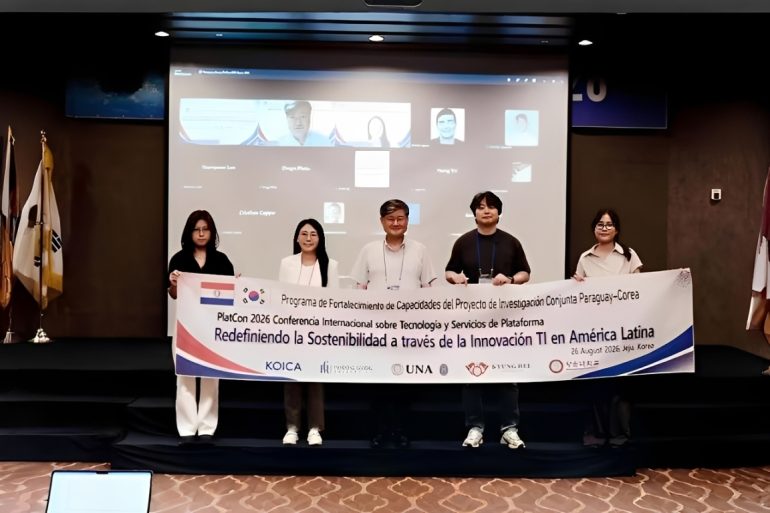

A Paraguayan-led AI research team received the Best Paper Award at the 2026 International Conference on Platform Technology and Service (PlatCon-26) in Jeju, South Korea. Their award-winning research explores how artificial intelligence can improve the classification of figurative elements found in trademarks. The paper, titled “Language-Aligned Fine-Tuning for Long-Tail Vienna Classification in an AI-Assisted Trademark Examination Platform”, addresses challenges involved in automatically identifying and classifying these visual elements.
The research forms part of a wider project developing an AI-assisted platform for Paraguay’s National Directorate of Intellectual Property (DINAPI). Financed by the Korea International Cooperation Agency (KOICA), the initiative is managed through the ICT Innovation Centre of the Facultad Politécnica of the National University of Asunción (FP-UNA). With a total budget of US$80,000, the project is expected to continue until March 2027 and aims to make DINAPI’s trademark classification and search process faster and more consistent.
Paraguay and South Korea collaboration
The research team includes Paraguayans Eduardo Cappiello Candia, Mirtha Balbuena, Diego Delpino, José Luis Vázquez Noguera, Luz Melinna Vázquez Benítez, Yandry Fernández Font, José Evaristo Ramírez Delvalle and Helena Gómez-Adorno. They worked alongside South Korean researchers Suhan Park, Yaesop Lee, Eun-Seong Kim and Nam-Young Kim as part of the international research collaboration. The wider project brings together FP-UNA, DINAPI, Paraguayan consultancy Sinergia Digital EAS and South Korea’s Kwangwoon University.
The Paraguayan researchers did not travel to South Korea for the conference. Eduardo Cappiello presented the research virtually, while the South Korean members attended the event in person. The award certificate recognises all 12 authors of the paper.
AI for trademark classification
The research focuses on the “long-tail” problem in machine learning, where some categories have significantly more training data than others. This creates a particular challenge for the Vienna Classification, which organises figurative elements found in trademarks through a standardised system. Administered by the World Intellectual Property Organization (WIPO), the system contains 29 categories, 145 divisions and 1,780 sections. However, some of its most specific categories have very few examples available for training artificial intelligence systems.
To address this challenge, the team used SigLIP2, an artificial intelligence model trained using pairs of images and text. Researchers tested the model using different training approaches to determine how effectively it could classify figurative elements found in trademarks. The best-performing approach placed the correct classification code among its first five suggestions in 90.5% of cases evaluated. The system could help DINAPI examiners identify relevant classifications more efficiently, while the final assessment remains in the hands of specialists.
Recognition and international visibility
The recognition highlights the potential of Paraguayan-led AI research to contribute to international technological projects. It also shows how international cooperation can address practical challenges faced by Paraguayan public institutions. The platform could eventually reduce some of the manual work involved in searching for and classifying figurative elements. Researchers have also suggested that similar technology could be useful for other intellectual property offices in the region facing the same challenges.
The Best Paper Award gives greater international visibility to research developed with Paraguayan participation. It also demonstrates how collaboration between Paraguay and South Korea can combine academic research with technological solutions designed for practical use.
Also read: Paraguay Moves To Pioneer Autonomous Aerial Spraying With New AI Initiative