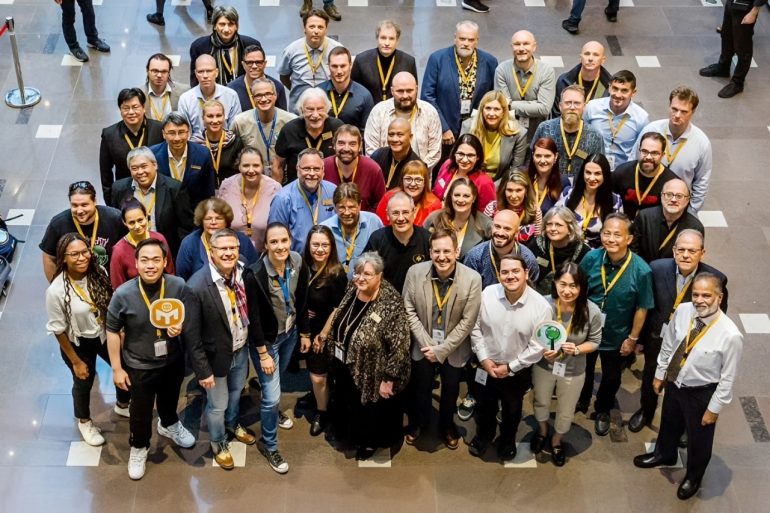

Paraguay has officially joined Mensa International, bringing one of the world’s most recognised intellectual organisations into the country’s growing cultural and educational landscape. Founded in the United Kingdom in 1946, Mensa is an international society open to people who score within the top 2% of recognised intelligence tests. However, organisers behind the Paraguayan chapter say the organisation is less about prestige and more about creating spaces for meaningful discussion, learning, and connection.
According to Alejandra Gavigan, Communications Manager of Mensa Paraguay, the launch responds to growing local interest in intellectually focused communities.
“The creation of Mensa Paraguay responds to a growing interest in intellectual community, and with the recent influx of people from all over the world, we believe now is the right time to create such a community.”

Mensa in Paraguay: Why now?
“For many years, Paraguayans and visitors interested in Mensa and intellectual activities in general had limited intellectually stimulating opportunities to participate locally,” Gavigan continues. “Establishing an official chapter creates a structured space for connection, dialogue, and intellectual exchange.”
“People are increasingly seeking communities built around curiosity, learning, and meaningful conversation rather than purely professional or social networking.”
Intelligence beyond a single measurement
Although Mensa is internationally associated with IQ testing, Gavigan stresses that the organisation does not claim to define every form of intelligence.
“Its admission criteria are specifically based on performance in standardised tests measuring certain cognitive abilities, particularly abstract reasoning and problem-solving. Human intelligence is clearly broader and more complex than any single metric. Creativity, emotional intelligence, social understanding, and practical wisdom are all important dimensions of human capability.”
She believes society’s understanding of intelligence continues evolving.
“What is evolving today is perhaps not the measurement itself, but society’s understanding that intelligence is multidimensional,” Gavigan adds.
How can I be part?
The admission process for Mensa Paraguay is based on a reasoning assessment rather than academic knowledge.
“The tests are designed to evaluate real-time reasoning ability rather than academic knowledge, meaning they do not require specialised educational preparation or prior study of specific subjects. It is more a way of getting to know yourself and exploring how you think.”
The assessments are carried out in person and in small supervised groups. Mensa Paraguay is currently organising upcoming sessions in Asunción on 13 May 2026 from 18:30 to 19:30 with sold-out slots, but two additional sessions on 23 May 2026 from 11:30 to 12:30 and from 15:30 to 16:30 have twenty available slots each.
One option costs ₲140,000 (approximately US$23) and includes the evaluation, supervision, and submission of results to Mensa International. A second option costs ₲250,000 (approximately US$41) and additionally includes a detailed report outlining percentile ranking, performance details, and interpretation of results. To reserve a slot, applicants must pay a non-refundable 50% deposit.
“One of the goals of Mensa Paraguay is precisely to make access to official testing more available locally, under fair and standardised conditions. Accessibility will be an important priority as the chapter develops.”
Responding to criticism and concerns about elitism
“It is an understandable concern, and one we take seriously. A high score on a cognitive test does not make someone more valuable, more ethical, or more important than others. Mensa recognises a specific type of cognitive performance, not human worth. One of the core principles behind Mensa was to build a society that transcended social class, nationality, religion, and political background. The intention is not exclusion, but community among people who often experience similar cognitive styles or interests.”
Gavigan compares the organisation to other interest-based communities. “It offers a place of belonging, similar to how sports clubs allow people with shared interests to connect.”
The Paraguayan chapter also recognises the country’s educational inequalities and says inclusivity must remain central to its development.
“A core principle of standardised intelligence testing is that it aims to evaluate reasoning ability independently of formal educational achievement as much as possible. At the same time, we recognise that social and educational inequalities can affect confidence, access to information, and opportunities. That is why transparency, accessibility, and responsible communication will be essential in how Mensa Paraguay develops locally.”
Building a community around curiosity
Initially, Mensa Paraguay plans to focus on community-building through informal gatherings, cultural activities, presentations, and discussion groups.
“Many members describe the value of being able to engage in conversations, projects, and activities with people who share curiosity and a love of learning. Beyond networking, Mensa communities around the world organise lectures, debates, cultural events, special-interest groups, and social gatherings. The Paraguayan chapter hopes to foster both intellectual stimulation and genuine human connection.”
Over time, organisers hope to expand into thematic activities covering science, literature, philosophy, psychology, and technology.
“The intention is for the community to be socially welcoming as well as intellectually engaging. We have seen curiosity from students, professionals, academics, entrepreneurs, creatives, and individuals simply interested in intellectual exchange. One common pattern is that many people are not necessarily seeking prestige, but rather spaces where curiosity and deep conversation are genuinely valued.”
Welcome opportunities for collaboration
“In the long term, we would certainly welcome opportunities for collaboration with educational and academic institutions. Future collaborations could include educational outreach, talks, or initiatives related to cognitive diversity, talent development, and critical thinking.”
Looking ahead, Gavigan believes Mensa International in Paraguay could contribute positively to the country’s intellectual and educational landscape over the coming decade.
“Over time, Mensa Paraguay could become a space that connects people across disciplines and backgrounds through shared curiosity, something that can positively enrich the country’s intellectual ecosystem.”
To reserve a slot, visit the official Mensa Paraguay website or contact them through their official WhatsApp account.