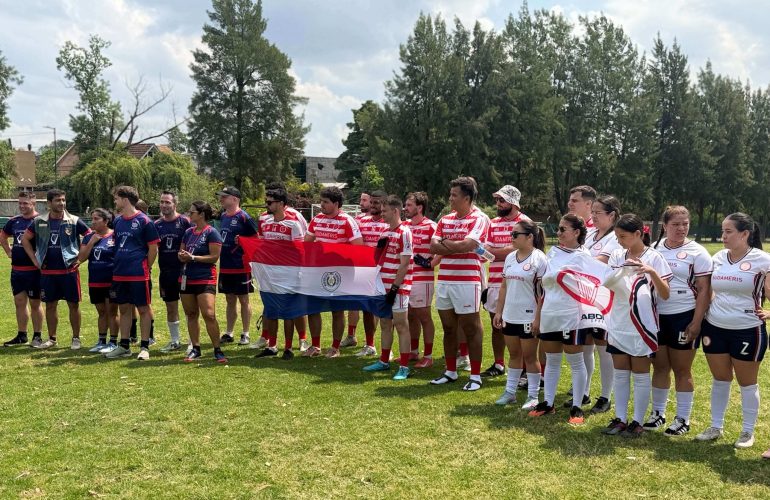

Paraguay’s Las Arpas GAA has secured official affiliation approval from the World GAA Council, becoming one of five South American Gaelic Football clubs across four countries to achieve this milestone. The recognition follows close support from World GAA on governance, structures and development, and pairs the club with Ulster GAA as its twinning partner for future coaching, expertise-sharing and stronger Ireland-South America links.
World GAA Chairman Ciarán McLaughlin praised the passion and perseverance of volunteers at clubs such as Las Arpas, noting that their efforts are expanding participation, building communities and laying foundations for further growth, including possible tournaments from 2027.
A successful outing at the Copa Almirante Brown
After the club’s approval, Paraguay’s Las Arpas teams returned from Buenos Aires this week with two divisional titles and a third-place finish after a successful outing at the Copa Almirante Brown on Saturday, 14 November 2026.
Competing against sides from across Latin America and Ireland, Las Arpas fielded two men’s teams, Azul and Rojo, alongside a women’s team at CASI – Boya 1 in San Isidro. Las Arpas divided its men’s squad into two teams, with the younger, faster players forming Azul and the older, more experienced players making up Rojo. The tournament brought together 12 men’s teams and six women’s teams, with matches played simultaneously across two pitches in bright, sunny conditions.
Although none of the Paraguayan sides claimed the tournament’s highest-ranked trophies, all three reached a division final or third-place play-off, with the women’s team and Las Arpas Rojo finishing their campaigns as divisional champions.
Paraguay’s Las Arpas Azul take seventh place
Azul began their campaign in Group A against Buenos Aires-based Limerick 2, securing an 8-6 victory. Their opening performance impressed team representative Andrew Kaminsky, who praised the players’ coordination and pace: “They played great; they were fast and connected. The team has practiced a lot together and worked really well together.”
Their second group match against San Isidro Gaélico proved considerably tighter. In a back-and-forth contest, Azul narrowly lost 9-8 after their opponents scored on the final play.
Finishing second in their group sent Azul into the Foxford trophy competition. The team faced Los Andes and Bogotá Beithig, a combined side representing players from Chile and Colombia, in the semi-final. After a goalless first half, Azul eventually lost 3-1.
The Paraguayan side then moved into the third-place play-off, where they faced Bulfin, an Irish team based in Buenos Aires. Bulfin draws on a rotating group of Irish players who spend time in Argentina, bringing considerable experience from a country where Gaelic football is widely played.
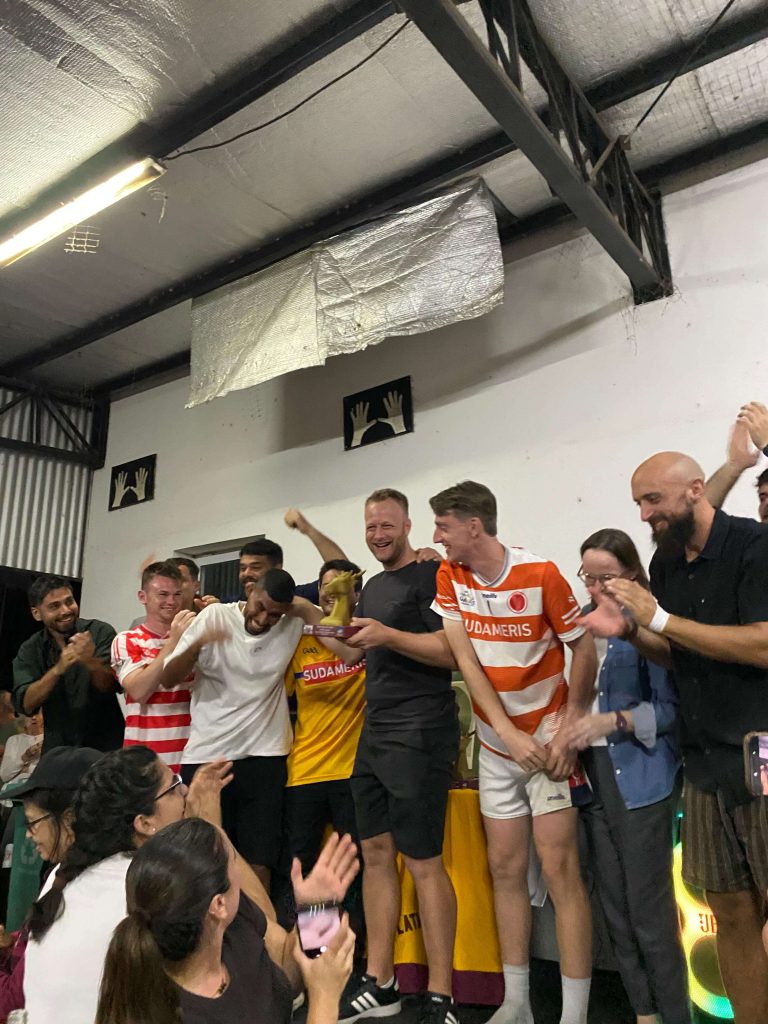
Azul responded with one of their strongest performances of the day, winning 6-3 to secure seventh place overall. The victory was a particularly significant result for Las Arpas, with the Paraguayan players overcoming a side whose players benefited from a strong connection to the sport’s traditional home.
Rojo recover to claim the Buenos Aires Gaelic trophy
Las Arpas Rojo faced a more difficult route through the group stage, drawing strong challengers, the experienced Bulfin and Hurling Club 1 in Group D. Their opening match ended in a 7-0 defeat to Bulfin, followed by a 7-1 loss against Hurling Club, who went on to win the tournament’s highest men’s trophy.
The results left Rojo third in their group and sent them into the Buenos Aires trophy competition. The team had entered the tournament without several important players, making it difficult to establish the same level of coordination they had developed during training.
Two notable absences were Jack Canning, one of the team’s leading players, who suffered an injury during training in Paraguay the week before the competition, and Joel Candia, another key Paraguayan player, who had injured his knee approximately a month earlier.
“We had a few newer players, and although we have played together a lot in the past, there were some recent changes. Some players could not make it to the tournament, others got injured the week before the tournament,” Kaminsky explained. “As this newly formed team, Rojo, we did not have a lot of experience playing together, and I think that was probably our downfall.”
The team nevertheless recovered in the knockout rounds. They defeated CASI 17-6 in the semi-final before facing Limerick 2 in the final, the same side that had opened Azul’s tournament campaign. Rojo produced a convincing 15-5 victory to claim the Buenos Aires trophy. The result gave Paraguay’s two men’s teams successful conclusions to the day, with Azul taking seventh place and Rojo finishing ninth as C-Group divisional champions.
Women’s team finish third overall
The women’s competition proved another highlight for Paraguay, with Las Arpas producing two victories from their three matches and finishing third overall. Their campaign began against Limerick, whom they defeated 9-0 in an impressive opening performance. “They were fantastic. They played incredibly and were the stars of the tournament, from Paraguay’s perspective,” Kaminsky said.
Their second group-stage opponent was Hurling Club 1, an exceptionally strong side that had represented Argentina at the World Games in Ireland, finishing second in its division after losing in the final. Las Arpas struggled to contain their opponents’ attacking pressure, eventually losing 16–0.
Despite the score, Kaminsky felt the match was more competitive than the result suggested. “It was just wave after wave of attack. The girls still played well, they fought so hard. I know the score does not show it, but it felt a lot closer. They had opportunities, they just could not capitalise on them, and when Hurling had opportunities, they buried them.”
The defeat left Paraguay second in Group B and sent the team directly into the Foxford Trophy final, with no semi-final required in the six-team women’s competition. There, they faced Combinado Sudamérica, a side bringing together players from different South American countries. The final proved a much closer contest, with the teams exchanging attacks throughout the match. Las Arpas eventually emerged with a 9-7 victory, securing the Foxford trophy and third place in the overall women’s standings.
A promising result for Paraguayan Gaelic football
The Copa Almirante Brown marked another step forward for Paraguay’s growing Gaelic football community. Having expanded from one men’s team and a combined women’s side in 2025 to three independent teams this year, Las Arpas demonstrated its increasing ability to compete against established sides from across the region.
The results in Buenos Aires also highlighted the different stages of development within the club. Azul’s victory over Bulfin demonstrated the competitiveness of its younger squad, while Rojo’s recovery from two group-stage defeats showed its ability to respond to a difficult start. The women’s team, meanwhile, delivered Paraguay’s strongest overall finish.