
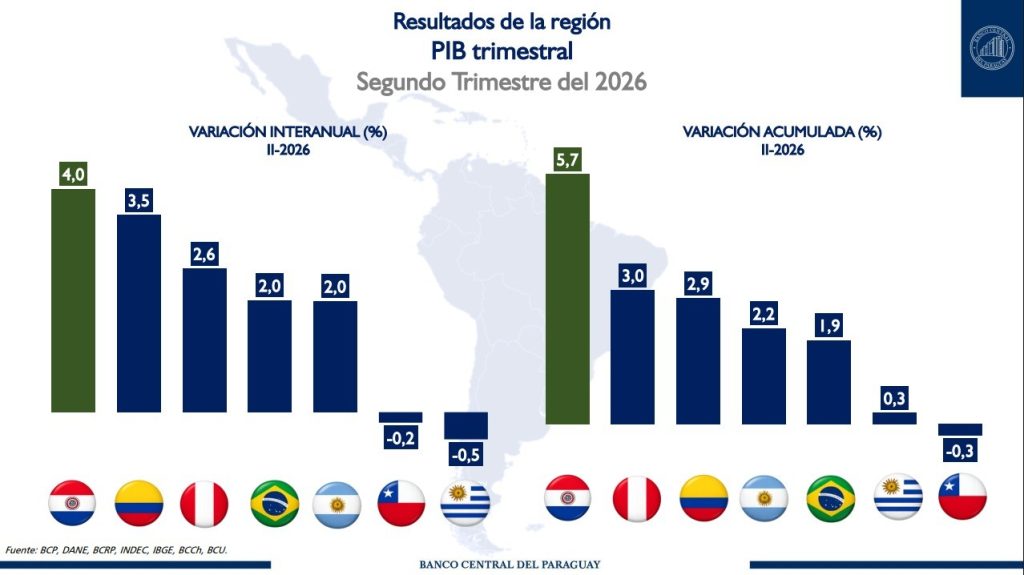
Paraguay enters the final quarter of 2026 after recording the strongest first-half economic growth among the South American economies compared by the Central Bank of Paraguay (BCP). Gross domestic product (GDP) expanded by 5.7% during the first six months of the year, supported by agriculture, services, energy and construction.
The result placed Paraguay ahead of Peru (3%), Colombia (2.9%), Argentina (2.2%), Brazil (1.9%) and Uruguay (0.3%). However, figures published by the BCP on 25 September 2026 also show signs of slowing momentum. Economic growth eased from 7.3% year-on-year in the first quarter to 4.0% in the second.
Growth eases in the second quarter
The 5.7% first-half figure combines two notably different quarters. GDP grew by 7.3% year-on-year in the first quarter, a figure revised upwards from an earlier estimate of 5.8%. Growth then slowed to 4.0% in the second quarter as several sectors lost momentum. Stripping out agriculture and the binational hydroelectric dams Paraguay shares with Brazil and Argentina, GDP still rose by 5.2% over the semester.
The second-quarter slowdown provides important context as Paraguay begins the final three months of 2026. Despite losing some momentum, the economy maintained positive growth across several major areas during the first half.
Agriculture leads, livestock lags
Agriculture was the standout performer, expanding by 12.3% over the first half of the year. The BCP attributed the surge largely to a bumper soybean harvest, one of Paraguay’s main sources of export earnings. Output of rice, beans, sunflower and tobacco also increased during the period. Lower estimated production of maize, cotton, sesame and yerba mate partly offset those gains.
Livestock, forestry, fishing and mining told a different story. The sector grew by 2.4% in the first quarter before contracting by 4.1% in the second, leaving it down by 0.9% for the semester. The BCP linked the reversal to farmers rebuilding their cattle herds, which reduced the number of animals sent to slaughter. Pig and poultry slaughter increased over the same period, alongside higher production of raw milk and eggs.
Construction, energy and services also grow
Growth elsewhere was broad-based, although only one major sector gathered pace during the second quarter. Manufacturing expanded by 4% over the semester, while construction grew by 4.9%. Electricity and water production, which includes the binational hydroelectric dams, accelerated significantly during the second quarter. Growth increased from 4.7% in the first quarter to 13% in the second, bringing first-half expansion to 8.5%.
The BCP linked the stronger performance partly to higher demand from energy-intensive industries. Services, the largest component of Paraguay’s economy, grew by 5.7% over the semester, while taxes on products increased by 3.7%. Financial intermediation, government services, telecommunications, real estate, restaurants, hotels and trade were among the main contributors. Transport recorded a negative result.
Investment falls even as exports rise
The picture was more mixed when looking at how money was spent across the economy. Domestic demand fell by 2.6% in the second quarter, reversing a 6.6% expansion during the first three months of 2026. Gross capital formation, a measure that includes investment in machinery, equipment and construction, dropped by 18.2%. Fixed investment declined by 11.8%, mainly because of lower imports of machinery, vehicles and equipment linked to cryptocurrency mining and aircraft.
Higher investment in construction and agricultural, forestry and industrial machinery partly offset the decline. Private consumption still grew by 3.2%, while government consumption increased by 6.2%. Exports of goods and services rose by 11.5% in the second quarter and 8.2% over the semester. The figures come as Paraguay experiences a broader wave of foreign investment extending beyond agriculture. Imports, meanwhile, fell by 5.7% during the second quarter and 1.4% across the first six months.
What to expect now Paraguay enters Q4 of 2026
Paraguay now enters the final quarter with forecasts pointing towards continued economic expansion, although at a slower pace than the first-half figure suggests. In September, the International Monetary Fund (IMF) concluded its 2026 Article IV consultation with Paraguay, its regular assessment of the country’s economy and policies. The Fund projected economic growth of 4.4% for 2026 as a whole, following an expansion of 6.6% in 2025. The IMF expects growth to eventually move towards a medium-term potential rate of around 3.8%. It also highlighted Paraguay’s economic resilience while noting the importance of continued fiscal consolidation.
The BCP has similarly become more optimistic about the country’s performance during 2026. In July, it raised its full-year economic growth forecast from 4.2% to 4.5%, citing record agricultural production. The central bank also lowered its inflation forecast to 3.3%, while identifying adverse weather, weaker global growth and international conflicts among the risks facing the economy.
With three months remaining in 2026, Paraguay therefore begins the final quarter from a position of strong first-half growth. The coming months will show how much of that momentum can continue after the slower second-quarter performance.