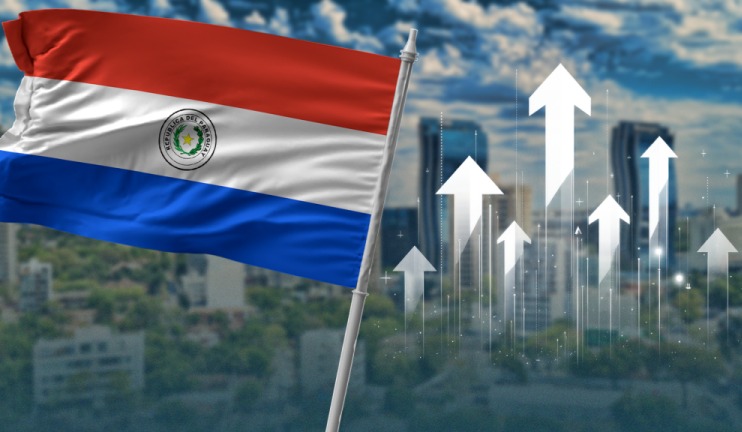

Paraguay is drawing foreign capital into a wider range of industries, led by real estate, commerce, transport and telecommunications. The trend is documented in a new study by the Central Bank of Paraguay (BCP) and the Latin American Reserve Fund (FLAR), which tracked foreign direct investment (FDI) between 2008 and 2024. The new foreign investment wave in Paraguay findings are reinforced by separate United Nations data showing one of the region’s strongest FDI increases in 2025. Together, the findings offer one of the clearest pictures yet of how Paraguay foreign investment has evolved over nearly two decades.
A widening circle of investors
According to the BCP-FLAR study, Paraguay received an annual average of US$590 million in direct investment between 2008 and 2024, equivalent to 1.6% of gross domestic product. The number of countries investing directly in Paraguay also grew, from 39 in 2008 to 68 in 2024. As a result, the country now relies less on any single trading partner, a shift The Asunción Times has tracked closely.
Non-financial services, covering trade, telecommunications, transport, real estate and data processing, led the way. The category captured around US$4.4 billion in net flows over the period, or 44% of the total, with an average return of 15% and the highest number of foreign-owned companies of any sector. Manufacturing followed with 26% of flows, financial services with 20%, and the primary sector, covering cattle ranching, forestry and agriculture, with 10%.
Manufacturing and financial services also expand
Manufacturing drew close to US$2.64 billion in direct investment over the period, the study found, spread across meat processing, oil production, pharmaceuticals, chemicals and car parts. The sector also showed a growing export orientation, with average annual foreign sales of roughly US$2.7 billion.
The number of manufacturing companies with direct foreign investment rose from 44 to 192 between 2008 and 2024, doubling in just the four years to 2016. Together, these companies accumulated close to US$1 billion in net flows.
Financial services, meanwhile, proved the most profitable segment overall. Investment in banks, finance companies, insurers and related intermediation activities totalled around US$1.96 billion, according to the study, generating an average return of close to 20% and a net margin of 28% in 2024.
Telecommunications drive a strong 2025
The trend towards diversification was reinforced in 2025, according to the World Investment Report 2026, published by the United Nations Conference on Trade and Development (UNCTAD). Paraguay and Bolivia together recorded a 40% increase in FDI inflows that year, a notable performance for two landlocked economies, which typically find it harder to attract foreign capital than countries with direct sea access.
UNCTAD singled out more than US$540 million in new “greenfield” telecommunications projects in Paraguay, meaning entirely new investments rather than expansions of existing ones. The report linked this growth to the availability of abundant, low-cost hydroelectric power, a resource that has become increasingly attractive to data-intensive industries. Among landlocked developing economies more broadly, UNCTAD found that investment tended to concentrate in renewable energy, infrastructure, logistics, mining and telecommunications.
Foreign investment wave in Paraguay: Part of a larger regional recovery
The improvement in Paraguay formed part of a wider, if uneven, recovery in global investment flows. Worldwide FDI rose by 6% in 2025 to reach US$1,624 billion, UNCTAD reported. Developed economies received US$723 billion, up 11% on the previous year, though this remained 13% below their 15-year average. Flows to developing economies grew more modestly, by 2%, to surpass US$901 billion, yet still sat 23% above their own long-term average.
Latin America and the Caribbean performed comparatively well, with flows to the region rising by 14% to roughly US$188 billion in 2025, excluding offshore financial centres in the Caribbean. Brazil led the region with a 23% increase in inflows and remained its top destination overall. Chile continued to draw significant investment in energy and mining, while Peru doubled its FDI inflows during the year. Paraguay’s own inflows have topped US$1 billion for three consecutive years, according to separate data from the Economic Commission for Latin America and the Caribbean (ECLAC).
What the numbers mean for foreign investment in Paraguay
UNCTAD noted that the outlook for Latin America and the Caribbean will depend on how well countries convert advantages such as natural resources and shifting global supply chains into steadier, more diversified investment flows. For Paraguay, the BCP-FLAR findings suggest that process is already under way, with real estate, commerce, transport, telecommunications and manufacturing now sharing a load once carried mainly by agriculture. In Asunción, that trend has coincided with a construction boom and record levels of approved projects.
The study credited institutional reforms with helping Paraguay build this capacity to attract capital, while cautioning that challenges remain around infrastructure, legal certainty and institutional efficiency. Addressing these, it concluded, would help channel foreign investment into wider economic growth and export gains for Paraguay.