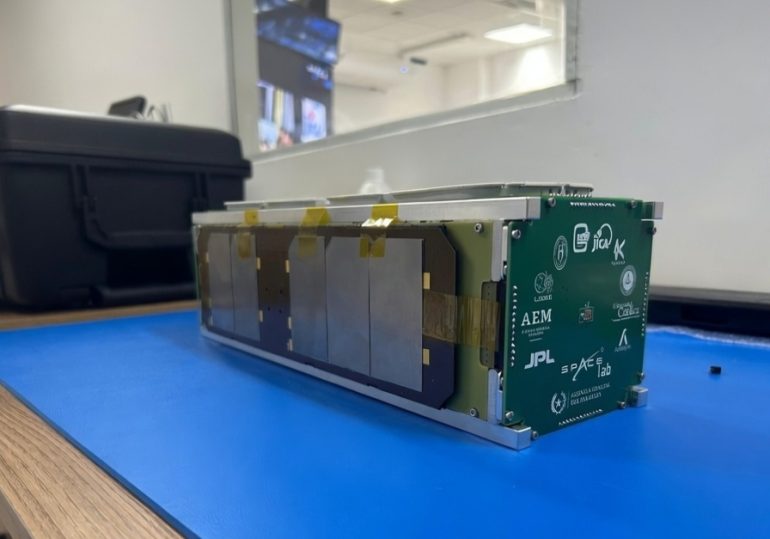

GuaraníSat-2, Paraguay’s second satellite and the first to be constructed entirely within the country, is now ready for transport to the United States. There, it will be integrated into the rocket scheduled to carry it into space. Adolfo Jara, the Director General of Planning and Management at the Paraguayan Space Agency (AEP), confirmed GuaraníSat-2 is ready for launch during an interview with state media.
Jara explained that GuaraníSat-2 represents a purely Paraguayan development, led by the AEP and bolstered by both national and international cooperation. The project is the culmination of three years of dedicated work, from its initial conception to its current pre-launch integration phase. Last year, Paraguay’s GuaraníSat-2 satellite successfully passed critical tests in Japan.
Transferring skills to a new generation
The development team for GuaraníSat-2 comprises more than 40 individuals. This group includes a mix of students and professionals from both Paraguay and abroad. Jara highlighted that the team is composed mainly of young people between the ages of 18 and 25, who are mostly university students working alongside professionals from the Paraguayan Space Agency.
He recalled that the challenge to develop a satellite entirely in Paraguay emerged following the return of the first group of Paraguayan professionals who travelled to Japan for training in 2022. Consequently, the knowledge they acquired is now being actively transferred to a new generation of professionals within the country, fostering a sustainable domestic space programme.
Scientific and academic missions
Once in orbit, GuaraníSat-2 will conduct a series of scientific and academic missions. One of its primary objectives is to study the anomaly in the Earth’s magnetic field, a mission developed by the Faculty of Engineering at the National University of Asunción (UNA). The satellite will also provide services to the amateur radio community by sending messages and data packets that can be retransmitted and stored for later download.
In addition, the satellite is equipped with a camera to capture images of the Earth. The processing and classification of these images will be managed by a Snapdragon coprocessor. This technology belongs to the same family of chips that NASA utilises in its exploration vehicles on Mars. Jara explained that the mission selection followed a rigorous process known as the Mission Definition Review, which analysed national and international needs to determine the satellite’s final objectives.
GuaraníSat-2 ready for launch countdown
A press conference is scheduled for 14 August, 2026, at the Luis Verganza Hall of CONACYT to provide further details. Following this, on 16 August, the team will travel to the United States to begin the integration of the satellite with the Deployer. This device is responsible for placing the satellite into orbit once the rocket reaches space.
The launch is currently planned for early October, although the final date is subject to environmental conditions. Jara provided this timeline while outlining the final steps before the historic mission begins.
Building a future in space technology
While preparations for the GuaraníSat-2 launch are underway, the AEP is already looking to the future. Work has reportedly started on GuaraníSat-3 and on the construction of dedicated satellite development and integration laboratories in Paraguay. A law was recently enacted to facilitate a donation of approximately US$24 million from the Government of Japan, via JICA, for the construction of these facilities.
The new laboratories will be located at Campus 2 of the National University of Asunción. These state-of-the-art spaces will enable environmental tests, which are currently conducted in other countries, to be performed in Paraguay. Eventually, these services could also be offered to other nations in the region. Jara noted that the campus is an ideal environment for this technological centre, due to the presence of students, academics, researchers, and other important national institutions.
From utopia to reality
The GuaraníSat-2 project has already had a significant impact, allowing Paraguayan students to produce thesis papers and participate in international congresses on nanosatellites. This demonstrates the project’s success in fostering academic and professional growth.
“Space is no longer a utopia for our country, it is now a reality,” Jara concluded by emphasising the extensive work that has been undertaken to ensure Paraguay becomes an active member of the international space ecosystem, marking a new era of technological achievement for the nation.
A project of national and international collaboration
On a national level, the GuaraníSat-2 ready for launch project has involved students and professionals from several key institutions. These include the Faculty of Engineering and the Polytechnic Faculty of the National University of Asunción (UNA). Additionally, the Catholic University Nuestra Señora de la Asunción (UCA) and the Paraguayan-German University (UPP) have also contributed significantly to the satellite’s development.
Internationally, the AEP has collaborated with a number of prestigious organisations. Jara mentioned the participation of NASA’s Jet Propulsion Laboratory, the Mexican Space Agency, and the National Autonomous University of Mexico. Furthermore, an Italian company and Japan, through the Kyushu Institute of Technology and with cooperation from JICA, have provided crucial support to the programme.