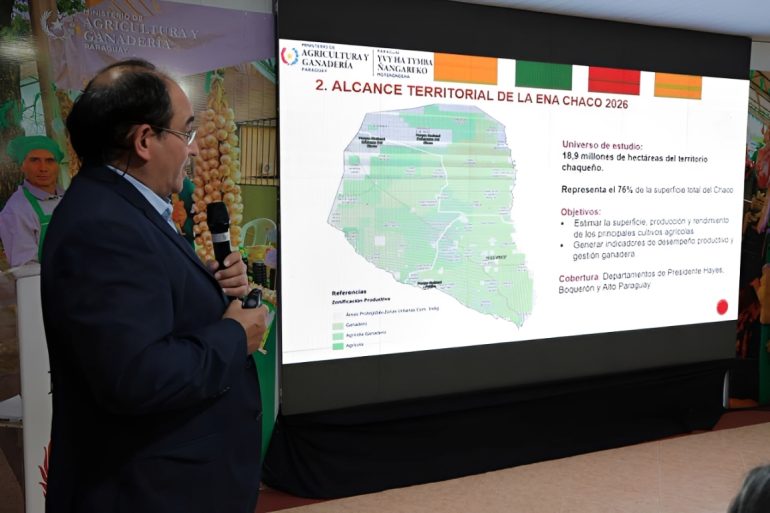

Boquerón has been identified as the department with the strongest livestock management in Paraguay, according to the 2026 National Agricultural Survey of the Chaco (ENA). The survey also found that agriculture now covers around 350,000 hectares across the Chaco, reflecting steady growth alongside the region’s dominant livestock sector.
The findings were presented by Anselmo Maciel, Director of Agricultural Censuses and Statistics at the Ministry of Agriculture and Livestock (MAG), who said the data will support public policies aimed at strengthening sustainable agricultural and livestock production in Paraguay’s Western Region.
Survey covers five million hectares
The ENA surveyed agricultural activity across the departments of Boquerón, Alto Paraguay, and Presidente Hayes, covering a sample of five million hectares. According to the ministry, agricultural and livestock production currently takes place on around 18 million of the Chaco’s 24 million hectares.
Fieldwork was carried out during March and April 2026. The survey used the 2024/2025 production cycle as the reference period for livestock and the 2025/2026 cycle for crop production. Maciel says livestock remains the Chaco’s principal productive activity, although agriculture continues to diversify with the expansion of commercial crops.
Boquerón outperforms other departments
According to the survey, Boquerón recorded the best livestock management indicators, both for breeding and beef production. Alto Paraguay ranked second, specialising mainly in beef production but showing greater variation between producers. Presidente Hayes recorded slightly lower performance indicators than the other two departments. The survey also highlighted the continued expansion of agriculture across the Chaco. Around 350,000 hectares are currently under cultivation, with crop production increasingly complementing livestock farming rather than replacing it.
Other crops
Among the most notable findings was the continued growth of soybean cultivation. Survey data identified approximately 150,000 hectares of soybeans, with production shifting from experimental and animal feed uses towards commercial sales. Alto Paraguay recorded yields comparable to those in Paraguay’s Eastern Region, while soybean production has also become significant in the Central Chaco.
Maize cultivation now covers around 50,000 hectares, divided equally between grain production and animal feed. Cotton occupies approximately 30,000 hectares, representing a 50% decline compared with the previous year. Sorghum accounts for a further 20,000 hectares, mainly for livestock feed, while peanuts and beans remain important agricultural crops.
More than 1,200 livestock establishments were visited during the survey. Around 950 producers had sufficient records to provide detailed information through an electronic questionnaire containing nearly 600 variables. Survey teams used mobile devices to georeference and map agricultural plots, improving the accuracy and consistency of the data collected. The operation involved approximately 130 field staff, including surveyors, supervisors, technical support personnel, and coordinators.
Also read: Paraguayan Meat Exports Surpass US$1.1 Billion In First Half Of 2026.