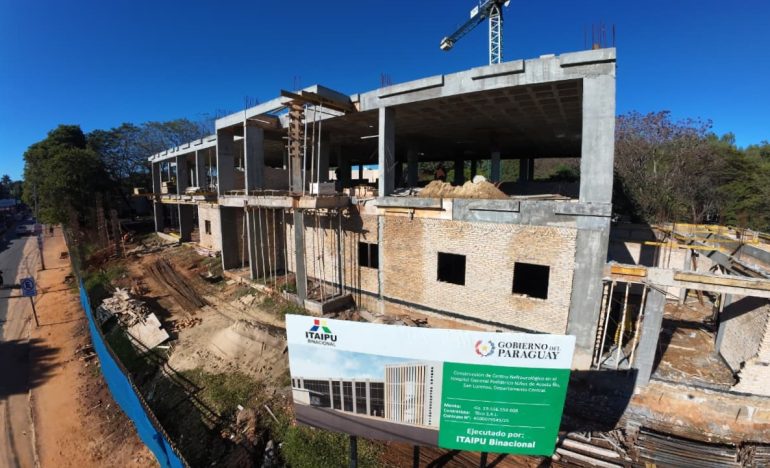

The Itaipu Binacional Entity is, according to officials, financing one of Paraguay’s most significant public health projects in recent years with the construction of the country’s first Paediatric Nephro-urology Centre. The facility is being built at the Niños de Acosta Ñu General Paediatric Hospital in San Lorenzo, backed by an investment exceeding ₲19,500 million (approximately US$ 3,2 million. This specialised establishment will become the first of its kind in Paraguay dedicated exclusively to the care of children with kidney and urinary tract conditions.
The construction, which is being carried out by the company TECO S.R.L., covers a 2,051-square-metre block. Work commenced in May 2025 and is scheduled for a 720-day execution period. Currently, the project is in the reinforced concrete structure phase and has achieved a progress rate of between 25 and 30 percent.
A landmark project for paediatric care
Officials have emphasised the unique nature of this facility and its potential to transform specialised care for young patients across the nation. Fabricio Guex, an engineer from Itaipu’s Coordination Directorate, highlighted the project’s importance.
Guex noted that while the current structural phase is the most time-consuming part of the construction process, more visible advancements will follow shortly as the building’s framework is consolidated. This foundational work is crucial for establishing a state-of-the-art medical facility designed to meet the specific needs of children.
Comprehensive facilities and patient capacity
The new centre is designed to provide a wide range of specialised services. The ground floor will house facilities for haemodialysis for chronic patients, along with dedicated areas for treating acute and infected patients requiring the procedure. Furthermore, it will feature rooms for peritoneal dialysis training and procedures, including automated peritoneal dialysis. The facility will also include an on-site laboratory and a Urodynamic Studies tower, which will be the only one of its kind in the country.
The second floor of the building will contain 10 outpatient clinics for related specialities, in addition to administrative areas and spaces for postgraduate medical training. This integrated approach ensures that the centre will not only provide direct patient care but also serve as a hub for professional development and research in paediatric nephro-urology.
Anticipated impact on early diagnosis and treatment
The centre is expected to significantly increase the capacity for specialised care. Doctor Miguel Franco, a leading nephrologist at the paediatric hospital and the future centre, provided projections on patient volume.
It is estimated that the centre will attend to about 15 patients daily in dialysis sessions and 30 in peritoneal dialysis. In total, about 130 patients are anticipated daily in the outpatient clinics, alleviating a historical need in the nephro-urological area and trying to ensure that patients access early care with these specialities.
Franco emphasised that by addressing a long-standing gap in the healthcare system, the facility will enable children to receive prompt and specialised attention. This focus on early intervention is critical for managing chronic conditions and improving long-term health outcomes for young patients.
Ensuring international standards and operational resilience
From a technical standpoint, the project incorporates international hospital standards to guarantee safety and quality. Engineer Ernesto Imás, also from the Itaipu Coordination Directorate, detailed the robustness of the planned infrastructure. He explained that a dedicated electrical system, complete with its own transformer and generator, will ensure uninterrupted service.
Imás pointed out that this means “100 percent of the services that form part of this centre will always be operational,” even during power cuts on the main grid. This resilience is vital for life-sustaining treatments. Additional advanced systems include a reverse osmosis water treatment system for haemodialysis and haemodiafiltration, a medical gas supply, hospital-standard climate control, and protection against atmospheric discharges.
A strategic initiative to decentralise healthcare
This project is part of a broader strategy by the Itaipu Binacional Entity to decentralise specialised medical services and improve access for people throughout the country. Imás recalled the organisation’s experience with similar ventures, noting that Itaipu supported the installation of water treatment plants for dialysis at the Santa Rosa del Aguaray Hospital.
More recently, the entity inaugurated the nephrology centre at the Hernandarias Hospital in Alto Paraná. He stated that the logic behind this initiative is to bring essential, specialised care closer to those who need it most. By establishing advanced facilities outside of the capital, the strategy aims to reduce the travel burden on families and ensure that more patients can receive timely, high-quality treatment within their own regions.
Also read: Your Guide To Hospitals And Medical Care In The Asunción Metropolitan Area.