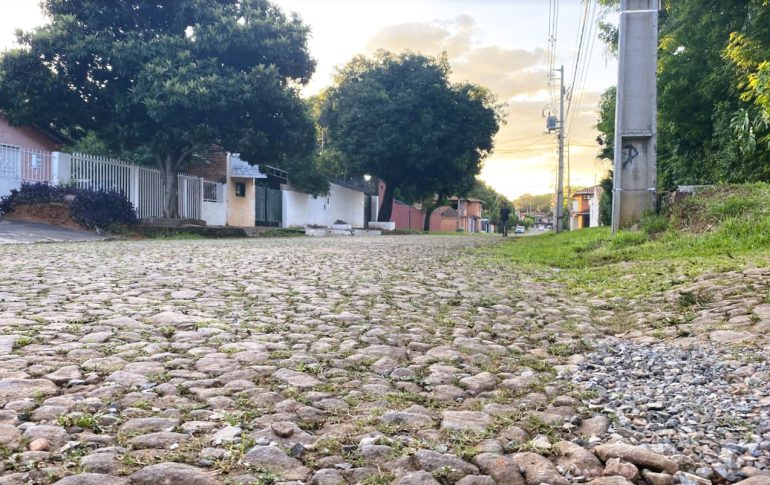

Walking along Paraguay’s cobblestone streets is often done without realising that centuries of history lie beneath each stone. It is not just about infrastructure, but also about social processes, political decisions, armed conflicts, technical knowledge, and a profound relationship between the land and its inhabitants. The cobblestone streets in Paraguay that support daily traffic today are also silent archives of the past.
Early use of stone in Paraguay
Historian Eduardo Ortiz Mereles places the earliest references to the use of stone in Paraguay at the very beginning of the Jesuit reductions. The extensive use of red sandstone from the Misiones Formation for paving, construction materials, and religious art dates back to the founding of San Ignacio Guazú in 1609 by Fathers Marcial de Lorenzana and Francisco de San Martín. From then on, stone began to be integrated into the daily life of the region.
For centuries, travelling across Paraguay was a complex undertaking. The dirt roads became impassable after rain, covered in mud and mire, a situation that, according to Ortiz Mereles in conversation with state media, is still visible in many rural areas. In those early times, journeys were made on foot, generally barefoot, on horseback, on mules, or in carts pulled by teams of oxen. Among hills, streams, lagoons, marshes, and rivers, travellers sought the most accessible routes, and thus the ancient Guaraní trails, true forerunners of today’s roads, were laid out.
These roads served not only a practical but also an economic function. They facilitated trade between cities and towns. Some of the most important ones acquired the status of “royal roads,” although, as Ortiz Mereles clarifies, probably no monarch ever travelled along them in Paraguayan territory.
Urban stone paving in the 19th century
Urban stone paving became more prevalent in the 19th century. According to historical records cited by Ortiz Mereles and historian Luis Verón, the first city with cobblestone paving was Villa Occidental (present-day Villa Hayes) in 1872. The cobblestone road connected the Paraguay River with the present-day Governorate of Presidente Hayes, within the context of the Argentine occupation of the Chaco region, which lasted until 1879, that is, before the Hayes Award of 1878.
That same year, paving work began in Asunción, linked to the quarrying of Tacumbú Hill, located near the present-day Sajonia neighbourhood. The work was carried out by companies holding concessions for the first tram service. The stones were reportedly supplied by Francisco Terlizzi, who had a quarrying permit granted by the government of Salvador Jovellanos (1871–1874).
From a geological perspective, Darío Gómez Duarte explains that Tacumbú Hill belongs to a group of volcanic rocks with prismatic structures, commercially known as basalts and scientifically classified as basanites, formed by the extrusion of lava that cooled rapidly. This characteristic facilitated its manual fragmentation and arrangement into cobblestones, which was a key reason for its use as paving material.
A remarkable diversity of rocks
Gómez Duarte further details that Paraguayan cobblestones utilise a remarkable diversity of rocks:
- Highly consolidated sandstones from Emboscada;
- Flagstones from Itacurubí;
- Red sandstones and flagstones from Carro Cachimbo in Caaguazú;
- Basalts and diabases from the Alto Paraná Formation;
- Crystalline igneous rocks from Pirayú, Sapucái, Quiindy, Caapucú, and other hills;
- Metamorphic quartzites from Itayurú, in Misiones.
These stones represent virtually all ages of geological time, from the Precambrian to the Cenozoic.
In cities like Areguá, Luque, and Capiatá, columnar sandstones from the Kói and Chororí hills were used, identified in older literature as “pseudotrachytes.” According to the geologist, the fundamental conditions for using these rocks as paving stones were their resistance to weathering, wear, and compression, as well as their ease of fragmentation into nearly cubic blocks.
The role of Bolivian prisoners in the Chaco War
A particular chapter of this story unfolds during the Chaco War (1932–1935). Ortiz Mereles and Gómez Duarte agree that, during and after the conflict, cobblestone roads were built using the labour of Bolivian prisoners. In Pirayú, this road is known as “Empedrado Bolí,” while in Sapucái it is called “Tape Bolí.”
Historian Claudio Velázquez Llano contextualises this process: after victories such as those at Campo Vía and Yrendagüé, Paraguay found itself with a large number of Bolivian prisoners. Some were assigned to families as domestic or rural servants, and others were put to work on road construction. In Pirayú, this construction took place toward the end of the war, since the prisoners’ return to Bolivia was delayed for more than a year and was part of negotiations that included financial compensation to Paraguay for their upkeep.
Ortiz Mereles explains that the term “Bolí” originated as a popular shortening of “boliviano” (Bolivian) and that, over time, it acquired a symbolic and even mocking connotation in everyday speech. However, beyond the name, these cobblestone streets fulfilled a key function within the road system: facilitating pedestrian, cart, and early automobile traffic, reducing dust during dry seasons and mud during rainy periods, and preventing soil deterioration at low cost.
Development, heritage, and preservation
In the following decades, especially after the Chaco War and then in the 1970s and 80s with the boom in the construction of the Itaipu Dam, the expansion of roads and paved paths intensified once again. For Ortiz Mereles, “all-weather” roads have always been synonymous with development: they allow rapid access to health services, commerce, and regional integration.
Today, the “Bolí” cobblestone pavement is declared a National Historical Heritage site by Paraguay’s National Secretariat of Culture, but specialists warn that much remains to be inventoried, catalogued, and protected. Velázquez Llano emphasises that numerous works created by Bolivian prisoners remain without formal recognition, despite their historical and symbolic value.
Beneath our feet there is not only stone. There are Jesuit missions, 19th-century governments, wars, prisoners, engineers, indigenous people, inmates, local guides, and neighbours who contributed water and labour. Preserving and promoting the cobblestone streets in Paraguay is not just an urban or technical matter: it is a way of acknowledging that Paraguay was also built, literally, from the ground we walk on.
Also read: The Making Of Modern Paraguay: A Historical Timeline Of Triumphs And Tragedies.