
On 29 June 2026, at Boston Stadium in Foxborough, two nations with wildly different football pedigrees will collide in the FIFA World Cup Round of 32. Germany, four-time world champions, face Paraguay, the resilient South American underdogs who are making their first knockout appearance since the 2010 World Cup. It marks only the third senior meeting between the sides, and the first in a World Cup since that tense night in 2002. The Asunción Times goes back in history, leading up to the 2026 World Cup clash that awaits on Monday, 29 June at 17:30 in Massachusetts.
South Korea, 2002
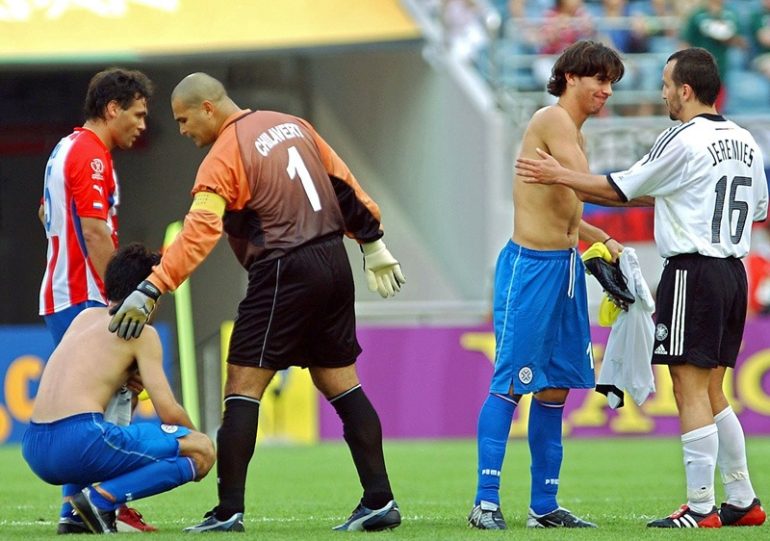
Flash back to 15 June 2002 in Jeju, South Korea. Paraguay had scraped through a tough group featuring Spain, South Africa, and Slovenia, advancing on goal difference. Germany, meanwhile, were marching with typical efficiency. The Round of 16 encounter was a masterclass in frustration: a cagey, attritional battle that showcased Paraguay’s legendary defensive grit.
For 87 minutes, the score remained 0-0. Paraguay’s goalkeeper José Luis Chilavert and defenders like Carlos Gamarra, Celso Ayala, and Carlos Bonet formed an iron wall, repelling wave after wave of German attacks. German goalkeeper Oliver Kahn was rarely tested at the other end.
The game looked destined for extra time until, in the 88th minute, substitute Oliver Neuville pounced on a loose ball and rifled it home. The 1-0 victory sent Germany through to the quarter-finals and, eventually, the final. Paraguay went home with heads held high, their disciplined performance earning global respect. For the Albirroja, reaching the last 16 was a landmark; for Die Mannschaft, it was simply another step toward silverware. The narrow defeat still stings in Paraguayan football lore, a near-miss against one of Europe’s giants on the biggest stage.
Kaiserslautern, 2013
Eleven years later, in August 2013, the teams met again in a friendly in Kaiserslautern. This time, the script flipped dramatically. A youthful, experimental German side, still finding its rhythm under Joachim Löw, faced a battle-hardened Paraguay boasting talents like Roque Santa Cruz.
What unfolded was footballing chaos at its finest. Paraguay raced into a 2-0 lead through goals from José Núñez and Wilson Pittoni, only for Germany to hit back with goals scored by İlkay Gündoğan and Thomas Müller. Then Miguel Samudio put Paraguay ahead once more, 2-3, only for the Europeans to equalise late to make it 3-3. Goals flew in, mistakes were punished, and both sets of fans were treated to an end-to-end thriller rarely associated with the two nations.
That high-scoring friendly remains a fond memory for Paraguayan supporters. Proof that, on any given day, the Albirroja can trade blows with the best. For Germany, it served as a reminder that friendly fixtures can expose frailties that must be ironed out before major tournaments.
Foxborough, 2026
All of that is now ancient history. Two decades have passed since Jeju, and over a decade since Kaiserslautern. New generations of players wear the jerseys, fresh tactical ideas dominate, and both nations arrived at the 2026 World Cup with renewed ambition. Germany will be favourites, chasing a fifth star, while Paraguay will once again rely on organisation, set-pieces, and that famous fighting spirit.
Yet on 29 June, when the referee blows the opening whistle at 17:30, those old encounters will feel vividly alive. Germany will play without Lennart Karl (thigh injury) and Nico Schlotterbeck (ankle injury), while Paraguay will be without Diego Gómez. The midfielder is suspended after receiving two yellow cards during the group fixtures, but Miguel Almirón is available after serving a one-game ban.
One match will write the next chapter in this infrequent rivalry. A story of giants and underdogs that football fans in both countries and beyond will savour. The stage is set. History beckons.