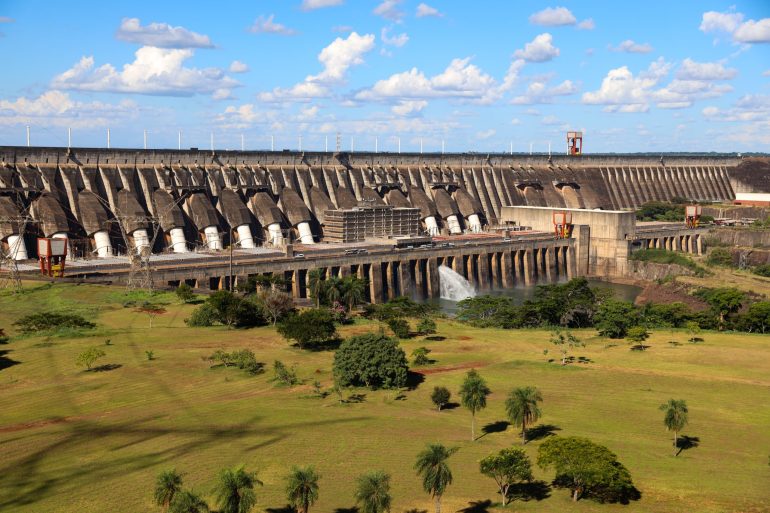

Paraguayan president Santiago Peña and his Brazilian counterpart, Luiz Inácio “Lula” da Silva, met in Campo Grande, Brazil, to discuss the review process of Annex C of the Itaipu Dam agreement. The meeting followed foreign ministers of Paraguay and Brazil reporting on substantial progress in negotiations over the Itaipu Binacional treaty between themselves in Asunción.
The development, according to officials, signals a potential breakthrough in the long-running talks concerning the financial terms of one of the world’s largest hydroelectric dams. What is at stake? The Asunción Times dives in.
What are these Itaipu treaty talks about?
The negotiations focus on revising Annex C of the treaty, which governs the financial and operational framework of the jointly managed power plant, owned and operated by the two countries on the Paraná River. These discussions have gained prominence as the dam’s original construction debt has been fully paid, prompting a re-evaluation of the energy tariff structure and the distribution of its economic benefits.
Annex C of the 1973 Itaipu Treaty outlines the financial bases, electricity service provisions, cost-sharing, tariff guidelines, and energy commercialisation rules. It includes provisions for dividing the generated energy (50/50 entitlement between the countries), handling surplus energy (Paraguay typically sells much of its share to Brazil, as its domestic demand is lower), and determining the tariff (price per kW or MWh) for energy services.
Paraguayan Foreign Minister Rubén Ramírez described the meeting in Asunción as “fruitful,” expressing optimism that a final agreement is within reach.
Tariff battle after debt end
The original treaty’s 50-year debt repayment period for the dam’s construction ended in 2023. A prior bilateral agreement from 2024 froze the Itaipu tariff for 2024-2026 to stabilise costs and minimise impacts on consumers, especially in Brazil. After 2026, the tariff is set to shift toward reflecting only the plant’s strict operating costs. Paraguay opposes a sharp drop, and is pushing for a higher tariff to generate revenue for necessary investments in the plant’s maintenance, modernisation, and future operations.
Paraguay seeks a broader revision of Annex C to ensure the tariff supports funding for infrastructure and investments at the binational plant, rather than limiting it solely to operating costs. Brazil has historically favoured a cost-based approach post-2026 to lower energy prices for its consumers. This creates tension, as Paraguay views a purely cost-based tariff as insufficient for long-term sustainability.
Talks had been delayed due to prior issues, including a 2025 espionage scandal that temporarily suspended negotiations. They resumed in late 2025, based on the 2024 bilateral understanding.
A higher income, and mutual state visits confirmed
President Peña stated that since the negotiations in January 2024, a much higher income has been achieved, which is allowing the financing of several important projects.
“It allowed us to purchase ambulances, patrol cars, and strengthen security through the National Police. It allowed us to have three hospitals under construction today: one in Curuguaty, another in Concepción, and another in the Paraguayan Chaco,” the president said.
Paraguayan Foreign Minister Ramírez announced that during this bilateral meeting held in Campo Grande, the presidents of Brazil and Paraguay agreed to conduct mutual state visits during the current semester, in order to advance and reach an agreement in the negotiations on the revision of Annex C of the treaty.