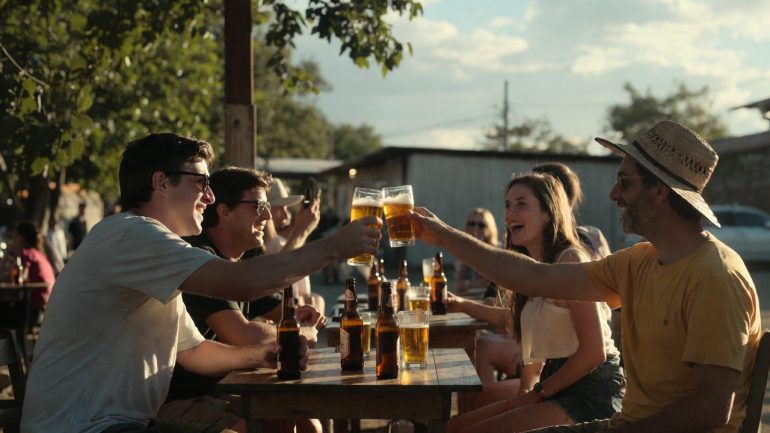

This is a guest article on The Asunción Times website from Kristian Niemietz, a German-born economist who lives in London. He is also a beer and wine blogger in a personal capacity, and in Paraguay, he discovered a real beer revolution. This is part one of his story about Paraguay’s beer revolution.
An intro
A lot has been written about the American craft beer revolution which started in the 1980s. Rightfully so: I cannot think of another example of where a country has so dramatically turned its brewing scene around, going from laughing stock to cutting edge.
The Great British Beer Revolution of the 2010s has also received its fair share of attention. Again – rightfully so. I have written about it myself on this blog, and I intend to keep doing so. But beer revolutions are also happening in unexpected places, where they typically attract far less attention. This is how I unsuspectingly stumbled into one of those: the beer revolution of Paraguay.
Paraguay’s beer revolution: The beginning of the story
A bit of background. I know Paraguay, or at least the capital region, reasonably well. My wife is Paraguayan, and my in-laws live in the country, so we go there every couple of years. It is, in many ways, a great place to visit. Summer is pretty much year-round, and unlike in Britain, “summer” actually means summer, not 14°C and rain. It is a friendly and welcoming place, and they have a wonderful barbecue culture, which consists of mountains of free-range meat roasting away on chimney-style grills the size of a London studio flat.
Until very recently, though, I also thought of Paraguay as a beer desert. I do not mean that in the sense that beer is hard to find, or that it is expensive, or that drinking beer is not part of the culture: the exact opposite on all counts. Beer is ubiquitous, and cheap as chips. But until very recently, it just was not any good.
A first visit
When I first visited in 2005, there were three major breweries with fake-German names making insipid, interchangeable lagers. It was basically the Duff brewery from The Simpsons. There were also a few Brazilian imports, but those were largely of the same style and not much of an improvement. And that was it. Nor did it get any better the next couple of times I visited.
This is not merely the impression of an ill-informed foreign observer who just did not know how to find the right places. Jorge Biedermann, one of the protagonists of the craft beer revolution, later explained:
“When we started [in 2011], 99% of the beers available in this country were basically of the same style or variety”.
Why was that? Because, according to Biedermann:
“Although ours is a beer-drinking country, the reality is that we don’t have a beer culture. […] [Consumers do not know what they’re drinking”.
Ice-cold beer in the tropical heat
To be fair, Paraguay had an excuse for that. In the tropical heat, beer is usually served ice-cold – which dampens the flavours – and drunk quickly. The climate is clearly not ideal for a culture of slowly savouring beers and allowing complex flavours to develop in the glass.
Excusable or not, though, the fact remains that Paraguay used to be a beer desert. A trip there meant much to look forward to, but the beer was not one of those things.
First improvements
It was on a trip in 2019 that I first began to notice some improvements. They had started to import more lagers, including some interesting ones from southern Chile and southern Argentina. We also found one craft beer pub (probably Sacramento Brewing – we will get back to them later), which served a variety of beer styles.
But these were still isolated examples, and you still had to put some effort into finding them. My visit in 2024, though, was a radically different experience. Craft beer breweries and bars had mushroomed and grown in the meantime. I sampled two dozen beers in a week, many of them excellent, and I was not even close to having tried everything I would have liked to try. I tried different types of ale, lager, porter, and even sour, all without much search effort. It was my first trip to Paraguay that I enjoyed not despite, but in part, because of the beer selection.
Now, I am not saying that Paraguay has become a beer paradise. My experience is limited to two or three boroughs of the capital: it is very far from representative of the country as a whole. Even in those boroughs, you cannot just walk into any random bar, and expect them to have good beer. In 2023, craft beer still only had a market share of less than 1%. It may well have crossed the 1% threshold in the meantime, but probably not by very much.
However, let’s not forget that even in Britain and the US, the bad beers still vastly outnumber the good ones. Even in the countries that have led the craft beer revolution, the median beer remains bad – hence the justified snobbery of us beer bores. Yet that one percentage point difference between a market share of marginally above 0% and a market share of around 1% makes, in practice, all the difference in the world.
It is the difference between a product that is virtually non-existent and a niche product that you can find if you look for it. That crucial percentage point fully deserves to be described as a beer revolution.
How did this happen?
The information I have found is extremely patchy, so a good, comprehensive account of Paraguay’s craft beer revolution has yet to be written – ideally by someone who lives in the country, or at least visits more frequently, and who has contacts in the brewing scene. But you have to start somewhere, and this is somewhere.
Before we delve into the craft beer revolution proper, though, let’s go back, just for a minute, to the very beginning: to how the art of brewing first arrived in Paraguay. This will sound like a pointless digression, but I promise it is not.
Ein Herken, bitte: How brewing came to Paraguay (1885)
In 1881, a group of German and Swiss emigrants set up a new settlement in Paraguay, which they named San Bernadino. We know quite a lot about San Bernardino’s early history because the founding fathers kept a logbook, in which they documented their activities. I read parts of it in a tiny local history museum when we visited San Bernardino in 2015.
Life for the early settlers must have been incredibly tough. In terms of today’s urban geography, San Bernardino is not far away from the edges of the conurbation around the capital city region, but back then, it would have been in the middle of nowhere, far from industrial civilisation. In addition, imagine your idea of “hot weather” is 25°C, and now you have to deal with temperatures in excess of 40°C. You have no prior immunity to tropical diseases, and no health system to fall back on.
The first-ever brewery on Paraguayan soil
Yet against the odds, San Bernardino thrived and grew. It was residents of San Bernardino who brought the first steam-powered boats to Paraguay, and who set up the first outlines of a tourism industry. More importantly for our purposes, it was a resident of San Bernardino, Peter Herken (or “Pedro Herken”, since the settlers had a habit of Hispanicising their names), who, in 1885, set up the first-ever brewery on Paraguayan soil. I read about it at the museum, and remember wondering what Herken beer would have tasted like. (Sadly, no Untappd reviews yet.)
If Pedro Herken was trying to recreate a German-style lager, it could not have been a good one. Lager needs long maturation under cold and constant temperatures, and at the time, only the most advanced industrial breweries used mechanical refrigeration: there is no way that this technology would have been available in the Paraguayan rainforest. Then again, imagine being a beer-starved settler in an isolated agrarian commune. Presumably, any beer would have tasted like the mead of Valhalla to them. I bet Mr. Herken’s neighbours were pestering him every day when his first batch of beer would be ready.
I did not see any remnants of the Herken brewery, and I remember leaving San Bernardino slightly sad about the fact that I would never be able to sample a pint of Herken. Technically, I was wrong about that. More on this in part two of Unsung Beer Revolutions: The Curious Case Of Paraguay’s Beer Revolution.
In the meantime, read People Of Asunción #3, and how James Meads From the UK loves the great craft beer scene in Asunción.
About the author
Dr Kristian Niemietz is a German-born economist who lives in London. He is also a beer and wine blogger in a personal capacity.