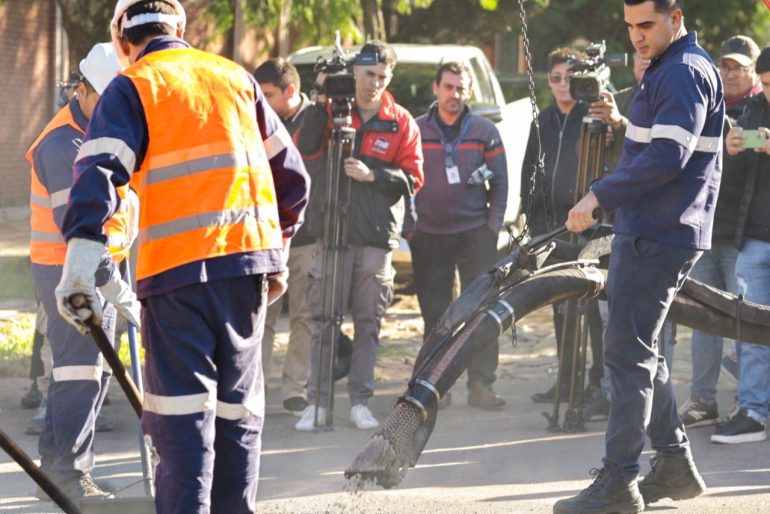

Paraguay’s Sanitary Services Company (Essap) has introduced new specialised equipment, named the Exterminador de Baches, or “Pothole Exterminator”, to improve the restoration of road surfaces following essential repairs to public water pipelines. This new tool provides a concrete response to one of the most frequent complaints from the public: the slow and often inadequate repair of streets after they have been excavated for utility work.
The introduction of this technology marks a step towards enhancing the efficiency of public infrastructure maintenance and reducing disruption for citizens.
Pothole Exterminator presentation
The equipment was officially presented by Luís Fernando Bernal, the President of Essap, during a press conference. He explained that the system is based on advanced injection-patching technology.
This modern method allows for road repairs to be completed in significantly less time compared to traditional techniques. Furthermore, the resulting patches offer greater durability, which minimises the need for repeat interventions and extends the life of the road surface.
New technology for faster response
The primary benefit of this system is its ability to reduce the impact of roadworks on traffic circulation. Faster repairs mean less time that lanes are closed or traffic is diverted, which in turn leads to fewer inconveniences for residents, commuters, and local businesses. The quality of the finish ensures that each intervention leaves the road in a better condition, improving safety and ride quality for drivers. The Pothole Exterminator is designed to provide a swift and effective solution that directly addresses public concerns about prolonged disruption from essential utility maintenance.
Among the key operational advantages is the significant optimisation of resources. The injection-patching technology requires a smaller team of personnel to operate, which translates directly into reduced labour costs for each repair.
This efficiency allows Essap to stretch its maintenance budget further, addressing a greater number of repair sites in a shorter period. Consequently, the company can accelerate the overall recovery of areas affected by pipeline work, ensuring that communities are returned to normal much more quickly.
A streamlined and durable repair process
The repair procedure itself is highly efficient, completed in a few straightforward steps designed for speed and effectiveness. The process begins with the thorough cleaning of the pothole to remove any loose debris and moisture, which is crucial for ensuring a strong bond.
Next, a layer of specialised emulsion is applied to the cavity, acting as a powerful binding agent. The aggregate mixture is then injected under pressure, completely filling the void and compacting to create a dense, stable patch. Finally, the surface is sealed to prevent water ingress, which is a common cause of pavement failure.
Rapid road reopening
This streamlined process allows for the rapid reopening of the road to traffic, often just a short time after the work has been completed. Moreover, the equipment is engineered to operate effectively across a range of climatic conditions.
This all-weather capability guarantees that the pavement restoration work can continue without the common delays caused by adverse weather, ensuring a more consistent and predictable repair schedule throughout the year. The enhanced durability of the finished patch also reduces the need for frequent rework, providing a more permanent solution. With the incorporation of the Pothole Exterminator, Essap aims to fundamentally improve the citizen experience by ensuring that every intervention concludes with the streets being left in an appropriate and safe condition.
Aslo read: Paraguay Boosts Development With US$690M For Infrastructure, US$500M For Healthcare.