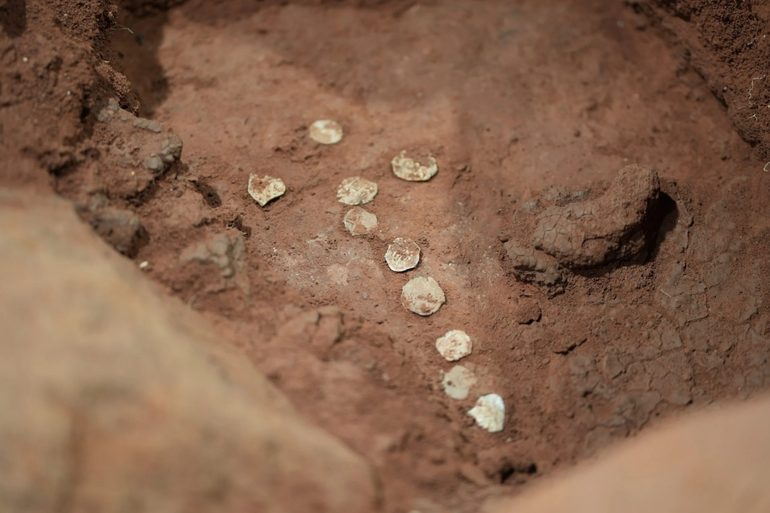

Paraguay’s National Secretariat of Culture (SNC) has announced the discovery of 13 colonial-era coins during restoration work at the San Buenaventura Temple in Yaguarón. Archaeologists believe the pieces could be linked to the origins of the historic church, located in the Paraguarí department.
The find occurred as part of the Tekorenda Programme, during archaeological investigations for the enhancement of the temple’s Sacristy. A team of Paraguayan technicians and local workers from Yaguarón are carrying out the works, under the coordination of Dr. María Victoria Roca, an archaeologist and researcher with Argentina’s CONICET.
A deliberate arrangement
The coins were found inside a structure intentionally built from sandstone rocks and arranged in a circle, measuring approximately 40 by 50 centimetres. This structure featured a flat base and was sealed with a superior stone that acted as a lid, creating a cavity.
Inside the cavity, eleven coins were arranged in the shape of a cross. Two additional coins were found resting on top of the stone lid. According to preliminary observations, all 13 pieces appear to be a type of colonial-era currency known as macuquinas, or cob coins, which were hand-struck.
Coordinating conservation and study
The specific arrangement of the coins and the context of their discovery are considered highly relevant by researchers. They suggest the items could represent a foundational deposit, placed at the beginning of the temple’s construction. However, this hypothesis requires confirmation through scientific studies to determine the origin, meaning, and function of the pieces.
Representatives from the SNC, the Catholic Church, and the Association of Friends of the Heritage of Yaguarón met to coordinate the handling of the find. The meeting established procedures for further investigation and conservation. Following the agreement, Presbyter Hugo Fernández, secretary of the Commission for the Cultural Assets of the Catholic Church, performed a blessing at the discovery site.
Future of the discovery
The coins will remain in the care of the National Secretariat of Culture while scientific analysis is conducted. The estimated timeframe for the studies and the subsequent return of the items is 30 working days. Once the procedures are complete, their restitution to the temple will be coordinated with the Church, following technical conservation recommendations. Officials noted that the full historical and scientific interpretation of the results may require a longer period.
The San Buenaventura Temple in Yaguarón is a site of immense patrimonial value. Constructed between 1755 and 1772 in a former Franciscan settlement, it is regarded as one of the foremost examples of Hispano-Guaraní baroque architecture. The temple is renowned for its colonial design and its intricate altarpieces and wood carvings, created by indigenous artisans under the direction of the Portuguese sculptor José de Souza Cavadas.
The Tekorenda programme
The temple is currently on UNESCO’s Indicative World Heritage List. The ongoing restoration is part of the Tekorenda Programme: Urgent Safeguarding of Paraguay’s Material Cultural Heritage, which is coordinated by the SNC. This national initiative includes intervention at eight heritage sites across the country, combining conservation, restoration, heritage education, and community participation.
This discovery offers new evidence for the archaeological understanding of the site and may expand knowledge of its construction and religious practices during the colonial period.