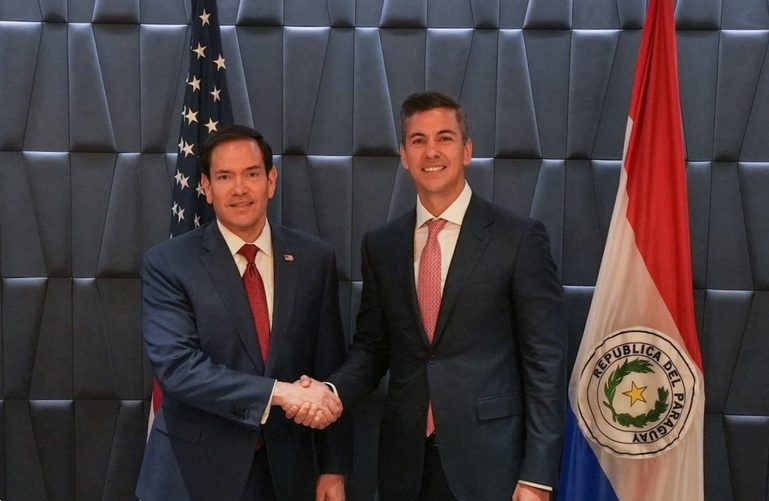

Paraguayan President Santiago Peña says the United States wants more Paraguayan beef exports. Speaking to Bloomberg Television in New York recently, Peña said Washington is turning increasingly to Paraguayan producers. The goal is to help ease rising domestic meat prices. The President added that the United States has not yet granted Paraguay a dedicated import quota, unlike some of its regional neighbours. The comments came during a wider trip in which Peña also promoted Paraguay as an investment destination.
Rising demand, no dedicated quota
Peña told Bloomberg that Paraguay is exporting beef to the United States, even as it continues paying import tariffs. “Paraguay is a very reliable and strong partner,” he said.
The president noted that the Trump administration has not carved out a separate quota for Paraguay. This is unlike the arrangement it holds with Argentina. Instead, Paraguayan shipments fall under a broader allowance shared with several other exporting nations.
That shared allowance is known as the “other countries” quota. It is split mainly with Brazil, by far the largest player within it. Once the tariff-free portion is used up, typically early in the year, further shipments face a 26.4% tariff. This is according to the Paraguayan Chamber of Meat (CPC).
Peña has previously said he would like Washington to grant Paraguayan beef preferential tariff treatment of its own. He noted last year that the broader US tariff measures affect Paraguay “to a lesser extent” than other countries.
Paraguayan beef exports keep climbing
Paraguayan beef exports to the United States have grown rapidly since shipments began there in late 2023. Volumes started at just 75 tonnes that year. They then rose to 28,000 tonnes in 2024 and to 49,456 tonnes in 2025. That data comes from Senacsa, Paraguay’s National Animal Quality and Health Service. The industry is aiming for 75,000 tonnes in 2026, and by August had already shipped 35,443 tonnes worth US$211 million.
That volume placed the United States as Paraguay’s second-largest beef export market for the period, behind only Chile. Senacsa president José Carlos Martín said in a recent interview that the sector is targeting 20% growth compared with last year’s volumes. This is despite a smaller number of cattle being slaughtered domestically this year. Export volumes have stayed strong all year: the sector had already shipped nearly 70 million kilograms of beef worldwide in the first quarter of 2026, generating US$453.3 million.
Temporary tariff relief for regional suppliers
In August 2026, President Donald Trump temporarily suspended tariffs on beef imports from several supplying countries, including Paraguay. The measure allows up to 300,000 tonnes of ground beef to enter the United States with reduced tariffs. This applies over a 90-day window, at a rate of 100,000 tonnes per month from September onwards. Paraguay’s meat industry has described the move as a fresh opportunity. However, it also places Paraguay in direct competition with Brazil for the same allowance.
Separately, Argentina secured an increase of 80,000 tonnes in its own dedicated US export quota. This came as part of trade negotiations between Buenos Aires and Washington. Brazil, meanwhile, benefits from the broader 300,000-tonne ground beef allowance introduced in August. Paraguay has no equivalent bilateral arrangement of its own.
Why the US market matters to Paraguay
Paraguay is the only South American country that still maintains formal diplomatic relations with Taiwan. As a result, it has no direct access to mainland China, one of the world’s largest beef and soybean markets. This makes the United States a particularly important outlet for Paraguayan beef exports. Paraguay is also working to diversify into other markets, including Taiwan, now a major buyer of Paraguayan beef.
Peña used his time in New York to promote Paraguay’s wider economic credentials. He also attended the United Nations General Assembly during the visit. He highlighted the country’s investment-grade credit rating, low inflation and steady growth. During the trip, he also announced a new investment: JP Morgan Natural Capital and Robinson Group will invest US$200 million in sustainable forestry development in Paraguay.