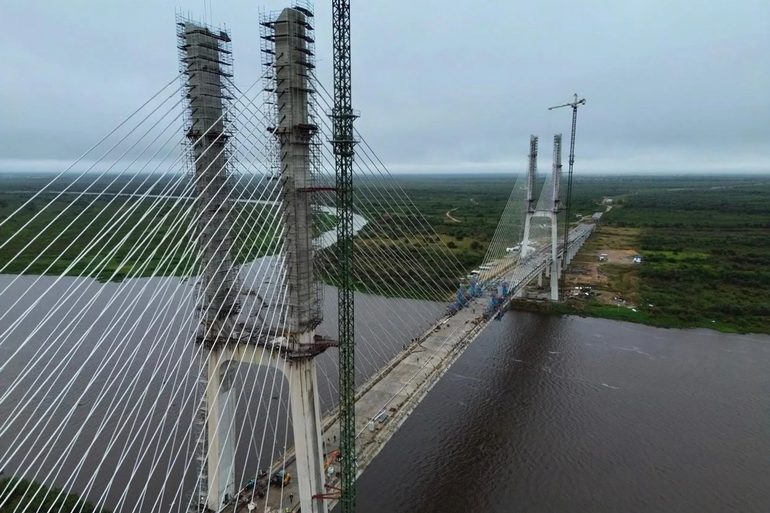

The Bioceanic Bridge is set to feature a sophisticated climate monitoring system, consisting of two meteorological stations designed to track how weather conditions affect the major new structure. The bridge, which connects Carmelo Peralta in Paraguay with Puerto Murtinho in Brazil, will have its temperature, cumulative rainfall, and wind speed and direction continuously recorded.
The monitoring stations will be situated on the upper sections of the bridge’s main towers. This system complements an existing network of sensors that is already installed. The combined technology will measure forces on the support cables, along with structural accelerations and deformations. This data is crucial for assessing the bridge’s behaviour and can be used to extend its operational lifespan.
Focus on structural performance
Julliana Duarte, a director at Consorcio JYI, the organisation responsible for supervising the works, explained the immediate purpose of the new equipment: “The stations were not initially designed to make forecasts, but to record the phenomena that occur in the bridge’s environment.”
Duarte added that the primary goal is to verify that the structure’s response to weather events remains within the predicted parameters of its design.
Future traffic safety alerts
In a later phase, the system will be enhanced to incorporate an alert function. This future capability will provide warnings when wind levels reach a point that could affect the safety of vehicles crossing the bridge after it is opened to traffic.
Furthermore, the monitoring system will create a detailed historical record of the climatic conditions at the location. This valuable information will be available to Paraguay’s Ministry of Public Works and Communications (MOPC). The data will be utilised for the long-term monitoring and maintenance of this infrastructure, which is a strategic component of the wider Bioceanic Road Corridor project connecting the Atlantic and Pacific oceans.
More than a Climate Monitoring System: Wind tests in Italy
The same Consorcio JYI, which is supervising the installation of the climate monitoring stations, earlier carried out wind tests on the Bioceanic Bridge at the Polytechnic University of Milan in Italy, a leading Italian institution in engineering, architecture and design. The road link between Carmelo Peralta and Puerto Murtinho was assessed as part of the studies completed before the project’s final stage, using a method applied to several bridges internationally.
Through the tests, which serve to verify the design and allow any necessary adjustments before the full completion, engineers can anticipate how the structure might behave under different wind conditions during its service life. Using a scale model in a controlled environment, the consortium confirmed how the bridge will respond to high-intensity winds and incorporated the findings, with modifications where required.