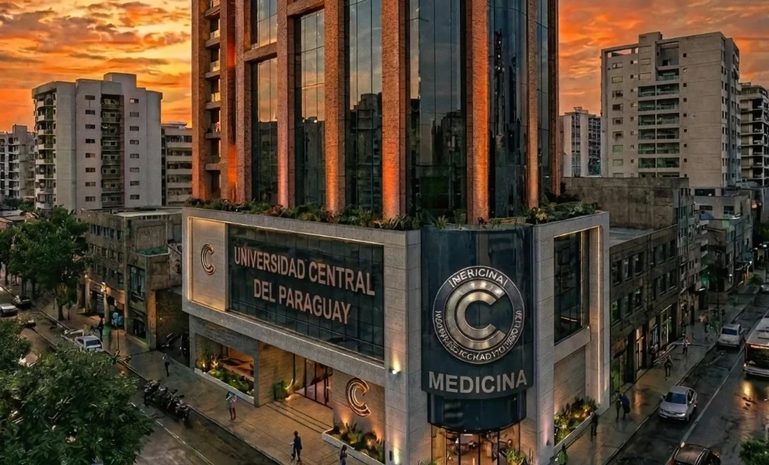

The Universidad Central del Paraguay (UCP) is promoting a plan to create a University District in the Historic Centre of Asunción. The project aims to generate approximately US$200 million in investment over the next five years and attract around 5,000 foreign students.
This initiative is part of a wider strategy to revitalise the capital’s historic core and aligns with the “Asunción 500 Años“ project, (Asunción 500 years) a government-led programme preparing the city for its 500th anniversary in 2037. During an interview on Paraguay TV’s “Tribuna” programme, UCP’s Vice Dean, Luis López Lafuente, detailed the proposal’s scope and the institution’s future projections.
Repopulating the historic centre
A key objective of the project is to contribute to the repopulation of the Historic Centre by attracting international students, primarily from Brazil. According to López Lafuente, just over 300 people currently reside in the historic zone. The university estimates this figure could rise to approximately 1,500 by 2027 as the project takes shape.
The five-year plan anticipates the arrival of about 5,000 foreign students. These students are expected to study, live, and use services within the area. This would consequently generate economic activity throughout the day.
Creating a university ecosystem
The vision extends beyond simply placing a university building in the city centre. The goal is to establish a comprehensive district with integrated facilities.
“The ambition is not to have an isolated faculty in the centre, but to consolidate a true university district where student housing, commerce, gastronomy, and services function as pieces of the same ecosystem.”
The first stage of the ambitious project is scheduled for February 2027. This phase involves relocating the UCP’s Faculty of Medicine to the Historic Centre of Asunción. For this initial step, the plan includes the development of two university towers, eight laboratories, a simulation clinic, and other spaces dedicated to academic training and innovation.
A comprehensive development model
The proposal aims to let students carry out much of their daily lives within the district. This includes providing access to housing, various services, dining options, sports facilities, and cultural activities.
López Lafuente highlighted the university’s previous success with similar models. He cited Pedro Juan Caballero, where the institution now has over 5,000 students, and Ciudad del Este, where the district concept also helped develop the surrounding area.
Economic impact and urban renewal
In addition to academic buildings, the project includes the development of student residences, dining venues, shops, medical services, gyms, and entertainment centres. According to UCP estimates, this university community could grow significantly. That growth could mobilise around US$200 million in private and academic investment over five years.
This investment could create significant employment in construction, real estate, commerce, hospitality, healthcare, and other service sectors. The university suggests that expanding its activities could help repurpose vacant or underused buildings. This could create new opportunities for living, studying, and investing in the Historic Centre.
Alignment with Asunción 500 Años
The University District project is integrated into the broader urban recovery vision of Asunción 500 Años. This city-wide initiative includes actions related to housing, economic development, mobility, security, public space recovery, and private investment.
In this context, national and foreign students are expected to arrive. New infrastructure is also expected to develop. Together, these changes could boost economic and residential activity. The UCP projects that its initiative will bring 1,500 new residents to the area by 2027 and a community of 5,000 foreign students within five years, driven by the estimated US$200 million investment.