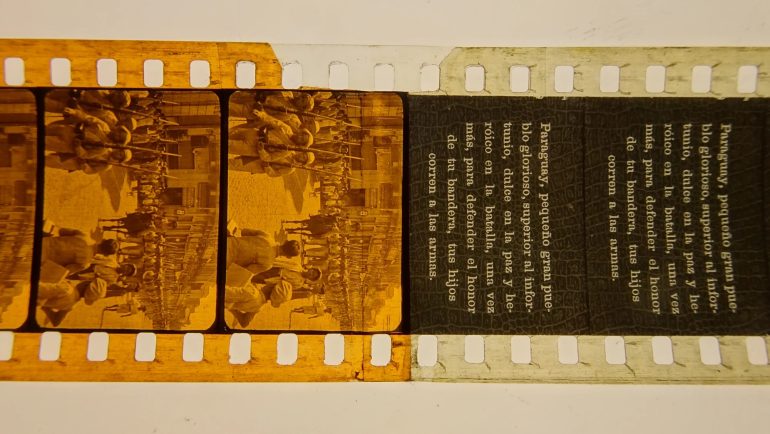

Two rare audiovisual records of the Chaco War have undergone conservation in Paraguay, marking a significant moment in audiovisual history. The Paraguayan Cinematheque Foundation completed the project in September 2026. The initiative received support from the National Audiovisual Institute of Paraguay. Together, the organisations safeguarded a 1932 documentary and a television documentary produced in 1983.
The project, Rescate Histórico: Filme y Video Guerra del Chaco (Historical Rescue: Chaco War Film and Video), focused on two fragile works. Both belong to the foundation’s collection in Asunción. Their preservation protects images and testimonies from one of Paraguay’s defining historical conflicts, also showcasing the challenges surrounding the country’s audiovisual history.
A film threatened by time
The first work, En el infierno del Chaco (In the Hell of the Chaco), dates to 1932. Argentine filmmaker Roque Funes directed the documentary, a co-production between Paraguay and Argentina. Its unique original copy survives on 35mm cellulose nitrate, a highly flammable film material.
Ageing and difficult storage conditions placed the film at risk of irreversible deterioration. Film conservation specialist Andrea Mangano led the restoration at IPAC LAB. She examined the film’s physical and chemical condition before repairing damaged sections and weakened joins.
The intervention stabilised the original copy and prepared the film for future digitisation. However, the 4K transfer remains pending. A high-resolution digital version would help preserve the images and improve access. The film offers a rare visual record of the Chaco War, which lasted from 1932 to 1935.
Preserving the voices of the Chaco War
The second work, Testimonios de gloria (Testimonies of Glory), began production in 1983. Paraguayan journalist and researcher Miguel Ángel Duarte Barrios created the television documentary. The programme contains more than six hours of testimonies from people connected to the war, including military personnel, support services, chaplaincy and nursing.
The original recordings survived on U-matic videocassettes, an analogue video format. Biological contamination and structural deterioration threatened the tapes. Audiovisual restoration specialist Carlos Molina led the recovery process. His team repaired or replaced cassette casings and removed mould and dust from the magnetic tapes.
The specialists then digitised the recordings and restored them in high definition. The resulting files preserve voices and images captured in the original production. The testimonies offer personal perspectives on the conflict, complementing its military and political history.
Why audiovisual preservation matters
The two restorations demonstrate the challenges involved in protecting historical audiovisual materials. Film and video deteriorate over time, while older formats can require specialised equipment and technical knowledge to access their contents.
In this case, conservation work helped stabilise a fragile nitrate film and recover recordings affected by biological and structural damage. The restored materials can support research into the Chaco War and Paraguay’s audiovisual history.
The two works therefore represent more than restored film and video. They preserve images and voices from a pivotal period in Paraguayan history. Their conservation also raises questions about public access and long-term protection.
The work still ahead
The technical restoration marks one stage of a broader effort. The foundation still needs to research both productions and their historical contexts. It also aims to make the materials available for public exhibition, although no confirmed exhibition date has been announced.
Public access would allow researchers, students and audiences to explore the recordings as historical sources. However, further coordination and resources remain necessary. The project demonstrates how conservation can protect audiovisual history while creating opportunities for future research.
The initiative also highlights a challenge in Paraguay’s culture preservation. The country still lacks a National Cinematheque. Established in 1989, the foundation has worked to safeguard audiovisual materials with support from institutions and the public. Yet many films and recordings remain vulnerable to deterioration.
Protecting Paraguay’s audiovisual history
The preservation of En el infierno del Chaco and Testimonios de gloria demonstrates what conservation can achieve. Specialists have stabilised a fragile film and recovered recordings threatened by physical damage. Their work protects two distinct forms of historical documentation.
Still, the project highlights the challenge of preserving Paraguay’s audiovisual heritage. Many historical films and recordings remain in fragile formats, making conservation, funding and storage essential to their survival.
Preserving audiovisual history means keeping the past available for future generations. Every surviving image and recorded voice adds detail to the country’s historical memory. The recent project has protected two important works, but much remains to be done.